
A legal CV is your first opportunity to demonstrate the precision, attention to detail, and professionalism that define successful legal practice. A good one must immediately convey your qualifications, experience, and unique value proposition.
This article will walk you through everything you need to create a compelling legal CV, from real-world examples for both junior and senior professionals to step-by-step guidance on structuring each section. We'll also highlight common mistakes that could cost you an interview and show you how to craft an effective job application even without formal experience.
Key Takeaways
A legal CV should emphasise relevant qualifications, measurable achievements, and sector-specific skills, such as legal research, drafting, and case management.
Outstanding legal CVs follow a reverse-chronological format and include contact details, a headline, work experience, education, certifications, and additional sections.
Entry-level candidates can strengthen their CVs by highlighting coursework, internships, volunteer legal work, and transferable skills such as analytical thinking and communication.
Common mistakes include using generic templates, listing irrelevant experiences, poor formatting, and failing to include measurable achievements or key case outcomes.
2 Outstanding Legal CV Examples
Before we examine the finer points of CV writing, let's look at two fully optimised legal CV examples that demonstrate what works in practice.
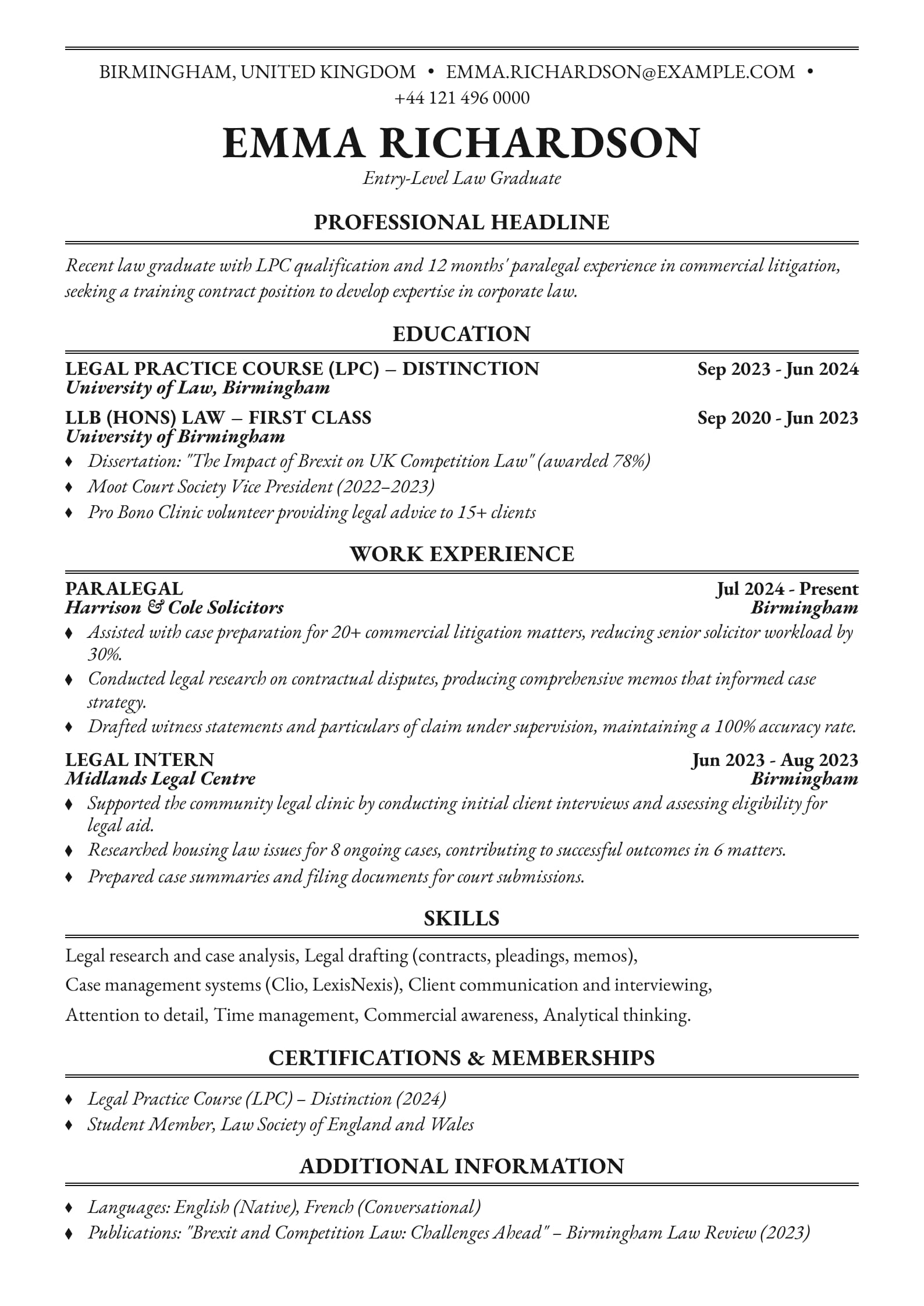
This law CV example immediately establishes credibility through strong academic credentials and relevant experience. The professional header clearly states the candidate's current position and career objectives, whilst the work experience section demonstrates tangible contributions using measurable results.
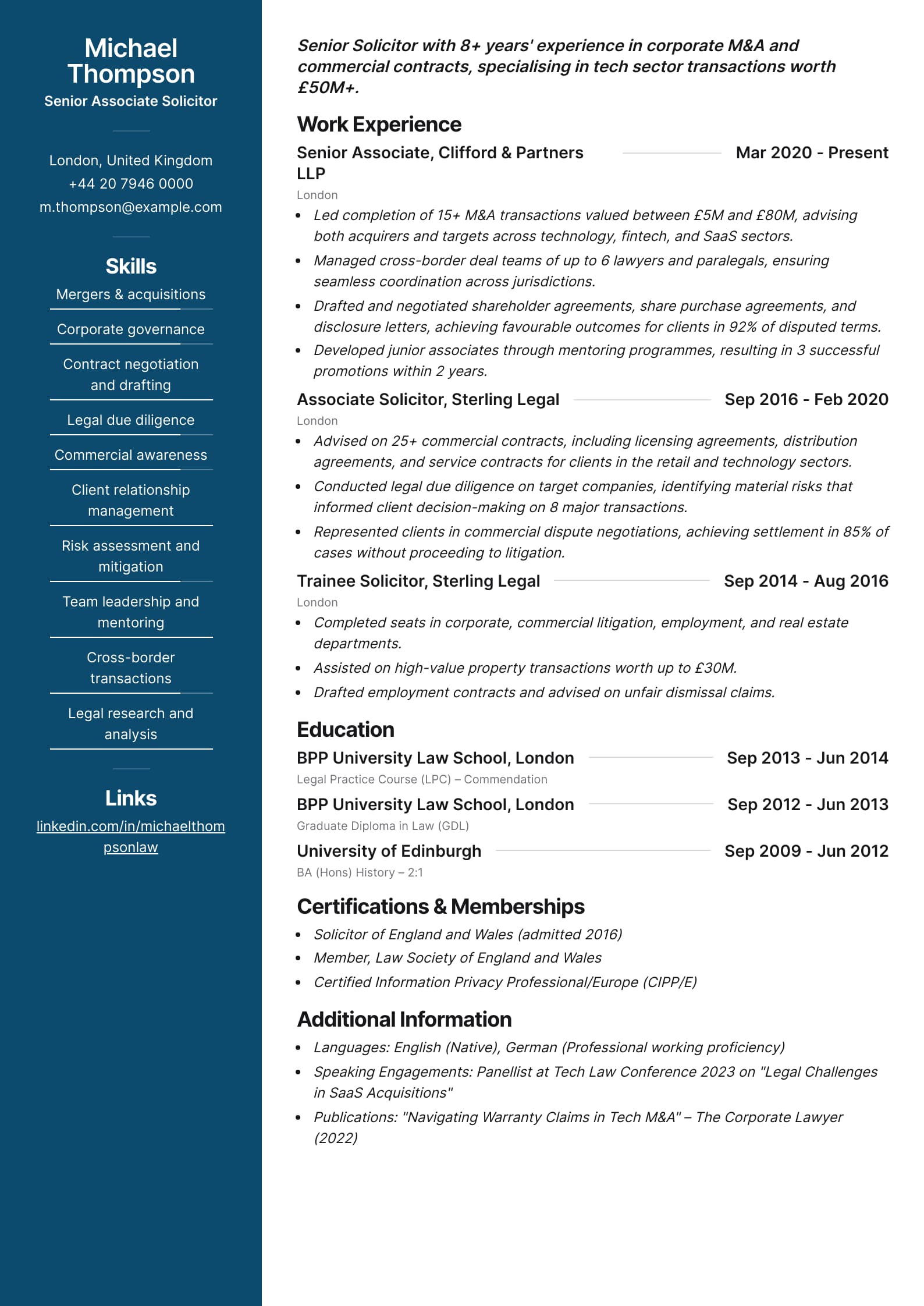
A senior-level CV example like this demonstrates clear career advancement and quantifiable impact. The addition of mentoring experience, speaking engagements, and publications establishes thought leadership, while relevant certifications (CIPP/E) show a commitment to staying current in evolving practice areas.
How to Write a Legal CV in 5 Simple Steps
To write an effective legal CV, you should pick the reverse-chronological format, as it remains the best option for legal CVs. This is because it allows recruiters to quickly assess your most recent and relevant experience whilst tracking your career progression.
Let's break down the process into five manageable steps that will help you write a CV that passes both the initial ATS scan and detailed review stages:
#1. Add Your Contact Details and a Professional Headline
Your contact information should sit at the top of your CV, clearly visible and professionally formatted. It should include:
CV Header Details
Your full name
Location (city and country)
Email address (avoid informal ones)
Cell phone number
LinkedIn profile link (this is increasingly expected in legal recruitment, so ensure your profile is current and matches the information on your CV)
The professional headline is your elevator pitch condensed into one powerful sentence. For legal CVs, this should state:
Your current status or level of experience
Your area of specialisation
Quantifiable achievement or distinctive qualification
If you maintain a legal portfolio website showcasing published articles, case summaries, or thought leadership pieces, include this link as well. However, ensure the content is genuinely impressive and professionally presented—an outdated portfolio can do more harm than good.
#2. Highlight Relevant Skills
The skills section of your legal CV should strike a careful balance between technical competencies and the soft skills that enable effective practice.
Hard skills that demonstrate your technical capability include:
Hard Skills
Legal research and analysis using platforms like Westlaw or LexisNexis
Legal drafting across various document types (pleadings, contracts, opinions)
Litigation and trial advocacy
Case management
Knowledge of specific practice area regulations
Providing legal advice
However, you shouldn’t neglect soft skills, as these often distinguish excellent lawyers from merely competent ones. They include:
Soft Skills
Negotiation abilities
Clear written and verbal communication
Attention to detail
Time management under pressure
Consider tailoring this section to match the job description. For example, if a firm emphasises client relationship management in their advertisement, ensure this skill features prominently if you possess it.
Plus, legal recruiters often use applicant tracking systems (ATS) that scan for specific keywords, so strategic alignment with the job posting can literally make the difference between your CV being seen or filtered out.
#3. Showcase Work Experience and Case History
This section forms the core of your legal CV and deserves the most attention. Each position should include:
Your job title
Organisation name
Location
Dates of employment
Several bullet points that outline your key responsibilities and achievements
Don't simply list duties; legal recruiters know what a solicitor, paralegal, or barrister CV typically looks like. Instead, focus on your impact and achievements using strong action verbs: drafted, negotiated, represented, advised, managed, coordinated, researched, analysed, etc.
More importantly, quantify your contributions wherever possible and include notable case outcomes (whilst respecting confidentiality). For transactional lawyers, mention deal values and types; meanwhile, if you’re an in-house counsel, reference cost savings achieved or risks mitigated. These specifics transform a generic CV into evidence of real-world capability.
#4. Include Education and Certifications
Legal education credentials carry significant weight, particularly early in your career.
List your qualifications in reverse-chronological order, starting with your most recent. For UK legal CVs, this typically means your Legal Practice Course (LPC) or Bar Professional Training Course (BPTC) first, followed by your undergraduate law degree (LLB) or Graduate Diploma in Law (GDL) if you converted from another discipline.
Furthermore, include your degree classification (First Class, 2:1, etc.) and any academic distinctions or awards. If you wrote a dissertation on a relevant or impressive topic, mention it, as this can serve as a conversation starter and demonstrates specialised knowledge.
However, once you've accumulated several years of work experience, academic achievements become less critical. For instance, a senior barrister with 15 years at the Bar doesn't need to detail their university grades in the same way a training contract applicant does.
Finally, professional certifications deserve their own prominence. Admission to the roll of solicitors, call to the Bar, or specialised qualifications like CIPP/E (data privacy), STEP (trusts and estates), or CFA (for corporate finance lawyers) all strengthen your CV and demonstrate commitment to professional development.
#5. Add Extras and Legal Portfolios
The additional sections of your CV provide opportunities to showcase dimensions of your legal career that don't fit neatly into education or employment categories. They involve:
Additional CV Sections for Legal Professionals
Publications, which carry particular weight, be it articles in legal journals, contributions to practitioner texts, or thought leadership pieces on firm websites. They position you as an expert and demonstrate clear thinking and strong writing skills.
Moot court competitions that particularly matter if you have achieved regional or national success and show advocacy skills and competitive drive.
Pro bono work that signals ethical commitment and often provides practical experience that paid roles don't offer, especially early in your career.
Volunteer positions with organisations like Citizens Advice or law centres, as they demonstrate both social responsibility and hands-on client interaction.
Languages, especially for firms with international practices or clients.
Professional memberships (Law Society, Bar Council, specialist associations), which show engagement with the broader legal community.

How to Write a Legal CV With No Experience
To write a legal CV with no experience, you should focus heavily on:
Your academic achievements. Particular modules relevant to the role you're applying for, academic awards, prizes, and scholarships can demonstrate specialised knowledge and capabilities, especially if they align with the firm's practice areas.
Internships and vacation schemes, even if brief, as these experiences show you understand professional legal environments and can conduct yourself appropriately.
Transferable skills. Perhaps you developed research and analytical skills through your degree, communication skills through presentations or group projects, attention to detail through editing university publications, or time management through juggling studies with part-time work.
4 Common Mistakes to Avoid in Your Legal CV
Legal CVs fail for predictable reasons, such as:
Using generic legal CV templates. Whilst CV templates provide useful structure, a legal CV format needs tailoring to your specific experience, qualifications, and target role. Generic language, overly creative legal CV design, or templates made for other industries rarely translate well to legal recruitment.
Listing irrelevant experiences. Focus on legal experience, law-related activities, and skills directly applicable to legal practice. If you must include non-legal work, keep it to a single line and emphasise transferable skills like communication, client service, or deadline management rather than the role itself.
Poor formatting and readability. Use clear headings, consistent formatting, adequate white space, and professional fonts like Calibri or Arial. Many firms use applicant tracking systems that struggle with unusual CV formats, so stick to conventional CV structures with standard section headings.
Omitting measurable achievements or key cases. Lawyers solve problems and create value, so your CV should prove you've done both. Whilst client confidentiality must be respected, you can describe case types, values, outcomes, and your role without breaching professional obligations.
Create Your Professional Legal or Solicitor CV Today
If you need additional support crafting your legal CV, we’ve got your back! Our builder provides legal, solicitor, and paralegal CV examples and templates specifically designed for professionals in this field, helping you create an ATS-friendly, personalised, and professionally formatted document in minutes!
Final Thoughts
Creating a standout legal CV requires combining precision, personality, technical competence, and interpersonal skills. So, regardless of whether you're a recent graduate seeking your first paralegal position or an experienced solicitor pursuing partnership, your job application must immediately communicate your qualifications, experience, and value proposition.
Your CV is a professional document first and foremost, so whilst it should reflect your unique experience and strengths, it must also adhere to the conventions of legal recruitment. Clear structure, quantified achievements, relevant qualifications, and error-free presentation aren't optional extras—they're baseline expectations in a profession built on attention to detail.
Legal CV FAQs
#1. How long should a legal CV be?
A legal CV should typically be 2 pages for junior lawyers and can extend to 3 pages for senior practitioners with extensive experience, as legal recruiters expect comprehensive detail about your qualifications, case experience, and professional achievements. However, recent graduates with limited experience should aim for 2 pages maximum.
#2. Should I include my law portfolio?
Yes, you should include a link to your law portfolio, as this significantly strengthens your CV, provided that it contains high-quality, relevant content. A portfolio might showcase published articles, case summaries (respecting confidentiality), legal analyses, or thought leadership pieces that demonstrate your expertise.
#3. What skills make a legal CV stand out?
The skills that make a legal CV stand out would be technical abilities like advanced legal research, drafting across multiple document types, case management, and practice area-specific knowledge. The same goes for strong negotiation, communication, analytical thinking, attention to detail, and time management skills.
#4. How to tailor a legal CV for different law firms?
Tailoring your legal CV for different firms requires researching each organisation's practice areas, culture, and specific requirements, then emphasising your most relevant experience and skills. Review the firm's website to understand their key practice areas and notable clients, then highlight your experience in those sectors.