
An internship CV is a document used by students and graduates to apply for internships, which is often their first step into the professional world. As a result, it can be quite challenging to write; after all, work experience makes up a significant portion of a standard CV, yet it can’t be the focus here, as it’s usually non-existent.
In this article, we will teach you how to write an outstanding application document, show you examples of student internship CVs, and give you a simple template you can use as a guide.
Key Takeaways
Students and graduates often use internship CVs when applying for different programmes that help them take their first steps towards employment.
When writing an internship CV, you should choose the reverse chronological format and pay attention to the font, paragraphs, headings, and white space.
An internship CV with no work experience can still include projects, volunteering, and other accomplishments that demonstrate the applicant’s relevant skills.
It’s essential to tailor your CV for different roles, use keywords from the job description, focus on your potential and skills, quantify your achievements, and double-check your grammar.
2 Outstanding Internship CV Examples
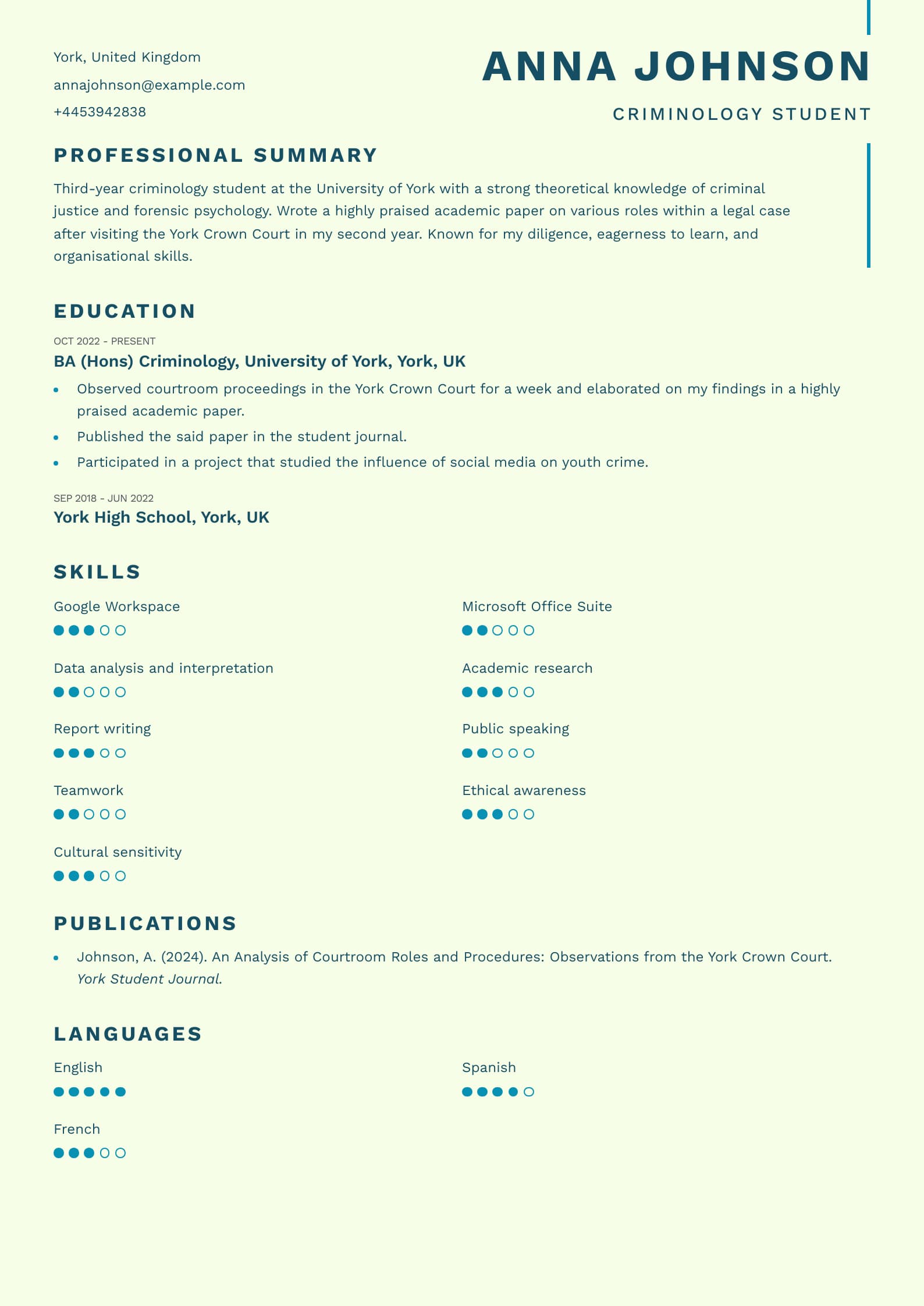
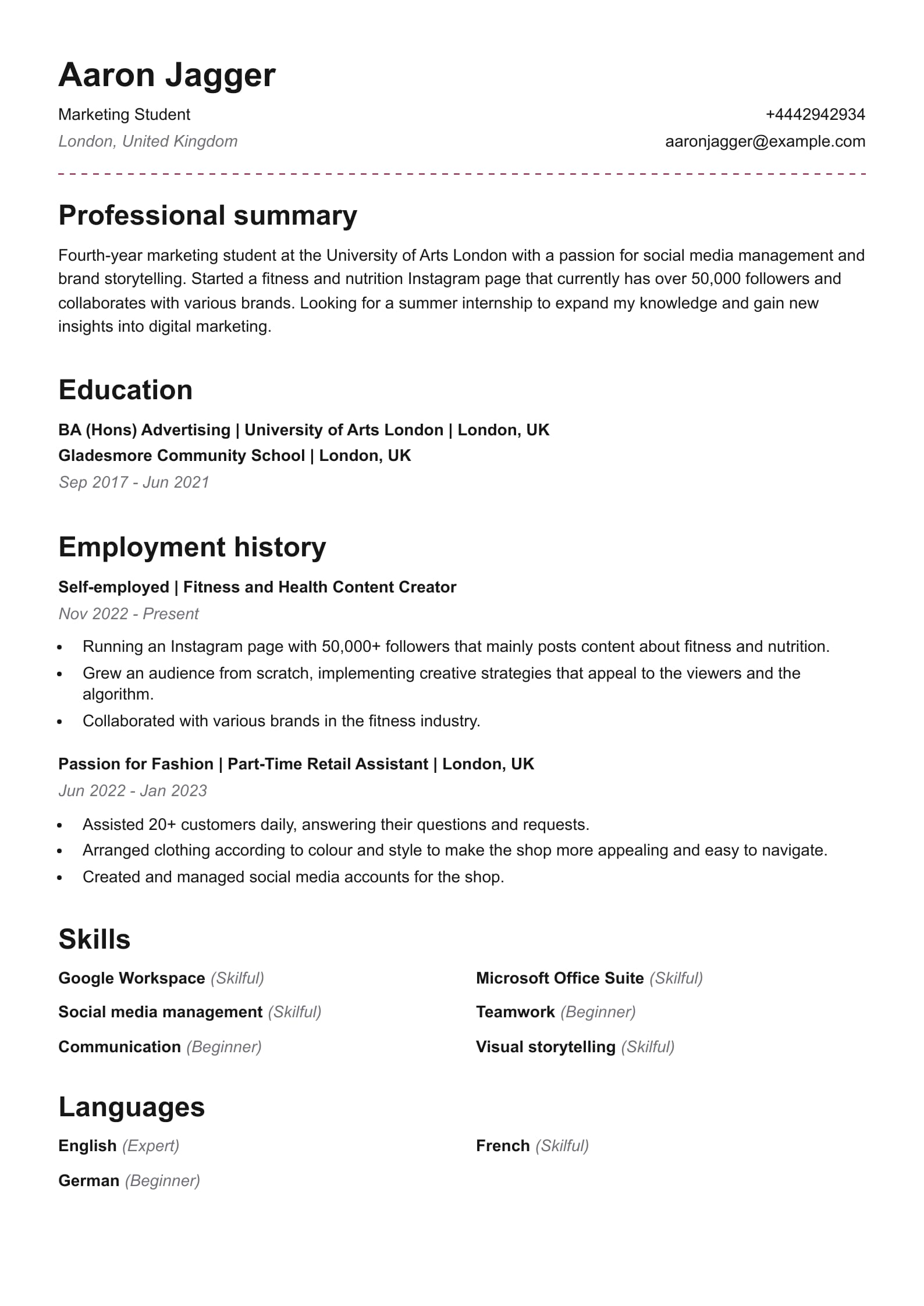
Before we get into details on writing internship CVs for college students and graduates, let’s take a look at two examples to inspire your own. Both are entry-level CV examples, but the first candidate has no work experience whatsoever, while the second one has gained some.
Internship CV Format: How to Do It the Right Way
Internship CV format should follow the standard formatting rules that apply to all application documents. This is a much safer option than experimenting with fonts and styles, as it guarantees professionalism and ensures that your CV passes applicant tracking system (ATS) scans.
So, here are some tips on creating a well-formatted internship CV:
CV Formatting Tips
Use the reverse chronological order. When arranging information in the work experience and education sections, start with the most recent entries and go backwards. This is the most widely accepted way of formatting CVs in the UK, as it places the most relevant details at the top, where recruiters can immediately see them.
Choose professional fonts. Submitting an application written in Comic Sans or Papyrus will just make you appear unprofessional and unserious. Instead, stick to the tried-and-true fonts, such as Arial, Times New Roman, Helvetica, and Calibri, and use the same font size throughout.
Use paragraphs, headings, and white space. Your CV should be readable at first glance, which is achieved by wisely balancing paragraphs, white space, and headings. Don’t submit a block of text and expect good results.
List information in bullet points. If you need to elaborate on anything, like your professional or academic achievements, write summaries in the form of bullet points. These create additional visual breaks in your CV and help it appear more organised overall.
How to Write an Internship CV and What Sections to Include
To write a successful internship CV, you should include sections such as contact information, personal statement, work experience, education, and skills. Aside from these, you can also add publications, projects, achievements, volunteering, languages, or anything else that seems relevant.
Now, let’s take a look at how to write a compelling CV for an internship:
#1. Add Your Contact Information
Contact information is placed in the header of your CV, where a potential employer can see it right away in case they want to reach out. Usually, it contains your full name, address, email address, and phone number. Optionally, you can include your LinkedIn profile or professional website, but these aren’t required.
On the other hand, make sure not to add irrelevant or personal details, like your age, birthday, marital status, social media, or personal websites. These will only take up space without contributing in any meaningful way and could even tarnish your professional reputation.
No matter what you do, don’t forget this section in your CV. It may not seem as important as some of the others, but recruiters won’t be able to contact you if they don’t have your information.
Here is what this section could look like:
Contact Information Section
Contact Information
Anna Johnson
York, United Kingdom
+4453942838
#2. Write a Compelling Personal Statement
Next comes a personal statement: a quick summary of your professional background, including your key skills and most significant achievements. This section serves as a hook that immediately highlights the most important information recruiters should know about you, so it can be challenging to write.
This is especially true for personal statements for internships, as these are usually written by students and graduates with limited or no work experience. As a result, they don’t have many professional achievements to include, so they may struggle to figure out what to say.
In this case, it’s a good idea to focus on academic successes, such as projects, publications, and accomplishments you’ve made during your studies. You can also add what you hope to achieve during the internship: the skills you want to improve and the knowledge you want to gather.
However, don’t go overboard; 4–5 lines of text should be enough. Anything more than that risks losing recruiters’ interest, which is something you definitely want to avoid.
This is what a personal statement for an internship CV might look like:
Personal Statement Section
Personal Statement
Third-year criminology student at the University of York with a strong theoretical knowledge of criminal justice and forensic psychology. Wrote a highly praised academic paper on various roles within a legal case after visiting the York Crown Court in my second year. Known for my diligence, eagerness to learn, and organisational skills.
#3. Emphasise Your Education

Most CV writing practices recommend putting work experience above education, but this isn’t the best idea when applying for internships. It’s better to place education first, as it covers up a lack of professional background.
Since you’re focusing on education, you can include more information about it, even if this isn’t standard practice for most CVs. For instance, you can add relevant courses, important projects, or your grade average if it is high enough.
Here is what the education section might look like on a CV:
Education Section
Education
BA (Hons) Criminology
October 2022–Present
University of York, York, UK
Observed courtroom proceedings in the York Crown Court for a week and elaborated on my findings in a highly praised academic paper.
Published the said paper in the student journal.
Participated in a project that studied the influence of social media on youth crime.
York High School
September 2018–June 2022
York, UK
#4. Add Your Work Experience (If Any)
Students tend to struggle with the work experience section, especially if they’ve never had a job. In those cases, many decide to leave it out entirely and focus on other sections instead.
This is acceptable if you really have no experience that could qualify as work, but you should consider your options first. Think of any projects you’ve participated in or volunteering you’ve undertaken. If anything comes to mind, you can include it as a substitute for actual work experience.
Also, make sure to list your accomplishments as bullet points and quantify them when possible. This applies to full-time and part-time jobs, projects, and volunteering; anything you decide to include in this section should come with an additional explanation.
This is how you can organise this section:
Work Experience Section
Work Experience
Fitness and Health Content Creator
Self-employed
November 2022–Present
Running an Instagram page with 50,000+ followers that mainly posts content about fitness and nutrition.
Grew an audience from scratch, implementing creative strategies that appeal to the viewers and the algorithm.
Collaborated with various brands in the fitness industry.
Part-Time Retail Assistant
Passion for Fashion, London, UK
June 2022–January 2023
Assisted 20+ customers daily, answering their questions and requests.
Arranged clothing according to colour and style to make the shop more appealing and easy to navigate.
Created and managed social media accounts for the shop.
#5. Include Your Standout Skills
Skills can compensate for a lack of work experience, so they are particularly important on an internship CV. Think of the relevant ones you possess and include them as bullet points, starting with hard skills and moving on to soft ones.
Since hard skills are often learnt through work experience, you may not have as many to add as more experienced professionals. This shouldn’t be a problem when applying for internships, though, and your other capabilities can more than compensate for it.
Here’s what this section might look like:
Skills Section
Skills
Google Workspace
Microsoft Office Suite
Data analysis and interpretation
Academic research
Report writing
Public speaking
Teamwork
Ethical awareness
Cultural sensitivity
#6. Publications
If you’ve published any research papers during your studies, it’s a good idea to include them on your CV. They can give you an edge with recruiters; after all, not every student has their work published.
Publications are usually listed as citations, which include your name, the year of publication, the paper’s title, and the journal where it can be found. You don’t need to include more information; your CV may become too cluttered with text if you do. Instead, you can elaborate on your work in the cover letter or during the interview.
Here’s what this section typically looks like:
Publications Example
Publications
Johnson, A. (2024). An Analysis of Courtroom Roles and Procedures: Observations from the York Crown Court. York Student Journal.
Internship CV Template
If you need extra help writing a perfect application, here is an internship CV template for students and graduates, where you can simply enter your information to customise it:
Internship CV Template
[Full name]
[Address]
[Email]
[Phone number]
[LinkedIn profile or website] (optional)
Personal Statement
Motivated/Hard-working/Communicative [Your title] with a passion for [Subject of interest], eager to gain knowledge and experience in [The field you’re applying for]. [Summarise briefly your most significant professional or academic achievement using action words and measurable outcomes.]
Education
[Latest degree type and title]
[Start date] – [End date (can also be present)]
[School name], [City], [Country]
[Previous degree type and title]
[Start date] – [End date]
[School name], [City], [Country]
Skills
Hard skill #1
Hard skill #2
Hard skill #3
Soft skill #1
Soft skill #2
Soft skill #3
Work Experience (if not applicable, write about relevant projects instead)
[Job title/Project role]
[Company or institution name], [City], [Country]
[Start date] – [End date]
Responsibility/Achievement #1
Responsibility/Achievement #2
Responsibility/Achievement #3
Achievements
Achievement #1, [Company/Organisation], [Year]
Achievement #2, [Company/Organisation], [Year]
Languages
Language #1 – Fluency level
Language #2 – Fluency level
5 Crucial Tips to Remember When Making an Internship CV
Crucial tips to remember when making an internship CV is to tailor your CV, use keywords from the description, focus on potential and skills, quantify achievements, and double-check your grammar.
Let’s examine these internship and graduate CV tips in more detail:
#1. Tailor Your CV
CVs shouldn’t be used as one-size-fits-all documents; such an approach isn’t likely to bring you much success. Instead, you should tailor them for each new internship, highlighting the skills, experiences, and qualities that seem most relevant.
This doesn’t mean you should make up skills that you don’t have or lie about your professional background. Think of it as shedding light on different aspects of your professional persona, depending on what a specific internship focuses on.
#2. Use Keywords From the Description
Read the internship description carefully and identify the most important keywords, then include those in your CV. Doing so will ensure that your document passes the ATS scan, which relies on keywords and gets picked up by an actual human being.
As for how to find them, focus on the technical knowledge, soft skills, and qualifications mentioned in the text. These, along with other frequently repeated words, are the keywords you’re looking for.
#3. Focus on Potential and Skills
A good rule of thumb for CVs, in general, is to emphasise your strengths to shift attention away from your shortcomings. So, if you’re an inexperienced student or graduate seeking an internship, that means focusing on your skills and the potential that arises from them rather than your professional past.
#4. Quantify Achievements
Whenever you discuss achievements in your CV, whether in a separate section, work experience, or personal statement, include measurable results. Anyone can claim they’ve accomplished something, but numbers help your application sound more specific and believable.
#5. Double-Check Your Grammar
Typos and grammar errors don’t leave the best impression on recruiters; on the contrary, you come across as unprofessional and careless. They may find it hard to believe that you would complete your tasks adequately if you can’t give your application proper attention.
So, make sure to double-check your CV and run it through a grammar checker before submission. You can also give it to someone else for proofreading; another pair of eyes can help spot the mistakes you missed.
Create an Impressive CV in Minutes
If you want to create a perfect CV for internships in the UK, use our CV builder for assistance. All you have to do is enter the required information; the builder will take care of the rest and create a standout application in less than 15 minutes.
And if you want to write your own CV but need some guidance, take a look at our CV examples. We have dozens of options across numerous industries, so you’re sure to find one that suits the position you’re applying for.
Final Thoughts
Hopefully, our guide has clarified how to write a CV for a summer internship or any other type you set your sights on. The key is to focus on your skills, projects, and academic accomplishments, demonstrating your potential and abilities to succeed in professional environments.
If you need extra help for specific industries, look into our CV templates. Pick the one that suits your needs, fill it out with your information, and submit it to your employer immediately!
Internship CV FAQ
#1. How long should an internship CV be?
An internship CV should be 1–2 pages long, like any other type. However, since students and graduates typically write these documents, the work experience section may not contain a great deal of information. As a result, internship CVs are often only a page long, which is sufficient for most employers.
#2. What do I do if I don’t have any work experience?
If you don’t have any work experience to add to your CV, focus on your skills and other achievements. For example, you can include volunteering, interesting projects you’ve participated in, or relevant courses you’ve taken during your studies. In other words, highlight your strengths rather than focusing on what you lack.
#3. Do I need to include references in my internship CV?
You don’t need to include references in your internship CV, as most recruiters don’t have time to follow up with them anyway. However, it’s not a mistake to do so, especially if your references are impressive or you feel like they may fill out the white space in the document.