
A well-written graduate CV is precisely what you need to start your career with a bang. Yet, simultaneously, it’s one of the more challenging documents to write due to your lack of relevant work experience.
So, how can you address this problem and impress your potential employer with an outstanding application document?
In this article, we’ve prepared a guide on writing graduate CVs, as well as some examples, formatting tips, and common mistakes to avoid.
Let’s dive in!
Key Takeaways
A graduate CV is an application document for recent graduates, containing their relevant experience, skills, and accomplishments.
Graduate CVs typically highlight skills and educational background to compensate for the lack of work experience.
It’s best to write this document in reverse chronological format, which is the most popular and accepted on the UK market.
You should avoid using a generic CV for all applications, overloading it with irrelevant information, failing to highlight transferable skills, and not using action verbs and quantifiable achievements.
What Is a Graduate CV?
A graduate CV is a document a graduate student submits when applying for a job. In some ways, it’s similar to a student CV, but it contains the completed degree and graduation date.
Since recent graduates don’t typically have an extensive professional background, they can’t write CVs in the same way as experienced employees. Instead of focusing on work experience, they must emphasise skills, education, and projects they’ve completed during their studies.
As a result, graduate CVs can be challenging to write, especially if you lack relevant projects and achievements. Still, it’s not impossible to create a stand-out document with a bit of innovation.
3 Graduate CV Examples for the UK Job Market
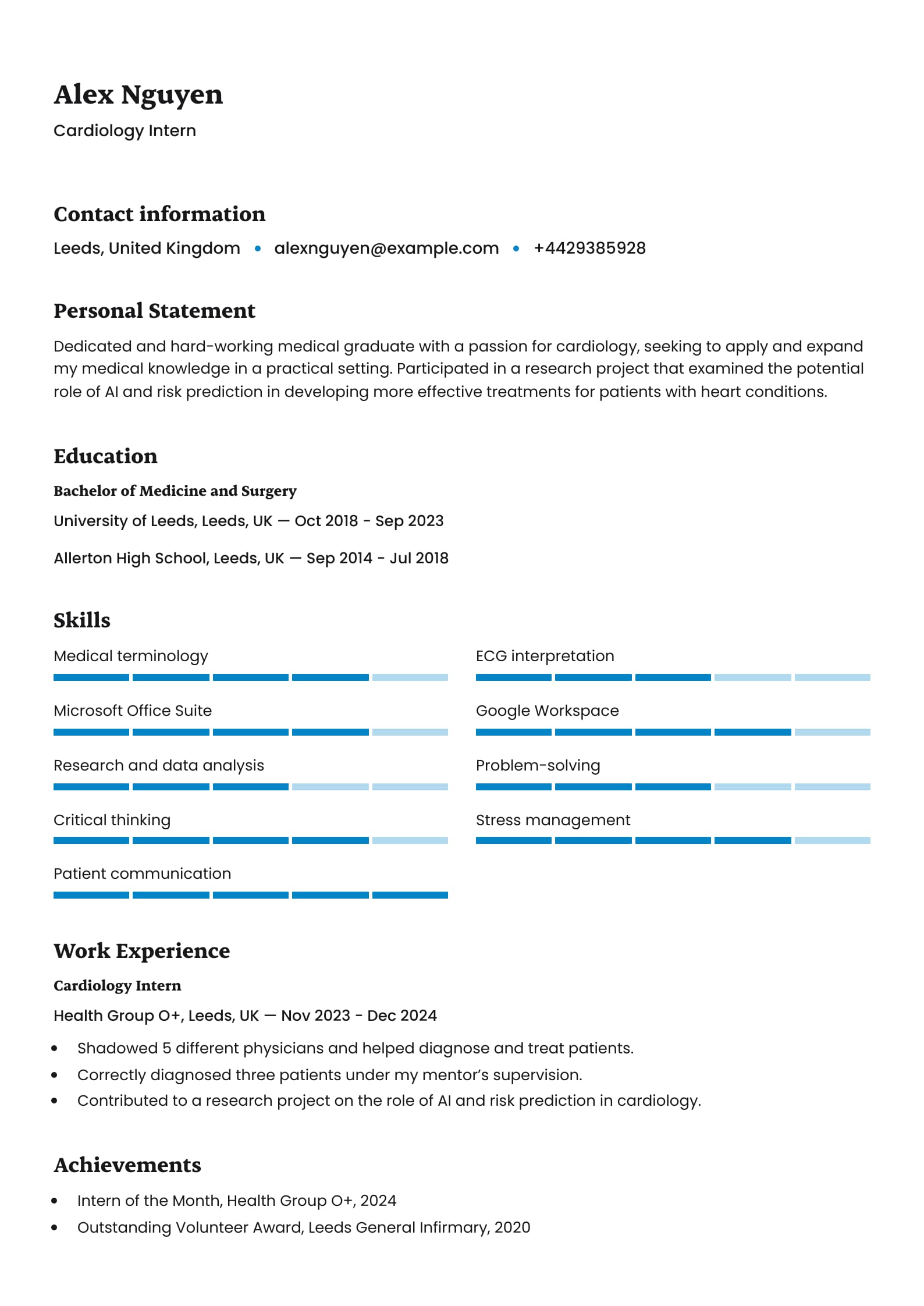
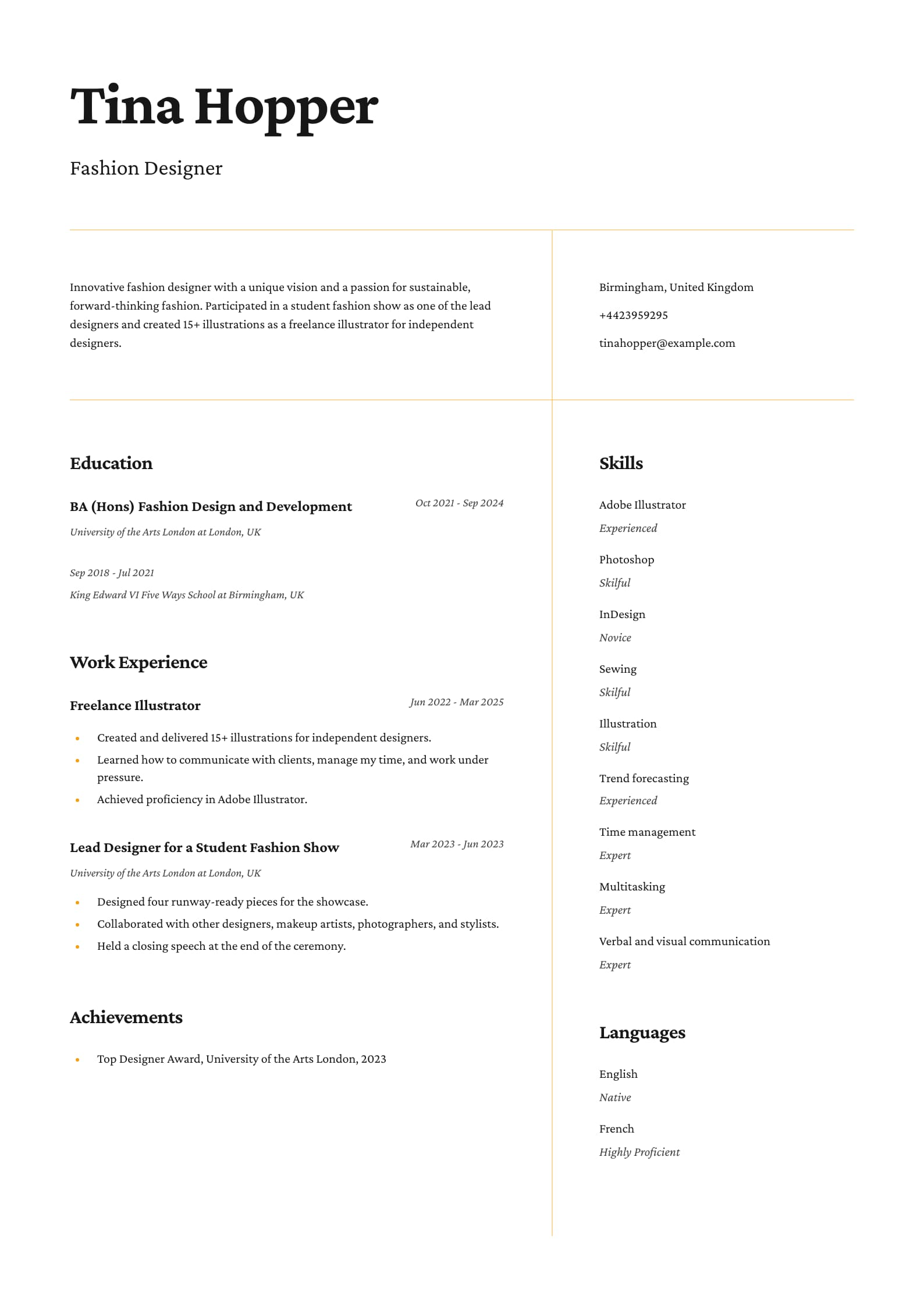
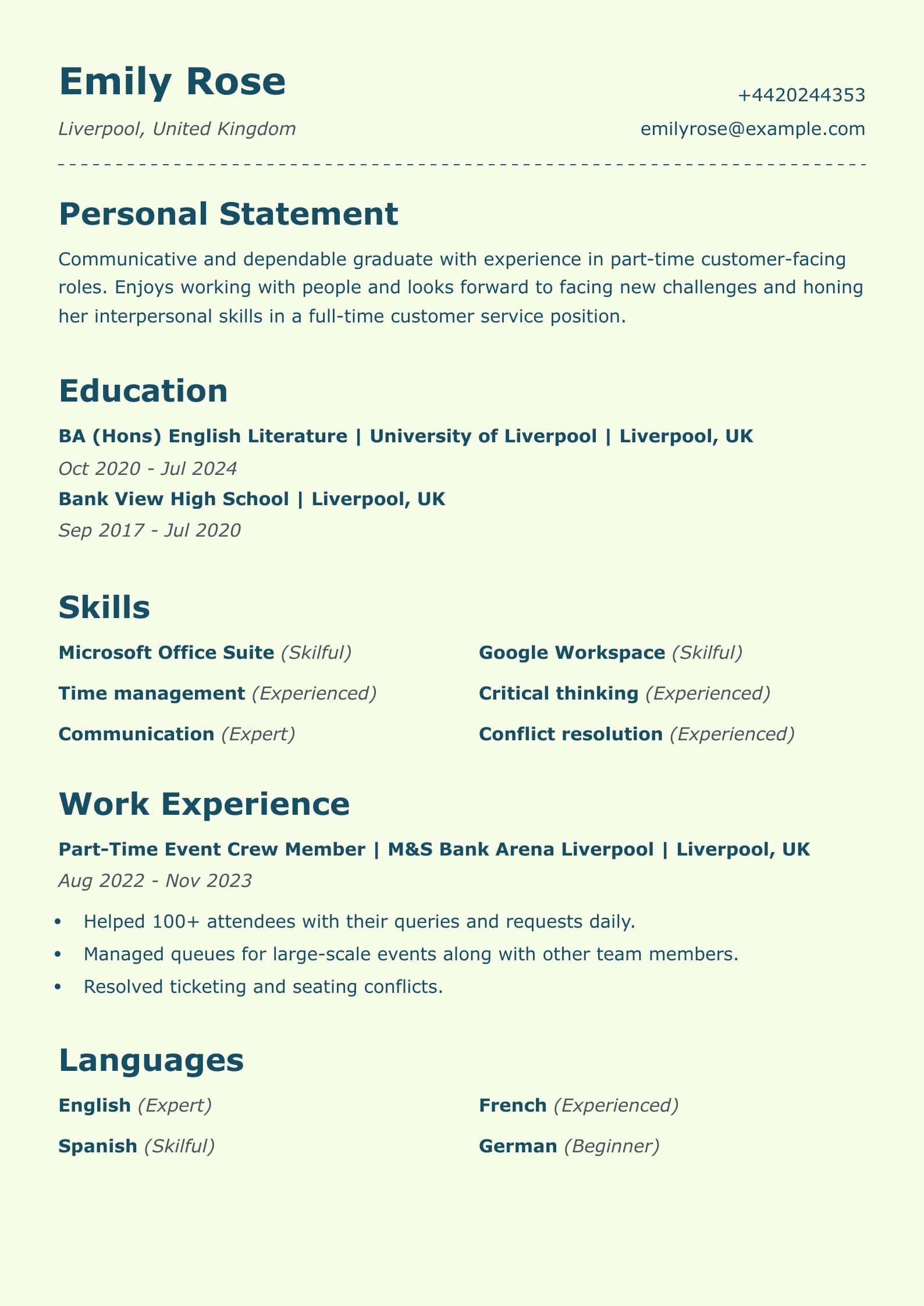
Now that we’ve covered what graduate CVs are, it’s time to see what they look like. Here are a few recent graduate CV examples to help you write your own:
How to Format Your Graduate CV
To format your graduate CV, you should follow the job market and industry standards, as these tend to receive the best responses from hiring managers. Furthermore, the correct CV format increases your chances of passing the applicant tracking system (ATS) scan, ensuring your application reaches an actual person.
Here are some tips on creating an ATS-friendly graduate CV:
Formatting Guidelines
Use the reverse chronological order. This order of displaying information is the most widely used and accepted in the UK. Essentially, you start with the most recent degree or professional experience and list all that apply in reverse. That way, hiring managers can view the most relevant details immediately and simultaneously follow your career progression.
Choose an appropriate CV font. Your CV should look professional at first glance; your font choice can significantly contribute to that. Opt for a commonly used one, like Arial, Calibri, or Times New Roman, and don’t experiment with more creative fonts. A CV written in Papyrus or Comic Sans is unlikely to be taken seriously.
Use paragraphs, bullet points, and white space. Your CV shouldn’t be a wall of text with no breaks to give a recruiter’s eyes some rest. Not only are such applications difficult to read, but they also rarely pass the initial software scan.
How to Write a Graduate CV
To write a successful graduate CV, you should include all crucial sections, like a personal statement, education, skills, work experience, and achievements. You can also add optional ones, such as publications, languages, conferences, and volunteering or research experience, though this isn’t necessary.
Below, we will give you some tips on writing a graduate CV that will secure you a job interview despite your inexperience.
#1. Personal Statement
A personal statement in a CV is a quick summary of you as a professional, with your work experiences and achievements at the forefront. Placed at the top of the CV, it’s the first section hiring managers see after your contact information, so it’s a crucial part of your application that must be carefully planned.
This is especially true because personal statements are only 2–3 sentences long, so every word must count. When writing it, highlight the most impressive aspects of your professional life and include quantifiable accomplishments if you have any.
This section may pose a challenge for a graduate with few professional experiences and achievements. As a result, you might need to get creative and incorporate your skills, projects, or interests instead. You could also directly state what you hope to accomplish if you get hired, like improving your abilities or gaining new knowledge.
Here’s a good example of how to write a personal statement:
Personal Statement Example
Personal Statement
Dedicated and hard-working medical graduate with a passion for cardiology, seeking to apply and expand my medical knowledge in a practical setting. Participated in a research project that examined the potential role of AI and risk prediction in developing more effective treatments for patients with heart conditions.
#2. Education Section
In the education section, you should include the degrees you’ve obtained in reverse chronological order, the study period, and the school’s location. You can add relevant courses or your grade average as bullet points, but only if you believe those give you an edge.
Typically, it’s enough to include two degrees: your bachelor's and GCSEs. If you’ve completed your master’s or PhD, list those instead of GCSEs, as employers are more likely to be interested in your higher levels of education.
Here’s how this section might look:
Education Section Example
Education
Bachelor of Medicine and Surgery October 2018–September 2023 University of Leeds, Leeds, UK
Allerton High School September 2014–July 2018 Leeds, UK
#3. Skills Section
On a graduate CV, skills are particularly relevant as they can compensate for the lack of professional background and ensure that your application doesn’t appear too empty. So, list as many relevant and applicable skills in this section using bullet points.
We recommend starting with hard skills directly related to your profession and then moving on to transferable skills. The latter are crucial, as they give you an edge even if you don’t have as many technical skills as more experienced candidates.
Here’s how you should organise this section:
Skills Section
Skills
Medical terminology
ECG interpretation
Microsoft Office Suite
Google Workspace
Research and data analysis
Problem-solving
Critical thinking
Stress management
Patient communication
#4. Work Experience
Work experience usually takes precedence over skills, but not in a graduate CV structure. Here, it’s better to include it at the bottom, as you’ll likely have less to write about in this section.
Still, even if you don’t have any serious work experience, you shouldn’t leave out this section entirely. Consider volunteering experiences, projects, and part-time jobs you’ve had and list those, along with your achievements and responsibilities during these engagements.
So, here is how this section might turn out:
Work Experience Example
Work Experience
Cardiology Intern Health Group O+, Leeds, UK November 2023–December 2024
Shadowed 5 different physicians and helped diagnose and treat patients.
Correctly diagnosed three patients under my mentor’s supervision.
Contributed to a research project on the role of AI and risk prediction in cardiology.
#5. Achievements Section
Finally, the achievements section isn’t always required, but it’s wise to include it on a graduate CV. It gives you an opportunity to pad your application some more and demonstrate your professional qualities to your employer.
When listing achievements, you can include recognitions you’ve received in your part-time jobs or internships, awards at competitions, or presentations you’ve given at conferences. Essentially, any relevant accomplishment that highlights your hard or soft skills is welcome on your CV.
This is how you can format this section:
Achievements Example
Achievements
Intern of the Month, Health Group O+, 2024 Outstanding Volunteer Award, Leeds General Infirmary, 2020

Free Graduate CV Template for UK Job Applications
If you need extra help when writing your application, here is a graduate CV template for UK candidates, where you can simply enter your information to make it your own:
Graduate CV Template
[Full name]
[Address]
[Email]
[Phone number]
[LinkedIn profile or website] (optional)
Personal Statement
Dedicated/Motivated/Creative [Your title] with a passion for [Subject of interest], seeking to improve knowledge and gain practical experience in [Your field]. [Summarise briefly your greatest professional accomplishment using action words and measurable outcomes when possible.]
Education
[Latest degree type and title]
[Start date] – [End date]
[School name], [City], [Country]
[Previous degree type and title]
[Start date] – [End date]
[School name], [City], [Country]
Skills
Hard skill #1
Hard skill #2
Hard skill #3
Soft skill #1
Soft skill #2
Soft skill #3
Work Experience
[Your title]
[Company name], [City], [Country]
[Start date] – [End date]
Responsibility/Achievement #1
Responsibility/Achievement #2
Responsibility/Achievement #3
Achievements
Achievement #1, [Company/Organisation], [Year]
Achievement #2, [Company/Organisation], [Year]
How to Tailor Your Graduate CV to Different Industries
To tailor your graduate CV to different industries, you should take into account specific standards and practices in the field you’re applying for. This will require some research beforehand, and you should also consider consulting someone who’s already been through the hiring process.
However, if you can’t find anyone like that, we can help you with our tips for particular industries:
#1. Finance and Accounting
Jobs in finance and accounting value precision, analytical skills, time management, and attention to detail, so your CV should demonstrate that you possess these qualities. The easiest way to include them is to list them as soft skills, but there are other strategies you can employ.
For example, you can add software dealing with data and numbers, such as Excel, to your hard skills. If you have any experience with accounting tools, like QuickBooks, NetSuite, or Xero, mention them too, as they will likely boost your standing among graduate applicants.
Also, carefully proofread your application for grammar and typing mistakes. This is important for any application, but it’s crucial for finance and accounting because obvious errors in your CV may indicate you don’t pay as much attention to details as you claim.
#2. Marketing and Communications
In marketing and communications, you should highlight creativity, teamwork, interpersonal skills, and the ability to craft compelling content. Once again, mention some of these in the soft skills section, but also sprinkle references to these qualities throughout your CV.
For example, if you’ve worked on a creative project during your studies, emphasise your responsibilities and achievements using strong action verbs. You may have created a piece of content, designed your presentation’s layout, or led your team in brainstorming ideas.
Ultimately, view your CV as another marketing opportunity in which you’re selling your skills and abilities. Highlight your strengths to mask your potential shortcomings and allow yourself some creativity in your document’s design and formatting. Don’t go overboard, though, as professionalism must still be your focus.
#3. IT and Technology
IT and technology jobs seek adaptable candidates who learn quickly and possess excellent analytical and problem-solving skills. In this case, tech proficiency is necessary; you’re unlikely to secure an IT job with soft skills alone.
So, you should focus on your technical skills and list all the software and programming languages you have experience with. These may include Python, Java, C++, CSS, HTML, SQL, and others frequently used by programmers and developers.
Since the IT job market is highly competitive, you’d do well to include projects you’ve worked on and certifications you’ve obtained. Be as clear and specific as possible when writing these and other sections.
#4. Engineering
Engineering professions favour candidates with excellent problem-solving abilities and hands-on experience. In addition, they should be team players, as most engineering projects are completed in collaboration with others.
So, make sure to showcase any past projects you participated in, even if they aren’t directly related to engineering. These can help you demonstrate the practicality, proactivity, and analytical skills every engineer should possess.
Furthermore, if you have any experience with the software typically used in engineering, you should include it in the hard skills section. Some of those are AutoCAD, SolidWorks, Simulink, and Multisim, although distinct engineering branches rely on different programs.
#5. Healthcare
Healthcare workers should possess dedication, strong communication skills, and the ability to care for patients. They should also have vast theoretical knowledge and know how to apply it practically to improve patients’ conditions or resolve their issues.
Thus, aside from an extensive educational background, you should emphasise your experiences in hospitals or clinics during internships and practical courses. These are valuable additions to your application, even if you’ve only shadowed other physicians or completed administrative work.
Additionally, including volunteering experiences can be particularly beneficial for future healthcare professionals. After all, they are a clear example of empathy and care for others, two crucial traits in this profession.
5 Mistakes to Avoid When Creating a Graduate CV
Mistakes to avoid when creating a graduate CV include using a generic CV for all applications, overloading your document with irrelevant information, failing to highlight transferable skills, not using action verbs, and not including quantifiable achievements.
Let’s take a closer look at all these mistakes to help you recognise and avoid them.
#1. Using a Generic CV for All Applications
So, you’ve followed all the guidelines and instructions and finally created a CV that, in your opinion, perfectly summarises your professional persona. Now, all that’s left is to send this document to all prospective companies that look for someone with your credentials, right?
Sadly, that’s not the case. A single, generic CV won’t necessarily be good enough to secure an interview; you need to go a step further if you want to improve your chances. Namely, you should tailor your CV to each application, highlighting the relevant skills and experiences for the particular position.
Of course, that doesn’t mean writing a CV from scratch each time you’re applying for a job. You already have a starting point, so use that as a base and tweak it to fit different requirements and expectations.
#2. Overloading With Irrelevant Information
Recent graduates often fall into the trap of including too much irrelevant information in their CVs, hoping to compensate for their lack of professional experience. You might think that a short document lowers your chances of getting selected, and respond to that by listing every project you’ve ever participated in.
However, this isn’t a good solution. Recruiters don’t typically have the time or the will to sift through paragraphs of irrelevant information to get to important parts. Instead, they prefer a shorter, easy-to-read CV that gets straight to the point.
So, don’t worry if your CV appears empty due to the lack of a professional background. Focus on the experiences and skills that matter for the job; this should be enough to show hiring managers that you’re a good fit.
#3. Failing to Highlight Transferable Skills
As mentioned before, recent graduates don’t have an extensive professional background or numerous technical skills to highlight. However, that doesn’t mean they have nothing to offer; transferable skills are a good way to pad your CV and make yourself more employable.
So, if you leave transferable skills out or don’t emphasise them enough, your application may appear weak. Don’t include a bunch just for the sake of it, though. Consider which soft skills would be useful in the job you’re applying for and list those.
#4. Not Using Action Verbs
Your CV and cover letter must present you as a proactive individual who tackles problems head-on. The best way to do that is to use action verbs; for instance, in the professional summary or when describing your responsibilities in previous workplaces.
Here are some action verbs you should consider including:
Earn
Clarify
Reach
Design
Explain
Exceed
Achieve
Facilitate
Complete
Demonstrate
Communicate
If you don’t use action verbs, you may appear passive and as if you’re lacking initiative. These aren’t desirable characteristics for an employee, so you want to avoid leaving such an impression on hiring managers.
#5. Not Including Quantifiable Achievements
Quantifiable achievements are important because they are specific and provable; in other words, not the kind of accomplishment everyone can claim to have achieved. Including only general achievements can convince your employer that you have little success to show and that you’re only listing things to bolster your application.
Create a Job-Winning Graduate CV With Our Builder
If you want to create an excellent graduate CV, use our CV builder and follow the instructions to generate one in less than 15 minutes. And in case you decide to write an application document without the help of our AI-powered assistant, use our CV examples as inspiration. We have options for various industries, positions, and career levels!
Final Thoughts
Hopefully, our guide has clarified how to write a successful graduate CV even with little or no experience. Ultimately, it’s all about highlighting your strengths to minimise the importance of your scarce professional background.
If you need extra help for specific industries, look into our CV templates. You can pick one that suits your needs, add your details, and submit it to a recruiter instantly!