
An investment banking CV is a job application document and your first—and often only—chance to impress recruiters, as this is one of the UK's most competitive career paths. A well-crafted one usually makes the difference between securing an interview and disappearing into a stack of hundreds of applications.
This guide covers everything you need to know to write a good investment banking CV, from proven examples, formatting rules, to essential skills it should include and tips for applicants without direct IB experience.
Key Takeaways
An investment banking CV must be ruthlessly quantified, results-driven, and optimised for ultra-fast recruiter screening in one of the UK’s most competitive job markets.
Recruiters prioritise measurable deal experience, technical modelling skills, academic pedigree, and commercial impact over generic responsibilities.
The ideal structure is reverse-chronological, ATS-friendly, and built around clear metrics like deal value, revenue generated, model accuracy, and transaction volume.
Strong IB CVs prove technical competence through financial modelling, valuation, and transaction execution—not vague finance buzzwords.
For candidates without IB experience, relevant internships, finance societies, case competitions, and self-directed learning can effectively substitute for live deal exposure.
2 Investment Banking CV Examples That Get Interviews
The following investment banking CV examples are based on formats that have secured interviews at well-known companies such as Goldman Sachs, J.P. Morgan, Rothschild, and similar firms across London and Edinburgh. Let’s see what they look like and why they work well.
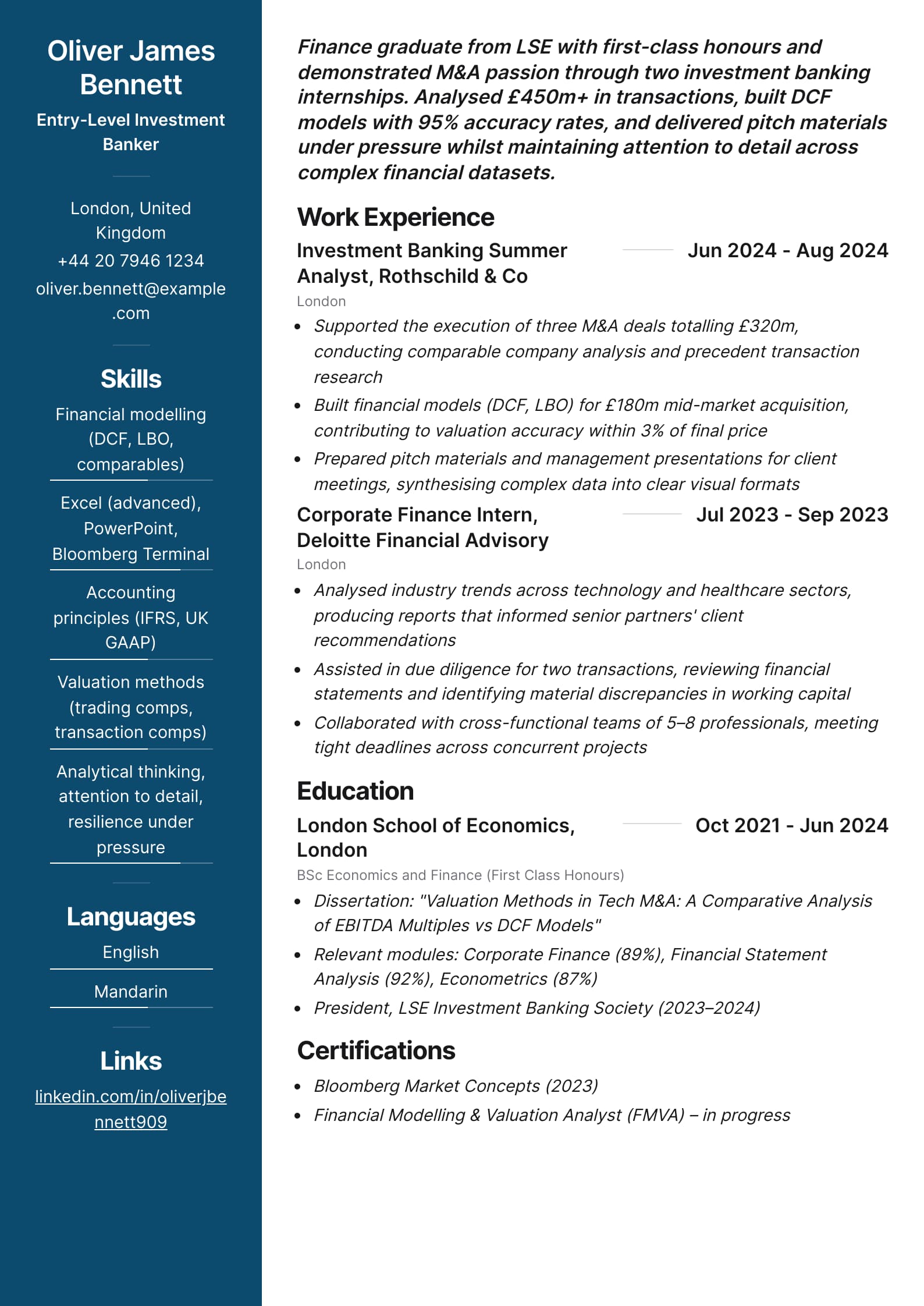
This CV example works well because it leads with credibility through prestigious institutions and quantifiable deal experience. The £320m in deals, 95% accuracy rates, and 3% variance demonstrate technical capability immediately, and every bullet point ties back to core IB competencies: modelling, analysis, client work, and precision.
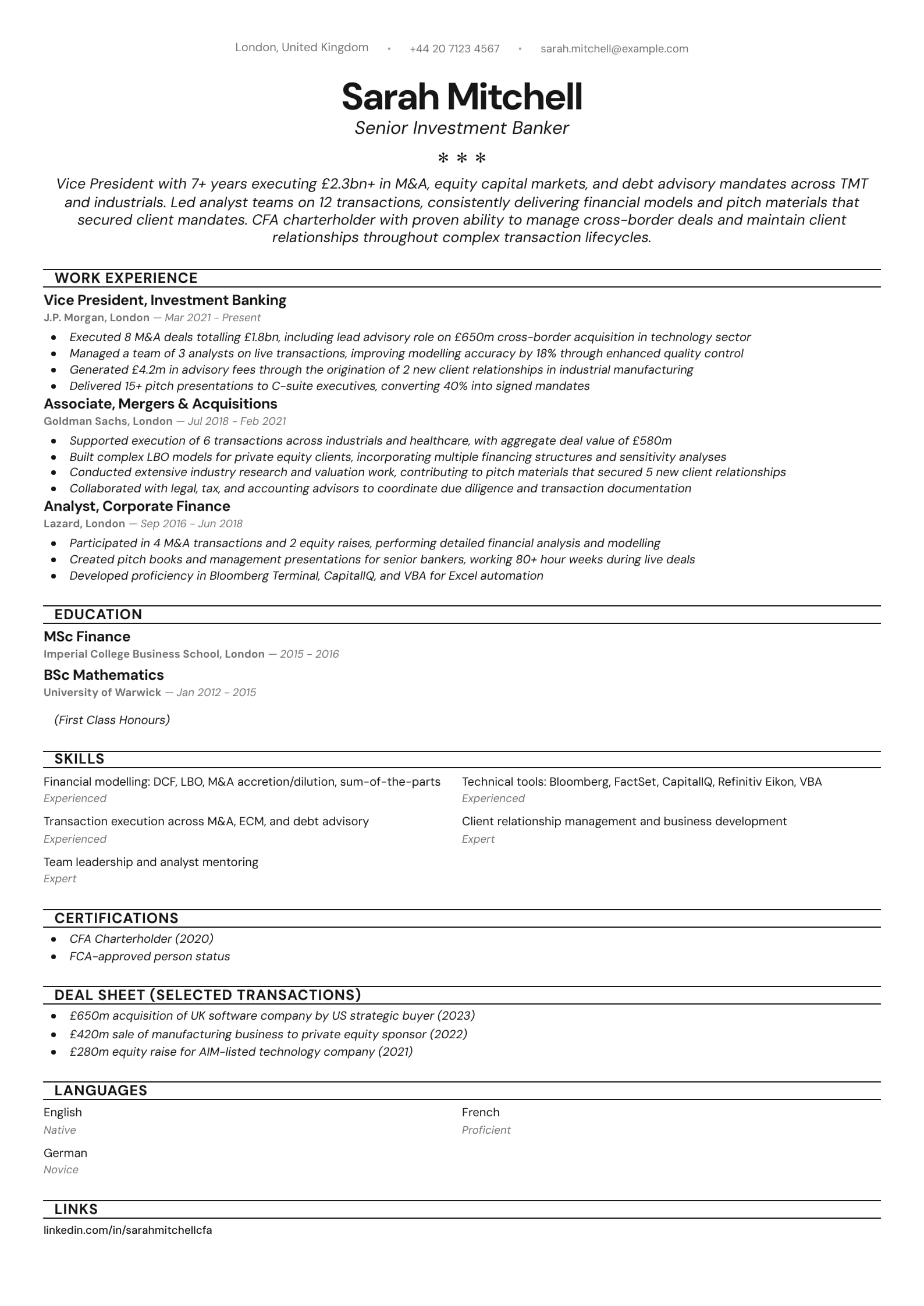
This experienced investment banker CV represents a good example because it speaks in metrics recruiters understand: deal flow, team leadership, revenue generation, etc. The deal sheet provides concrete transaction evidence, whilst numbers like "£4.2m in advisory fees" and "40% conversion rate" demonstrate commercial awareness beyond pure technical skills. Additionally, the progression from analyst through associate to VP tells a clear advancement story.
How to Write an Investment Banking CV in 6 Simple Steps
Writing a compelling investment banking CV is about structure and clarity, given that recruiters spend around 7.4 seconds reviewing it, according to one of the eye-tracking studies conducted. That's barely enough time to check your education, glance at experience, and make a judgment.
As for the CV format, reverse-chronological remains the gold standard because it's ATS-friendly, familiar to recruiters, and showcases your most recent (and relevant) experience immediately.
That said, let's see how to build an investment banking CV that passes applicant tracking systems (ATS) and lands interviews:
#1. Add Your Contact Details and a Professional Headline
This is the first thing recruiters see. Here, you include the following essentials:
CV Contact Details
Full name
Location (city-level is sufficient)
Professional email
Phone number
LinkedIn profile
Next, add a professional headline below your contact details. If you're a CFA candidate or hold an ACA qualification, add this to your headline since it signals a serious commitment to finance. The key is to be specific and credible; with that in mind, let’s compare the two headline examples below:
Good example: "Economics graduate | CFA Level II candidate | M&A and capital markets focus"
Bad example: "Looking for opportunities | Hard worker | Team player"
#2. Write a Powerful CV Summary or Objective
Your CV summary (or objective, if you're entry-level) sits directly below your contact details and serves as your elevator pitch. Therefore, this 3–4 line section needs to pack maximum punch.
If you’re experienced, use a CV summary that highlights:
Years of experience and specialisation
Deal value or transaction count
Key achievement with measurable result
Technical skills or unique value proposition
Here’s a good example:
CV Summary Example
Vice President with 7+ years executing £2.3bn+ in M&A and ECM mandates across TMT and industrials. Led analyst teams on 12 transactions, consistently delivering models that secured client mandates. CFA charterholder with cross-border deal experience and client relationship management expertise.
However, if you’re an entry-level candidate, use a CV objective that emphasises:
Academic credentials and relevant coursework
Internship experience or finance society involvement
Technical skills you've already developed
Genuine enthusiasm for investment banking
That said, let’s see a good CV objective example:
CV Objective Example
Finance graduate from LSE with first-class honours seeking an analyst role in M&A. Completed two investment banking internships analysing £450m+ in transactions, building DCF models with 95% accuracy. Passionate about corporate finance with advanced Excel skills and CFA Level I candidate status.
#3. Highlight Essential Investment Banking Skills

Investment banking demands technical prowess and personal resilience; your skills section should reflect both, weighted heavily towards hard skills that actually get work done.
Hard skills you should prioritise include:
Investment Banking Hard Skills
Financial modelling (DCF, LBO, comparables analysis)
Valuation methods (trading comps, transaction comps, precedent transactions)
Accounting fundamentals (income statement, balance sheet, cash flow)
Excel mastery (including VBA for automation)
Pitch-book creation and formatting
Bloomberg Terminal, FactSet, CapitalIQ, Refinitiv Eikon
UK GAAP and IFRS understanding
On the other hand, soft skills that matter the most would be:
Relevant Soft Skills
Analytical thinking under pressure
Resilience (80-hour weeks are real)
Attention to detail (one decimal error can tank a model)
Communication (explaining complex concepts to clients)
Teamwork across functions
#4. Show Work Experience That Demonstrates Technical Ability
Recruiters want evidence—hard proof you can handle the intellectual demands and time pressures of investment banking. Therefore, vague statements like "responsible for financial analysis" won't cut it; you need action verbs, quantifiable results, and deal-specific details.
A strong work experience section specifies modelling type, deal size, outcome, and measurable impact. For senior applicants, including a deal sheet (within your CV or as a separate attachment) is standard practice. List your most significant transactions by size, sector, and your specific role; this serves as tangible proof of experience.
Here’s an example of a strong work experience entry:
Strong Work Experience Example
Investment Banking Summer Analyst Rothschild & Co, London June 2024–August 2024
Supported the execution of three M&A deals totalling £320m, conducting comparable company analysis and precedent transaction research
Built financial models (DCF, LBO) for £180m mid-market acquisition, contributing to valuation accuracy within 3% of final price
Prepared pitch materials and management presentations for client meetings, synthesising complex data into clear visual formats
#5. Include Your Education and Relevant Certifications
Investment banks care deeply about academic pedigree. Given this, your education section should prominently feature your degree (especially finance, economics, mathematics, or business), university, classification, and relevant modules or dissertation topics.
Here’s what to actually include:
Degree title and classification (First Class Honours, 2:1, etc.)
University name and dates
Relevant coursework: corporate finance, financial statement analysis, valuation, econometrics
Dissertation topics demonstrating financial knowledge
Leadership roles in finance societies or investment clubs
Let’s see how this works in practice:
Education Section Example
Education
MSc Finance Imperial College Business School, London 2015–2016
BSc Mathematics University of Warwick 2012–2015 (First Class Honours)
If your degree isn't directly finance-related, don't panic; plenty of successful investment bankers studied engineering, physics, or humanities. Demonstrate you've acquired the necessary financial knowledge through coursework, certifications, or self-directed learning. A CFA Level I pass can partially compensate for less traditional backgrounds.
#6. Add Portfolio Links and Additional Sections
Strategic additions can set you apart from similarly qualified candidates, and they are your opportunity to showcase depth beyond the standard CV format. Here’s what you could add:
Financial models (if permissible): Host sanitised versions on GitHub or personal websites
Deal sheet: Transaction summary with appropriate confidentiality disclaimers
Quantitative projects: GitHub repositories demonstrating Python, R, or VBA skills
Relevant certifications: CFA progress, FMVA completion, specialised training
Languages: Particularly valuable for cross-border M&A roles
Awards: Finance competitions, academic prizes, industry honours
Publications: Articles in student finance journals or relevant blogs
Be selective and only include items that genuinely strengthen your candidacy. A half-finished model or outdated blog post won't help. If referencing GitHub repositories, ensure code is clean, well-commented, and demonstrates genuine technical skill.
How to Write an Investment Banking CV With No Experience
Writing an investment banking CV with no experience requires demonstrating you possess the raw materials (analytical ability, work ethic, financial knowledge) even without a £500m M&A deal under your belt.
Here are a few strategies that work:
Highlight relevant internships. Even non-IB roles in corporate finance, audit, or financial analysis show you understand business and numbers. Emphasise any modelling, valuation work, or client-facing experience.
Showcase finance society involvement. Leadership positions in university investment clubs or finance societies demonstrate genuine interest. Also, managing a student fund, analysing stocks, or organising networking events all count.
Include case competitions. Finance or strategy competitions (like CFA Society UK events) prove you handle pressure, work in teams, and deliver analyses under time constraints, which are all core IB competencies.
Leverage coursework strategically. If you excelled in corporate finance, valuation, or econometrics, mention them explicitly. Your 89% in Financial Statement Analysis tells recruiters more than a generic "studied finance."
Add self-directed learning. Completed Wall Street Prep's modelling course? Built practice models in your spare time? Passed CFA Level I whilst at university? These signal exceptional motivation.
Position transferable skills prominently. Research ability, Excel proficiency, analytical thinking, and resilience translate directly to investment banking. If you've managed complex data projects in non-finance roles, explain how those skills apply to deal execution.
Common Mistakes to Avoid in Your Investment Banking CV
Here are the most frequent investment banking CV mistakes and how to avoid them.
Mistake | Explanation |
|---|---|
Using generic, non-ATS-friendly templates | Graphic-heavy templates break in ATS systems used by banks. Use clean layouts, standard fonts, and no images or text boxes to avoid early rejection. |
Including irrelevant information | Hobbies and non-IB details waste space. Every line should highlight IB-relevant skills or achievements. Remove fluff and long paragraphs that don’t add value. |
Describing tasks instead of achievements | Avoid vague duties. Use action verbs, specifics, and measurable results to show real impact. Add context when metrics aren’t available. |
Typos and formatting errors | IB demands precision. Typos, inconsistent dates, and messy formatting suggest poor attention to detail. Proofread carefully and keep formatting consistent. |
Let Us Handle CV Making in Your Stead
If you’re still finding CV creation tedious, we offer you a shortcut! You can create your investment banking CV with our CV builder, which was built for finance professionals targeting competitive roles, within minutes. Enter the information our tool requires, choose the most appropriate template, and we’ll generate a submission-ready job application document for you in no time.
Final Thoughts
Crafting an investment banking CV that lands interviews requires strategic positioning, ruthless prioritisation, and forensic attention to detail.
As you could see, it’s best to focus relentlessly on measurable achievements demonstrating technical capability, such as deal value you supported, model accuracy, efficiency improvements you introduced, etc.
The difference between a CV binned in seven seconds and one earning you a first-round interview often comes down to these fundamentals: quantify everything, prove technical skills with concrete examples, and present it all in an immediately scannable format.
Investment Banking CV FAQs
#1. How long should an investment banking CV be?
An investment banking CV should be one page long for undergraduates and recent graduates; two pages is acceptable for experienced professionals with 5+ years in the industry. Never exceed two pages; recruiters won't read beyond that, and it suggests you can't prioritise information effectively. If struggling with length, cut less relevant experience rather than shrinking fonts below 10pt.
#2. Do I need to include a deal sheet?
Yes, you should include a deal sheet in your CV; it should be either integrated into your document or provided separately. Additionally, it should list your most significant transactions by deal value, your role, and outcome. For analysts and interns, it's optional, but it strengthens your application if you participated meaningfully in transactions.
#3. Should I include my GPA or degree classification?
Yes, you should include your GPA or degree classification in your CV. First-class honours or 2:1 from a target university should feature prominently. Plus, if your overall classification is lower but you excelled in relevant finance modules, consider listing those individual grades. US candidates should include GPA if above 3.5; if grades aren't impressive, you can omit them, but be prepared to discuss academic performance in interviews if asked directly.