
A digital marketing CV is an industry-specific job application document that allows you to demonstrate both your strategic thinking and the ability to deliver measurable results. Unlike traditional marketing roles, digital marketing demands a specific blend of creative vision and analytical prowess, and your CV must reflect that balance.
In this article, we'll walk you through everything you need to create a compelling digital marketing CV, from real-world examples and step-by-step guidance to common pitfalls you may encounter on the way.
Key Takeaways
Digital marketing CVs should balance creativity with professionalism, highlighting both hard skills (SEO, analytics) and soft skills (communication, problem-solving, etc).
Entry-level CVs benefit from showcasing internships, campaigns, and transferable skills, whilst senior CVs should emphasise strategy, leadership, and ROI metrics.
Always quantify your achievements with specific metrics like traffic growth, conversion rates, or engagement improvements.
Include portfolio links to campaigns, content samples, or analytics dashboards to provide tangible evidence of your capabilities.
2 Professional Digital Marketing CV Examples
Before we walk you through CV writing, let's look at two digital marketing CV examples that show what works at different career stages. These demonstrate how to structure your information and highlight achievements that matter to employers in the digital marketing sphere.
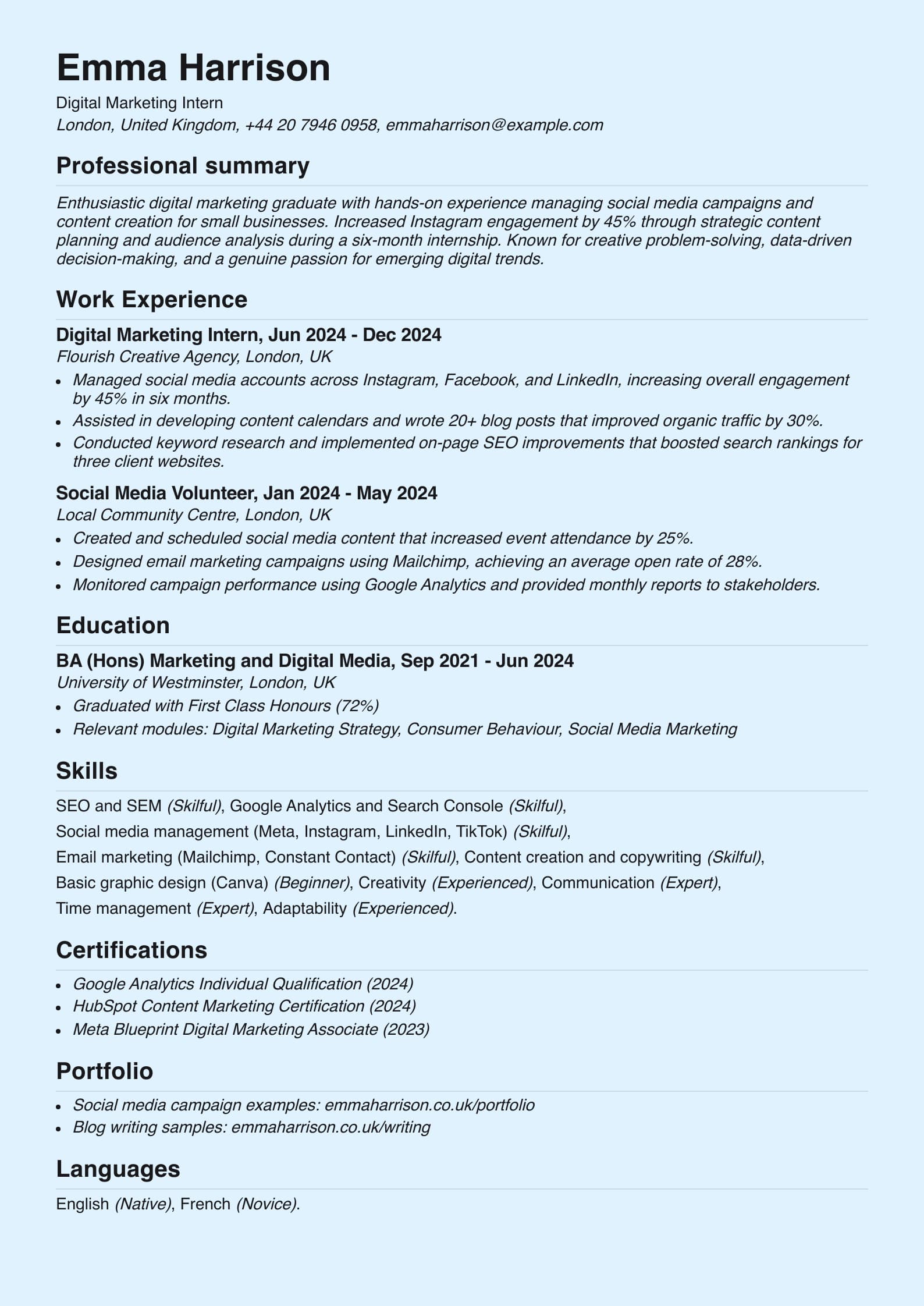
This CV example immediately shows the candidate’s value through specific metrics (45% engagement increase, 30% traffic growth) rather than vague claims. The structure prioritises relevant experience and demonstrates understanding of key digital marketing tools. Finally, portfolio links provide proof of her work, whilst certifications show initiative.
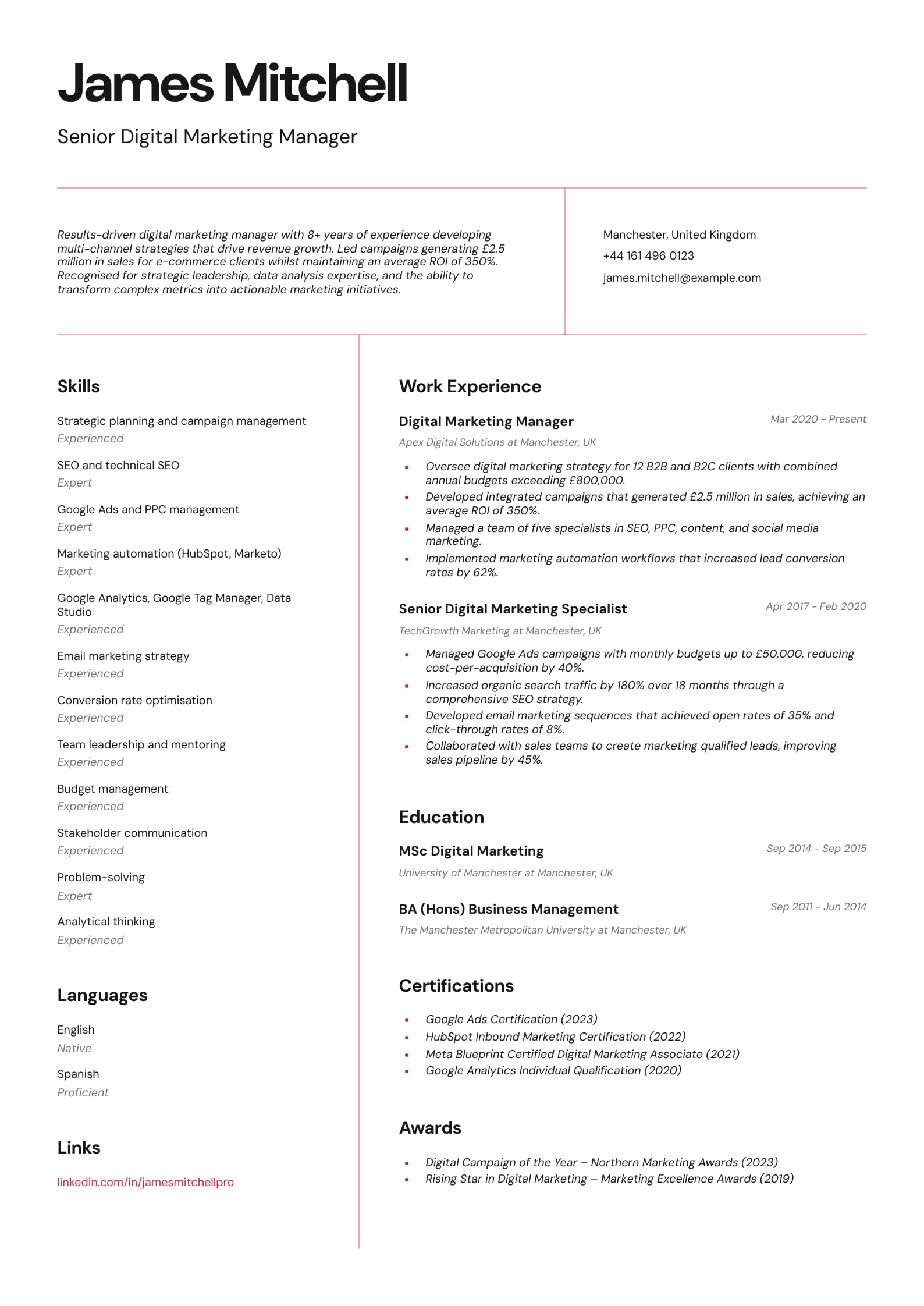
The example above shows clear progression from execution to strategic leadership, and the quantified achievements immediately demonstrate business impact. The candidate’s skill set spans both technical expertise and soft skills essential for senior positions. Plus, the awards section adds third-party validation, whilst certifications show ongoing professional development.
How to Write a Digital Marketing CV: A Step-by-Step Guide
Writing an effective digital marketing CV requires strategic thinking about how to present your skills and achievements.
As per the statistics provided by the Graduate Recruitment Bureau (GRB), the value of the UK digital marketing sector is expected to increase to more than £77 billion in the next 10 years. This implies the long-term growth of the industry, which will need a large number of qualified individuals to fill different roles in the field.
Therefore, it’s crucial that your most impressive qualifications appear prominently on your CV. Additionally, many companies use applicant tracking systems (ATS) to filter applications, which means your format must be both visually appealing and machine-readable.
That said, let’s see how to write an effective digital marketing CV step by step:
#1. Add Your Contact Details and a Creative Headline
Your contact information should appear at the very top of your CV, in the header, and include:
Contact Details
Full name
City and country
Professional email address
Phone number
LinkedIn profile
For digital marketers, adding portfolio links or a personal website showcases your understanding of personal branding. Plus, your professional email should be simple; firstname.lastname@email.com works best. Avoid outdated or overly creative addresses that don't look professional.
Additionally, create a compelling headline or professional summary directly below your contact details. This 3-4 line paragraph should capture your experience level, key achievements, and what makes you valuable. Think of it as your elevator pitch—concise, specific, and results-focused.
Here's what an effective contact section looks like:
Contact Section Example
Contact Information
Sophie Chen Birmingham, United Kingdom sophie.chen@example.com +44 121 496 0789 linkedin.com/in/sophiechen123 sophiechen.digital
Professional Summary
Creative digital marketing specialist with 4 years of experience driving measurable growth through integrated campaigns. Increased e-commerce revenue by 85% through strategic SEO and paid advertising whilst reducing customer acquisition costs by 30%. Passionate about leveraging data insights to create compelling customer experiences across digital channels.
#2. Highlight Relevant Skills
The skills section is critical because it often determines whether your application passes ATS screening. Include both hard skills (technical abilities) and soft skills (interpersonal qualities) that match the job description.
Hard skills for digital marketing include:
Hard Skills
SEO and technical SEO
SEM and PPC advertising
Google Analytics and data analysis
Social media advertising (Meta, LinkedIn, TikTok)
Email marketing platforms (Mailchimp, HubSpot)
Content management systems (WordPress, Shopify)
Marketing automation (HubSpot, Marketo)
Basic graphic design (Canva, Adobe Creative Suite)
Meanwhile, some essential soft skills for this field would be:
Soft Skills
Creative thinking and problem-solving
Written and verbal communication
Adaptability
Team collaboration
Time management
#3. Showcase Work Experience and Campaigns
Your work experience section tells the story of your professional journey whilst demonstrating tangible impact. For digital marketing roles, this means going beyond job descriptions to highlight specific campaigns and measurable results.
Structure each entry with your job title, company name, location, and dates. Include 3-6 bullet points focusing on achievements rather than responsibilities, and use strong action verbs, such as launched, optimised, increased, developed, managed, implemented, and created.
Here's what this section should look like:
Digital Marketing Work Experience Example
Work Experience
Digital Marketing Specialist GrowthHub Digital, Bristol, UK January 2022–Present
Managed integrated digital campaigns across SEO, PPC, and social media for eight clients, generating a combined revenue of £1.2 million annually.
Increased average client website traffic by 165% through strategic content creation and technical SEO improvements.
Developed email marketing campaigns achieving average open rates of 34% and CTR of 7.2%, exceeding industry benchmarks by 85%.
Implemented conversion rate optimisation strategies that improved average landing page performance from 3.1% to 7.8%.
#4. Include Education and Certifications
The education section demonstrates your foundational knowledge, whilst certifications prove your commitment to staying current. For digital marketing, relevant degrees include Marketing, Business, Communications, or Digital Media—but certifications often carry equal weight with employers.
List your degrees in reverse chronological order with the qualification type, subject, institution, and dates. If you're a recent graduate with limited or no experience, you can elaborate on relevant coursework or dissertation topics.
Certifications deserve particular attention because they demonstrate specific platform expertise. The most valuable include:
Google Analytics Individual Qualification
Google Ads certifications
HubSpot Inbound Marketing Certification
LinkedIn Marketing Solutions certifications
Also, present your education and certifications clearly, like this, for example
Education and Certifications Example
Education
BA (Hons) Marketing and Communications University of Leeds, Leeds, UK September 2018–June 2021
Graduated with Upper Second Class Honours (2:1)
Dissertation: "The Impact of Influencer Marketing on Gen Z Purchase Decisions"
Certifications
Google Analytics Individual Qualification (2024)
Google Ads Search Certification (2024)
HubSpot Inbound Marketing Certification (2023)
Meta Blueprint Digital Marketing Associate (2023)
#5. Add Portfolio Links and Extras
Unlike many professions, digital marketers benefit enormously from providing examples of their work. Portfolio links allow recruiters to see your strategic thinking, creativity, and results documentation.
Your portfolio might include:
Campaign case studies showing strategy and results
Content samples (blog posts, social media, emails)
Analytics dashboards highlighting your measurement abilities
Creative work (graphics, videos, ads)
Client testimonials
If you maintain a personal website or professional blog, this becomes your portfolio hub. Otherwise, platforms like LinkedIn or Google Drive folders work well.
Beyond portfolios, consider adding:
Awards and recognition from employers or industry organisations
Speaking engagements or publications showing thought leadership
Volunteer work demonstrating your skills for good causes
How to Write a Digital Marketing CV With No Experience

If you don’t have any or little work experience in marketing, start by reframing your actual experiences. Focus on internships, even if unpaid or short-term; also, you can volunteer to handle digital marketing for student societies, local charities, or small businesses, as these projects offer real experience whilst helping organisations that need support.
Academic or personal projects carry weight with employers. Therefore, starting a blog, building a social media following, or creating content on TikTok or YouTube all show initiative. Document the growth metrics; even modest numbers demonstrate you understand what resonates with audiences.
Finally, emphasise transferable skills from other contexts, such as writing, research, analysis, creativity, and communication, and frame these in marketing terms. Invest time in free certifications from Google, HubSpot, and Meta, as these show initiative while teaching useful skills, and many can be completed in just a few days.
4 Common Mistakes to Avoid in Your Digital Marketing CV
Even experienced marketers sometimes undermine their applications through avoidable errors. Here's what to watch out for:
Using generic templates without customisation. Every CV should be tailored to the specific role, incorporating keywords from the job description and highlighting relevant experience. Generic phrases like "responsible for social media" tell recruiters nothing meaningful about your contributions. Instead, be specific about what you achieved and how you did it.
Failing to quantify achievements. The biggest weakness in marketing CVs is describing responsibilities rather than demonstrating impact. Don't just say you "managed email campaigns"—specify: "developed automated email sequences that increased customer retention by 35% whilst reducing unsubscribe rates by 12%." Always include percentages, revenue figures, traffic numbers, or engagement metrics.
Overloading with buzzwords instead of substance. Terms like "innovative," "results-driven," and "passionate" appear so frequently that they've lost meaning. Rather than claiming you're a "highly motivated self-starter," demonstrate these qualities through specific examples. Show your motivation by listing certifications you've completed, and prove your creativity by describing a novel campaign approach that achieved measurable results.
Creating ATS-unfriendly formatting. Many talented marketers sabotage their applications by prioritising visual creativity over ATS compatibility. Applicant tracking systems struggle with complex graphics, unusual fonts, text boxes, and images. Stick to standard section headings (Work Experience, Education, Skills), use common fonts (Arial, Calibri), and save as .docx or PDF. Test your CV format by copying it into plain text—if it doesn't transfer cleanly, ATS will struggle too.
Create Your Professional Digital Marketing CV
If you need help structuring your application, our CV builder offers professionally designed templates optimised for ATS compatibility. Simply input your information, select a template, and generate a polished CV within minutes!
Final Thoughts
Creating an effective digital marketing CV requires knowing how to make strategic content and having a professional presentation.
Successful applications tell a compelling story about your capabilities through specific, quantified achievements rather than vague descriptions. Therefore, your CV should demonstrate both your technical expertise and your creative problem-solving abilities that drive business results.
Digital Marketing CV FAQs
#1. What should I include in a digital marketing CV?
Your digital marketing CV should include contact information, a professional summary, work experience with measurable campaign achievements, relevant skills, educational background, and industry certifications. Consider adding portfolio links to campaign examples and any awards or recognition you've received.
#2. How long should my digital marketing CV be?
Your digital marketing CV should be one to two pages long, with one page being ideal for candidates with less than five years of experience. Focus on quality over quantity; include only relevant information that demonstrates your value to employers. As you progress in your career, a two-page CV becomes acceptable, but never sacrifice readability for the sake of including every detail.
#3. What skills make a digital marketing CV stand out?
The skills that make a digital marketing CV stand out are hard skills such as SEO, Google Analytics, PPC advertising, marketing automation platforms, and social media advertising. Additionally, complement these with soft skills such as analytical problem-solving, creative content creation, project management, and clear communication.
#4. Do I need a portfolio with my CV?
Yes, you need a portfolio with your CV, as this significantly strengthens your application. Create a simple website or online portfolio showcasing campaign case studies, content samples, analytics dashboards, or creative work. At a minimum, ensure your LinkedIn profile thoroughly documents your experience.