
A software engineer CV is a job application document that helps you demonstrate why you're the right fit for a role—and in a field as competitive as tech, that first impression matters. With so many applicants vying for the same position, your CV needs to showcase your impact, technical expertise, and problem-solving ability seamlessly.
In this article, we'll walk you through how to write a software engineer CV that stands out, provide two complete examples, and highlight the most common mistakes to avoid.
Key Takeaways
A software engineer CV should highlight technical skills, measurable achievements, and relevant projects with clear evidence of impact.
It should include contact details, a professional headline, work experience with metrics, education, certifications, and links to GitHub or portfolios.
Avoid generic templates, listing every technology you've used, and forgetting to optimise for applicant tracking systems (ATS).
Tailor your CV for each role by emphasising the most relevant tech stack and achievements.
Use action verbs like "implemented," "optimised," and "designed" to describe your contributions.
2 Software Engineer CV Examples That Stand Out
First, let’s look at two examples that actually work; these align with common tech recruiting practices, formatted for both humans and ATS, and tailored to different career stages.
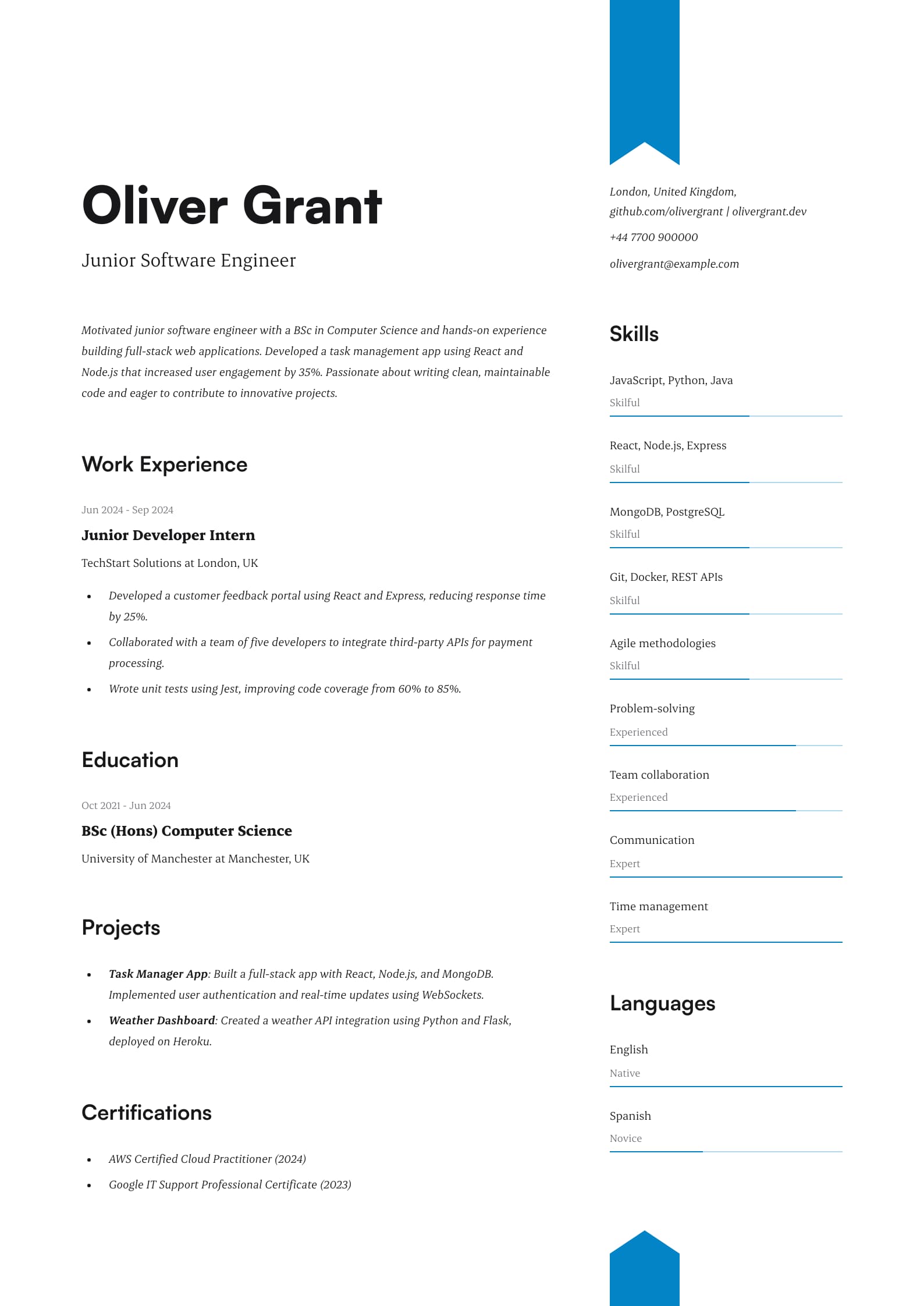
This example is clean, focused, and immediately shows what the candidate can do. The professional software engineer CV summary includes a measurable result (35% increase), which grabs attention. The projects section demonstrates practical experience, and GitHub links give recruiters easy access to his work.
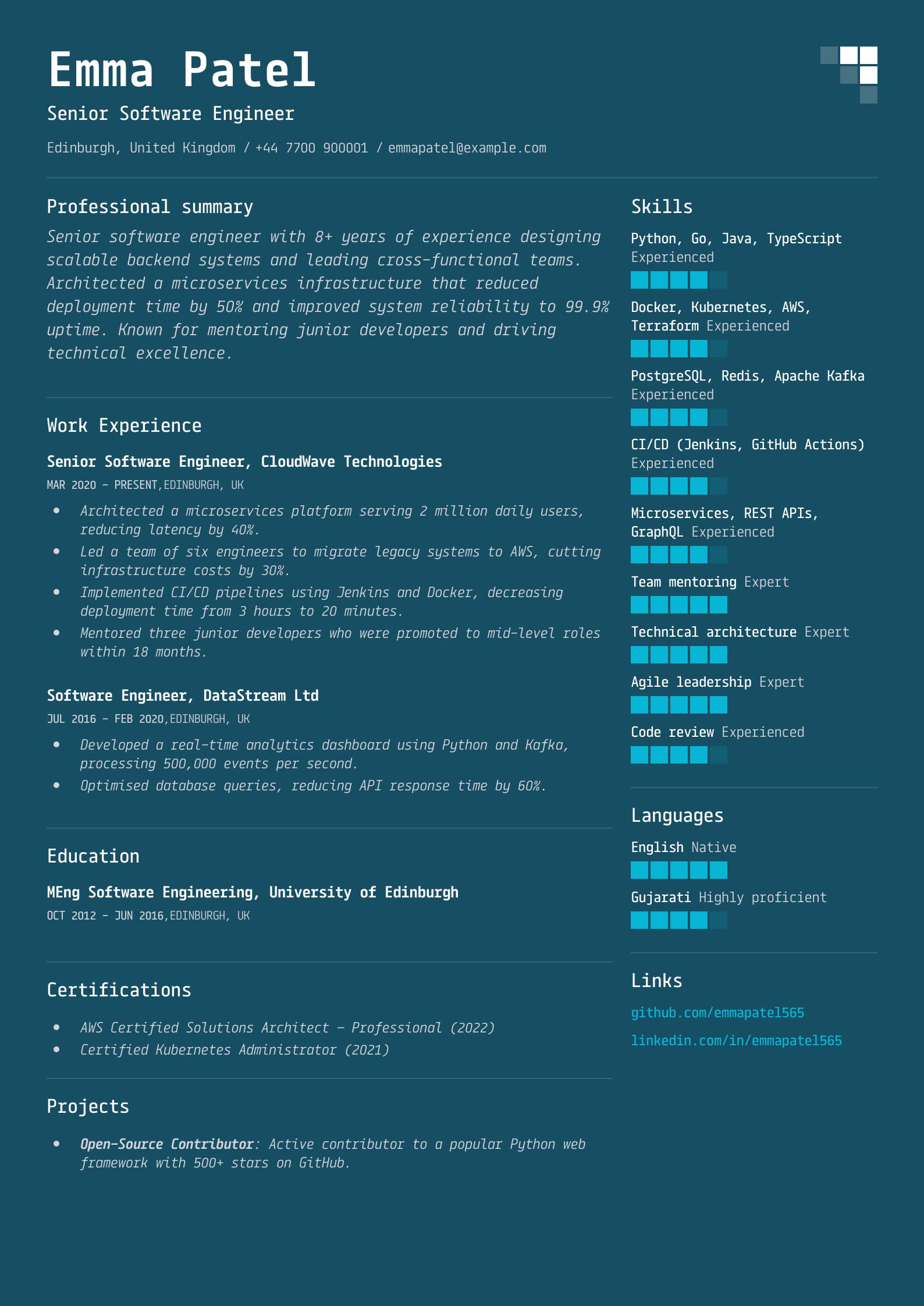
This candidate's CV immediately establishes her seniority. The professional summary highlights leadership skills and measurable impact (50% reduction in deployment time). Her work experience shows results, not just responsibilities, and the certifications and open-source contributions add credibility.
How to Write a Software Engineer CV in 5 Easy Steps

Writing a software engineer CV doesn't have to be complicated, but it does need to be strategic. Above all, your document needs to be clear, well-structured, and immediately impactful.
The best format is the reverse chronological format, which prioritises your most recent experience and works reliably with applicant tracking systems (ATS). That said, let’s see how to write your CV step by step:
#1. Start With Contact Details and a Clear Headline
Your contact information might seem straightforward, but it's where some candidates make avoidable mistakes.
Include your:
CV Header Details
Full name
City (no full address needed)
Professional email
Cell phone number
Links to your GitHub profile and portfolio site
LinkedIn profile
Recruiters in tech expect to see your code, so GitHub is essential, while a portfolio site demonstrates that you care about presentation. If you've done well in coding challenges on platforms like LeetCode or HackerRank, include those too; avoid outdated email addresses and ensure your LinkedIn profile is current.
Contact Information Example
Contact Information
Sophie Turner Bristol, United Kingdom sophieturner@example.com +44 7700 900002 github.com/sophieturner879 | sophieturner.dev | linkedin.com/in/sophieturner879
#2. Highlight Your Technical and Soft Skills
Your skills section is one of the first things recruiters look at and one of the main areas that ATS software scans for keywords.
Focus on technologies you're genuinely proficient in and that are relevant to the roles you're applying for. Hard skills are your technical competencies and might include:
Technical Skills
Programming skills and languages (JavaScript, Python, Java)
Frameworks (such as React and Django)
Databases like PostgreSQL and MongoDB
DevOps tools (Docker, Kubernetes, etc.)
Cloud platforms like AWS and Microsoft Azure
Soft skills matter too, some of them being:
Soft Skills
Teamwork and collaboration
Communication
Time management, etc.
Don't just list these; if you've mentored developers or presented technical solutions, mention those examples in your work experience section.
Skills Section Example
Technical Skills
Python, JavaScript, Java, Go
Django, React, Node.js
PostgreSQL, MongoDB, Redis
Docker, Kubernetes, AWS
CI/CD (Jenkins, GitHub Actions)
Soft Skills
Problem-solving
Team collaboration
Communication
Mentorship
#3. Showcase Strong Work Experience With Metrics
Your work experience section proves what you can do.
Start each bullet point with a strong action verb, and then back up each action with measurable results. If you're early in your career, internships, freelance projects, and university projects count. Focus on what you built, what you learned, and any feedback or results you received.
Software Engineer Work Experience Example
Work Experience
Software Engineer InnovateTech Ltd, London, UK January 2022–Present
Developed a real-time notification system using Node.js and WebSockets, handling 1 million daily notifications with 99.8% delivery success.
Implemented automated testing with Jest and Cypress, increasing code coverage from 55% to 90% and reducing production bugs by 35%.
#4. Include Education, Certifications, and Bootcamps
Your education section should include your degree, institution, and graduation date. If you studied Computer Science or Software Engineering, that's relevant, but non-traditional backgrounds work too.
If you completed a coding bootcamp like General Assembly or Makers Academy, include it. Certifications can give you an edge, especially in cloud computing, such as:
Google Cloud Professional Cloud Architect
Microsoft Azure Administrator
Certified Kubernetes Administrator
Don't list expired certifications; if you're currently working towards one, mention that.
Education and Certifications Section
Education
BSc (Hons) Computer Science University of Bristol, Bristol, UK October 2019–June 2022
Certifications
AWS Certified Solutions Architect – Associate (2023)
Certified ScrumMaster (2021)
#5. Add Projects, GitHub Links, and Extra Sections
This is where you show off work that matters most. Your projects section should include 2–3 technical projects demonstrating your software engineer skills. For each, include the project name, technologies used, a brief description, and a link to the GitHub repository or live demo.
If you've contributed to open-source projects, mention that; it shows engagement with the developer community. Optional extras include hackathons, tech blogging, coding competitions, and publications.
Additional CV Sections
Projects
E-Commerce Platform: Built a full-stack site using React, Node.js, and Stripe API. GitHub
Open-Source Contribution: Contributed bug fixes to a popular JavaScript framework with 10,000+ stars.
Hackathons
Winner, London Tech Hackathon 2023
5 Common Mistakes to Avoid in Your Software Engineer CV
Even strong candidates can sabotage their chances with a poorly structured CV. Here are the most common mistakes you might make and how to avoid them.
Listing every technology you've ever touched. It's tempting to include every language and framework you've used, even if it was just for a single tutorial, but you shouldn’t do that. Recruiters care about what you're proficient in, not what you've dabbled with.
Using overly generic CV templates. Those one-size-fits-all CV templates with clip art and bright colours might look creative, but they're a nightmare for ATS. Stick to clean, simple designs with clear headers, standard fonts like Calibri or Arial, and no images or complex graphics.
Forgetting to include GitHub or project links. If you're a software engineer and your CV doesn't link to your GitHub profile or portfolio, you're missing a huge opportunity. Research has shown that this platform became a major part of the software-engineering research ecosystem, hosting millions of repositories and users. Therefore, recruiters will definitely want to see your work there.
ATS issues. Many CVs get rejected before a human ever sees them because they don’t have an ATS-friendly format. Avoid tables, unusual fonts, images, and headers with important information (some ATS can't read them). Save your CV as a .docx or .pdf file—never as a .jpg or .png.
Writing long paragraphs instead of bullet-point achievements. Nobody wants to read a wall of text. Break your work experience into bullet points, each starting with an action verb and including a measurable result. It's easier to scan, easier to remember, and far more impactful.
Generate a Job-Winning CV With Us
Use our CV builder to create a professional CV in under 15 minutes!Final Thoughts
Writing a software engineer CV that gets you noticed isn't about cramming in every skill or using the flashiest template, but about clarity, relevance, and results.
Focus on what you've built, the problems you've solved, and the impact you've had—backed up with numbers wherever possible. Keep it clean, make it easy to read, and show recruiters why you're the person they need!
Software Engineer CV FAQs
#1. What should a software engineer put on a CV?
A software engineer should put contact details, a summary, technical and soft skills, work experience with measurable achievements, education, certifications, and links to projects or GitHub on their CV. Optional sections like hackathons or tech blogging strengthen your application, especially early in your career.
#2. How long should a software engineer CV be?
For most software engineers, a CV should be 1–2 pages long. Junior developer CV should aim for one page, while senior software developer CV or that of software engineers with extensive experience can go up to two pages. Still, ensure every piece of information adds value.
#3. Do recruiters check GitHub or personal projects?
Yes, most tech recruiters check GitHub. Therefore, a well-maintained profile with clear documentation, active contributions, and polished projects sets you apart. If your GitHub is sparse or outdated, consider tidying it up or highlighting your best work in a portfolio site instead.