
A social worker CV represents your opportunity to demonstrate your commitment to safeguarding vulnerable individuals and supporting communities. In a field experiencing significant staff shortages across the UK, a well-crafted application can help you stand out to hiring managers looking for compassionate, qualified professionals.
So, be it your first social care CV or an experienced practitioner's job application document, it must showcase both your technical competencies and the empathy that drives your work. This guide will walk you through creating an effective social worker CV, from structuring your contact details to highlighting measurable achievements.
Key Takeaways
Social worker CVs should combine technical skills (safeguarding, risk assessment) with soft skills (empathy, communication, resilience).
Use measurable achievements to demonstrate impact, such as caseload sizes, improved outcomes, or reduced response times.
Tailor your CV to specific areas of social work (children's services, adult care, mental health, or safeguarding) to match job requirements.
Include your Social Work England registration prominently and ensure your CV format is ATS-friendly, with a clear structure and relevant keywords.
If you lack experience, emphasise placements, volunteer work, academic projects, and transferable skills from other roles.
2 Professional Social Worker CV Examples
Before we break down the writing process, let's look at two complete social worker CV examples that demonstrate what works in practice. These highlight different career stages and show how to present your experience effectively.
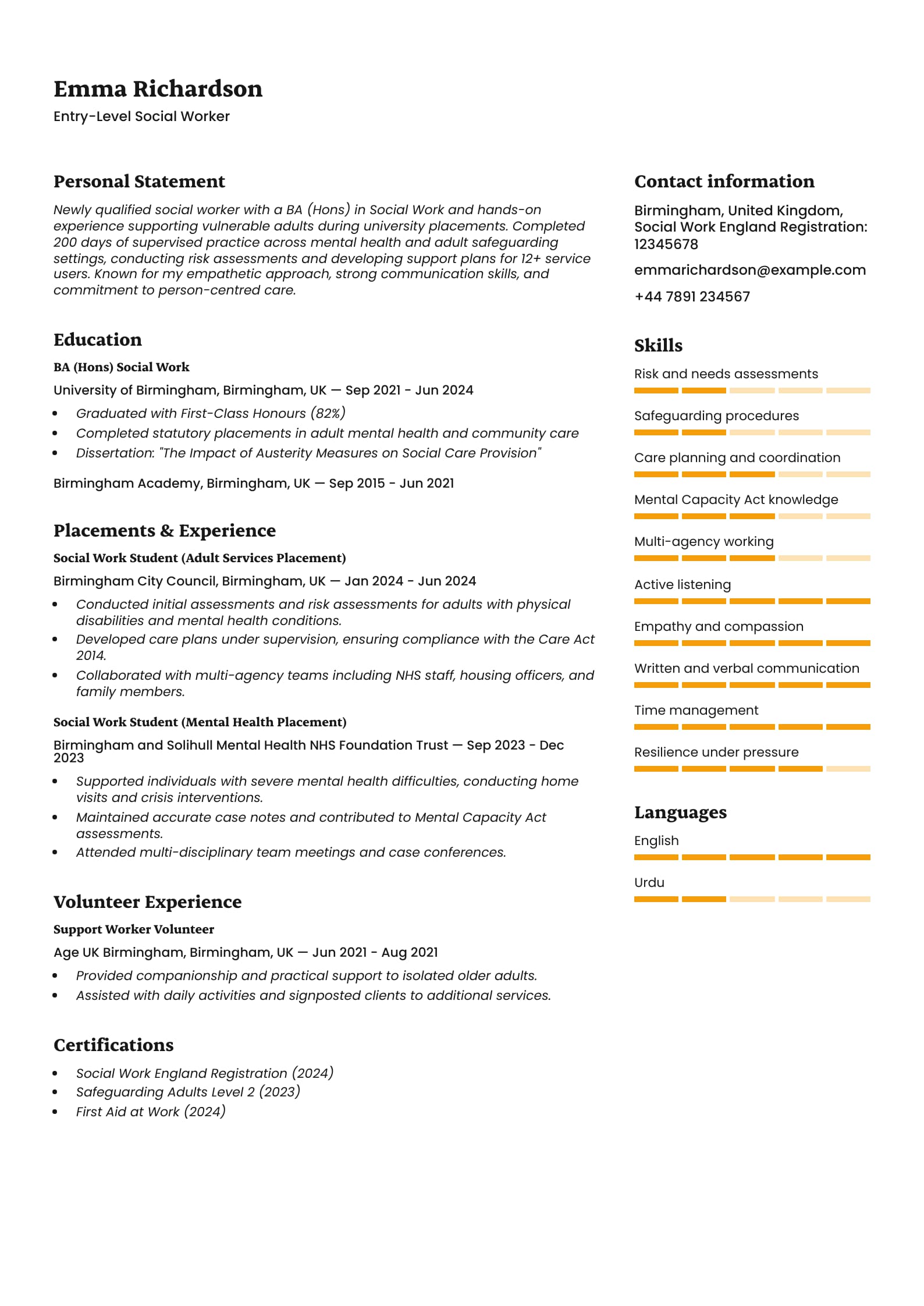
Why this works: This CV compensates for limited post-qualification experience by emphasising substantial placement hours, academic achievement, and relevant volunteer work as a support worker. It demonstrates practical application of social work principles whilst highlighting transferable skills that employers value in newly qualified practitioners.
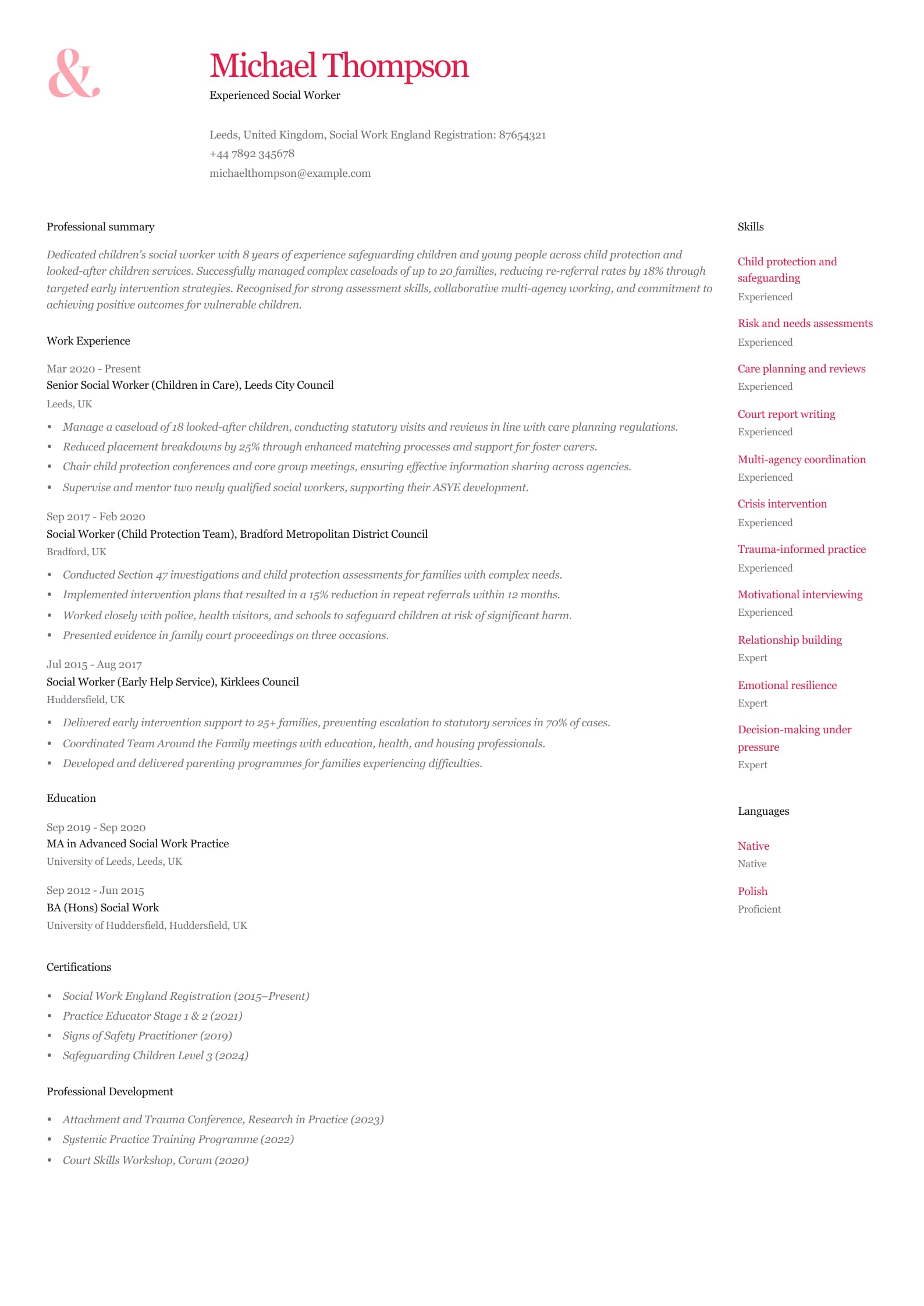
Why this works: It demonstrates career progression with quantifiable achievements at every stage. It shows specialist knowledge in children's services, evidence of continuous professional development, and leadership experience through supervision of junior colleagues—all critical factors for senior social work roles.
How to Write a Social Worker CV in 5 Simple Steps
To write a social worker CV that will showcase your competencies in the best possible way, you must choose the right sections and CV format, as well as mind the content you include in it.
The social care sector faces considerable workforce challenges. According to the survey conducted by Social Worker England, 63% of social workers believe that there’s a significant shortage of adequate candidates for such positions. This means employers are actively looking for serious candidates who can demonstrate both competence and compassion.
The reverse-chronological CV format is the preferred structure for social worker CVs. It presents your most recent and relevant experience first, making it easy for hiring managers to assess your current capabilities. This format also works well with applicant tracking systems (ATS), which many local authorities and NHS trusts use to screen applications.
Here are the steps you should follow to create a social worker or a community support worker CV:
#1. Start With Your Contact Details and a Clear Headline
Your contact information sits at the top of your CV, in the header, where recruiters can immediately see it. This section needs to be accurate and professional—a missed interview invitation because of a typo isn't the impression you want to leave.
Include these essential details:
CV Header Details
Full name
Location (city and county)
Professional email address
Cell phone number
Social Work England registration number
LinkedIn profile (optional)
Your Social Work England registration number should be prominently displayed here. It's the first thing many employers check, as it confirms you're legally qualified to practise. If you're awaiting registration, note "Social Work England registration pending" with your expected date.
Here's what a strong contact section looks like:
Contact Information Example
Contact Information
Sarah Mitchell Manchester, United Kingdom sarahmitchell@example.com +44 7890 123456 Social Work England Registration: 98765432
Avoid adding personal social media accounts unless they're strictly professional. Also, choose a readable CV font like Calibri or Arial in 10-12 point size for this section and throughout your document.
#2. Create a Powerful Social Worker CV Summary or Objective
Directly beneath your contact details comes your CV personal statement, which is either a summary or an objective. This 3-4 line paragraph serves as your hook, giving employers a snapshot of who you are before they've read a single job description.
Use a summary if you're an established social worker with relevant experience:
CV Summary for an Experienced Social Worker
Professional Summary
Experienced adult social worker with 6 years of experience specialising in learning disabilities and autism support. Successfully coordinated care packages for 25+ adults with complex needs, improving independent living outcomes by 30% through person-centred planning and multi-agency collaboration. Known for building trusting relationships with service users and maintaining high professional standards under pressure.
Meanwhile, you should use an objective if you're newly qualified or transitioning from a community support worker position or related role:
CV Objective for an Entry-Level Social Worker
Career Objective
Newly qualified social worker with a BA (Hons) in Social Work and 200 days of placement experience across children's safeguarding and family support services. Seeking to apply my knowledge of child protection procedures, risk assessment, and family engagement to support vulnerable children and families in a dedicated children's social care team.
The difference is subtle but important; a summary proves your track record, while an objective demonstrates your potential. Both should be tailored to the specific role; a mental health position needs a different emphasis than an adult safeguarding role.

#3. Highlight Your Social Worker Skills
The skills section demonstrates both your hard skills and personal qualities. Social work requires specific professional knowledge alongside emotional intelligence; for example, you need to understand legislation whilst genuinely caring about the people you support.
Start with hard safeguarding skills specific to social work, such as:
Key Safeguarding Skills
Risk and needs assessments
Safeguarding children/adults procedures
Care planning and coordination
Mental Capacity Act 2005 knowledge
Care Act 2014 compliance
Multi-agency working and coordination
Court report writing
Crisis intervention techniques
Case management systems (e.g., Mosaic, LiquidLogic)
Section 47 investigations (for children's services)
Best Interests assessments
Then include essential soft skills, which include:
Essential Soft Skills
Empathy and compassion
Active listening
Verbal and written communication
Emotional resilience
Decision-making under pressure
Cultural sensitivity
Boundary management
Advocacy
Relationship building
Time management
Choose 8-12 skills most relevant to the specific role. For example, if you're applying for a mental health position, emphasise crisis intervention and therapeutic relationship skills; for children's safeguarding roles, highlight child protection knowledge and court experience.
#4. Showcase Relevant Experience and Achievements
This section carries the most weight on your social worker CV. Structure each role with your job title, organisation, location, and dates, followed by bullet points that blend responsibilities with measurable achievements.
Also, use action verbs to start each bullet point and quantify your impact wherever possible, like in these examples:
"Managed a caseload of 22 adults with learning disabilities"
"Reduced re-referral rates by 15% through targeted family support"
"Coordinated care packages for 18 looked-after children"
"Conducted 40+ initial assessments annually"
Finally, mention relevant legislation to demonstrate professional knowledge: Care Act 2014, Mental Capacity Act 2005, Children Act 1989 and 2004, Working Together to Safeguard Children, Signs of Safety framework, etc.
Here's what strong experience entries look like:
Professional Experience Example
Work Experience
Social Worker (Adult Services) Manchester City Council, Manchester, UK June 2019–Present
Manage a diverse caseload of 20-25 adults with physical disabilities, mental health conditions, and dementia.
Conduct comprehensive Care Act assessments and develop person-centred support plans in collaboration with service users and families.
Reduced emergency hospital admissions by 20% through proactive risk management and early intervention strategies.
Chair safeguarding enquiries under Section 42, ensuring appropriate protective measures are implemented.
Supervise and mentor a student social worker during their final placement.
#5. Add Education, Certifications & Additional Sections
Your education section confirms you have the academic foundation for social work practice. List your degrees in reverse chronological order:
BA (Hons) or BSc in Social Work
MA or MSc in Social Work or Advanced Social Work Practice
Postgraduate diploma conversions
Also, include the institution, location, and dates; if you're newly qualified with limited experience, you can add relevant modules or your dissertation topic.
Education Section Example
Education
MA in Advanced Social Work Practice University of Sheffield, Sheffield, UK September 2020–September 2021
BA (Hons) Social Work University of Bradford, Bradford, UK September 2015–June 2018
Here are some extra sections you can add to your CV:
Additional CV Sections for Social Workers
Certifications and professional registration deserve their own section and may include:
Social Work England registration (include your registration number)
Practice Educator awards (Stage 1 and/or Stage 2)
Best Interests Assessor qualification
Specialist training certificates
Safeguarding training levels (typically Level 3)
Languages are particularly valuable in diverse communities. If you speak community languages, list them with proficiency level—this can be a significant asset for supporting families who struggle with English.
Volunteer work in community settings, mental health organisations, or support services shows your commitment extends beyond paid employment.
Professional development activities like conferences, workshops, and specialist training demonstrate that you stay current with best practices.
Keep your CV length to two pages maximum; one page for newly qualified workers, two for experienced practitioners with extensive training and achievements.
How to Write a Social Worker CV With No Experience
To write a social worker CV with no experience, you should emphasise your placement details by treating them like paid employment. Detail what you did, which service user groups you worked with, and what outcomes you contributed to, like this:
Social Work Placements Example
Social Work Student Placement (Children's Services) Kent County Council, Maidstone, UK January 2024–June 2024
Conducted initial assessments for 8 children subject to child protection plans.
Co-worked with a senior social worker on Section 47 investigations involving neglect and domestic abuse.
Attended 12 child protection conferences and contributed to safety planning.
Maintained accurate case notes and prepared reports for core group meetings.
You can also highlight:
Academic achievements that demonstrate your theoretical knowledge. If you achieved a First-Class degree or if your dissertation explored a relevant topic like trauma-informed practice or the impact of austerity on social care, include it.
Transferable skills from any paid work alongside your studies. Customer service roles develop communication and de-escalation skills, while care work teaches empathy and patience, and administrative positions build organisational abilities. If you've worked as a support worker, that experience is directly relevant to social work roles.
You can also browseCV templates and examples designed specifically for entry-level social care roles to see how other newly qualified practitioners structure their applications.
4 Common Mistakes to Avoid in Your Social Worker CV
Even strong candidates undermine their applications with avoidable errors. Here's what to watch out for:
Using vague responsibilities instead of measurable achievements. Saying you "supported service users" tells employers nothing distinctive. "Supported 15 adults with learning disabilities to develop independent living skills, resulting in 8 transitioning from residential care to supported accommodation," paints a far clearer picture of your impact.
Overusing generic soft skills without examples. Listing "excellent communication skills" and "empathy" without demonstrating these qualities makes your CV blend into every other application. Show these skills through your achievements, which you will quantify with measurable results.
Ignoring ATS formatting requirements. Many local authorities use applicant tracking systems (ATS) to filter job applications before human reviewers see them. These systems struggle with unusual fonts, graphics, tables, and text boxes. Stick to standard fonts, use clear section headings, and save your document as a .docx or PDF file.
Not tailoring your CV to specific areas of social work. A generic social worker CV suggests you haven't thought carefully about the role you're applying for.
Create Your Professional Social Worker CV Today
Let our CV builder guide you through creating an ATS-friendly job application!Final Thoughts
Writing a compelling social worker CV requires demonstrating your genuine commitment to safeguarding vulnerable people whilst showing you have the professional knowledge to do so effectively.
Your CV should balance technical competencies with the empathy and resilience that make social work meaningful. Focus on measurable achievements that show your impact, tailor your application to the specific area of social work you're targeting, and you’ll have some interviews scheduled in no time!
Social Worker CV FAQs
#1. What skills are essential for a strong social worker CV?
Essential skills for a strong social worker CV include both technical competencies and personal qualities. On the technical side, you need risk and needs assessment capabilities, knowledge of safeguarding procedures, understanding of relevant legislation, care planning abilities, etc. Meanwhile, soft skills are equally important, including empathy, active listening, resilience under pressure, effective communication, decision-making, and much more.
#2. How long should a social worker CV be?
Your social worker CV should typically be two pages long. Newly qualified practitioners can sometimes keep it to one page if they lack extensive work experience, though substantial placement hours usually push it to two pages.
#3. Should I include my Social Work England registration on my CV?
Yes, you should include your Social Work England registration number in your CV; it should appear prominently in your contact information section at the top of the document. This immediately confirms to employers that you're legally qualified to practise social work in England.