
An HR CV is a document designed to help you secure a job in this dynamic and highly competitive field. Since the competition is fierce, HR specialists must impress their potential employers with their superb soft skills and standout qualifications if they want to secure this job.
In this article, we will guide you through the writing process for HR CVs, provide you with two sample applications, and show you what mistakes to avoid. We will also teach you how to craft a CV without any experience.
Key Takeaways
An HR CV needs to be highly professional and eye-catching to stand out among the competitors.
To write an HR CV, you need to add your contact details and a personal statement, showcase work experience, highlight relevant skills, include education and certifications, and consider additional sections.
If you have no experience, you should focus on your education, transferable skills, volunteering, and certificates.
Avoid writing generic content, failing to proofread, forgetting to include keywords from the job description, and formatting improperly.
2 Outstanding Human Resources CV Examples
Before we share specific tips on writing a human resources CV, we’ll share two examples to demonstrate what these applications look like in practice.
How to Write an HR CV in 5 Key Steps
To write a professional HR CV, you should follow these five key steps:
#1. Add Your Contact Details and a Personal Statement
First and foremost, add your contact information to the header of the application, where employers can immediately see it in case they want to contact you. Otherwise, you risk missing great job opportunities.
The information you should provide in the contact details section includes:
Header Details
Full name
Address
Email address
Phone number
LinkedIn profile (optional)
Professional website (optional)
It’s generally not recommended to add more than this, even if you may be tempted to include social media or personal blogs. These details can harm your application more than benefit it, especially if your posts don’t align with company values.
A contact information section should look like this:
Contact Information CV Section
Contact Information
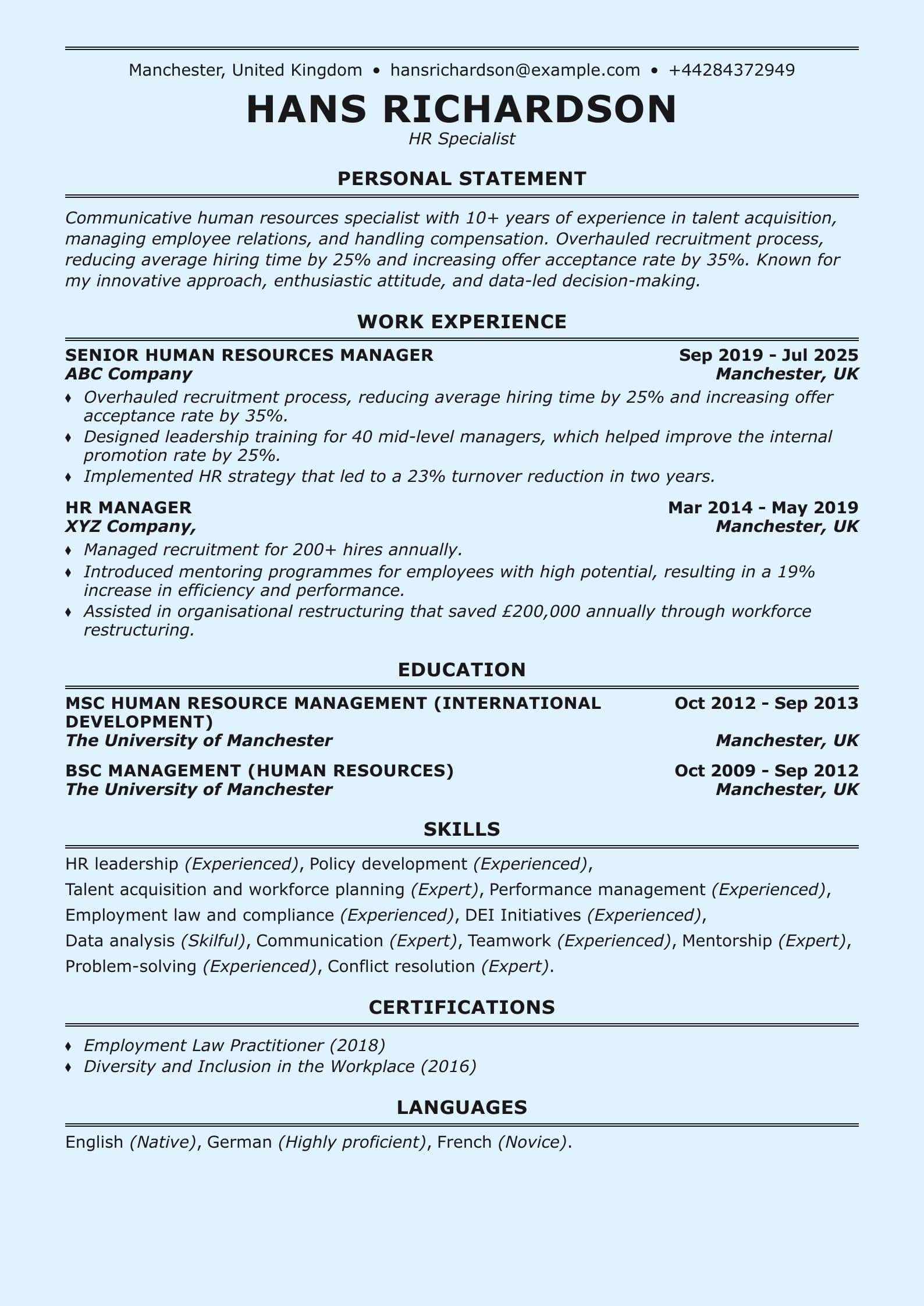
Hans Richardson Manchester, United Kingdom hansrichardson@example.com +44284372949
As for the personal statement, it should provide a brief snippet of what the CV is about. However, you should fit this information into 4–5 lines of text, so each word should demonstrate your value to the employer.
We recommend using the following formula:
Sentence #1: your title, years of experience, and basic responsibilities at your previous positions. Alternatively, you can include your most recent degree and the institution that issued it here
Sentence #2: your most significant achievement described using a strong action verb and measurable results
Sentence #3: your relevant soft and hard skills, often used as attributes to describe you.
If we put that into practice, it should look like this:
Personal Statement Example
Personal Statement
Communicative human resources specialist with 10+ years of experience in talent acquisition, managing employee relations, and handling compensation. Overhauled recruitment process, reducing average hiring time by 25% and increasing offer acceptance rate by 35%. Known for my innovative approach, enthusiastic attitude, and data-led decision-making.
#2. Showcase Work Experience
The next section is the most significant one on your application: the work experience section. It should contain all your relevant past positions, along with the company you worked for and the period of your employment.
However, the most important part is the achievements placed in bullet points under each entry to explain how you’ve contributed to your past roles. They are not the same as responsibilities; rather than describing what the position entails, they focus on your performance and accomplishments.
Although achievements are crucial, there’s not much room to discuss them here; each should be one sentence long, and there should be between 3 and 6 per entry. If you want to elaborate further, do so in an HR cover letter or save some of your explanations for the interview.
Here’s what the work experience section looks like on an HR CV:
Work Experience Section for an HR CV
Work Experience
Senior Human Resources Manager ABC Company, Manchester, UK September 2019–July 2025
Overhauled recruitment process, reducing average hiring time by 25% and increasing offer acceptance rate by 35%.
Designed leadership training for 40 mid-level managers, which helped improve the internal promotion rate by 25%.
Implemented HR strategy that led to a 23% turnover reduction in two years.
HR Manager XYZ Company, Manchester, UK March 2014–May 2019
Managed recruitment for 200+ hires annually.
Introduced mentoring programmes for employees with high potential, resulting in a 19% increase in efficiency and performance.
Assisted in organisational restructuring that saved £200,000 annually through workforce restructuring.
#3. Highlight Relevant Skills
Your HR skills should be sprinkled throughout your CV, but the main section is the skills section, usually placed before or after education. It’s up to you to decide on the position; if you consider them a priority, write about them first.
The skills section is very simple; it’s a bullet point list of your abilities, starting with hard skills and ending with soft ones. Typically, you should include 6–10 skills, as that range ensures you cover the most relevant ones and still not go overboard.
This is what skills sections usually look like on an HR CV:
Skills Section Example
Skills
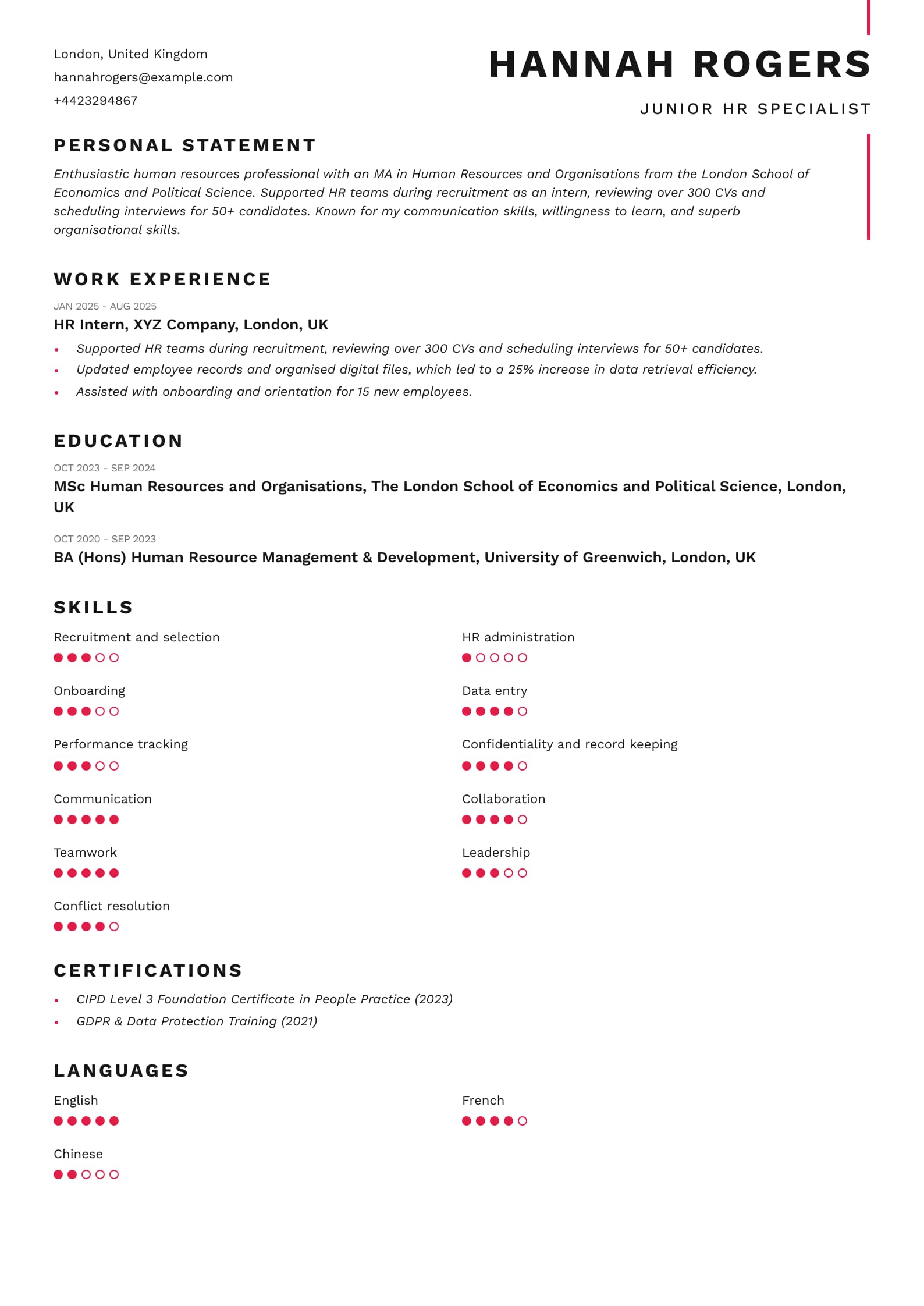
Recruitment and selection
HR administration
Onboarding
Data entry
Performance tracking
Confidentiality and record keeping
Communication
Collaboration
Teamwork
Leadership
Conflict resolution
#4. Include Education and Certifications
The education section should contain your degree, the institution where you obtained it, and the period of attendance. This information is usually sufficient, but you can add more if you don’t have relevant job experience to write about.
As a rule, you should only include two of your most recent degrees. So, if you have a master’s and a bachelor’s, there’s no need to write about your GCSEs or A-Levels, as they are no longer so relevant.
Here’s an example of the education section on an HR manager CV:
Education Section for HR Manager CV
Education
MSc Human Resource Management (International Development) October 2012–September 2013 The University of Manchester, Manchester, UK
BSc Management (Human Resources) October 2009–September 2012 The University of Manchester, Manchester, UK
Your certifications should also be included on your CV as bullet points in a separate section. In this case, it’s enough to just write the name of the certificate and the year you obtained it. Further information is unnecessary, unless you feel that the name isn’t transparent enough.
So, here’s what that looks like:
Certifications Section Example
Certifications
CIPD Level 3 Foundation Certificate in People Practice (2023)
GDPR & Data Protection Training (2021)
#5. Consider Adding Other Sections
The sections we’ve mentioned are more or less obligatory on every CV, but you can add a few optional ones to further pad out your application. This is especially important if you don’t have much professional experience to write about.
In that case, consider including the following sections:
Additional CV Sections
Publications, where you can mention the articles and papers you’ve written or contributed to
Languages, where you should list all the languages you speak, along with your fluency level
Hobbies and interests, where you should list activities and subjects you enjoy, which are still relevant to HR
Awards, where you should mention any prizes you might have received for your excellent performance
For all of these, you should just use bullet points without any lengthy explanations; if anything’s not entirely clear, you can elaborate in a cover letter.

How to Write an HR CV Without Experience
To write an HR CV without experience, you can try the following strategies:
Highlight education. If you don’t have a professional background to discuss, education can be your trump card. You can discuss your achievements in this section, too; just add bullet points under each entry, like you would for work experience. This is a perfect opportunity to mention your honours, awards, and relevant courses.
Showcase transferable skills. Even if you don’t possess the job-specific abilities gained through experience, you’ve surely acquired a few transferable skills over the course of your education. These include communication, leadership, teamwork, and certain widely used software, such as Microsoft Office, and can be incredibly useful on your CV.
Include volunteering experience. Volunteering may not count as work officially, but it is that in every other sense; you complete particular responsibilities and develop certain skills. Furthermore, volunteering demonstrates initiative, enthusiasm, and willingness to contribute to your community, which most employers appreciate.
Add certificates. Certificates are proof that you possess the skills you claim to have, and they can contribute significantly to your application. So, look into the common certificates for HR, like the ones provided by the Chartered Institute of Personnel and Development (CIPD), and make sure to obtain and include them on your CV.
4 Common Mistakes to Avoid in Your HR CV
Common mistakes to avoid in your HR CV are:
Lack of specificity. Unspecific applications rarely receive much attention from recruiters, as they appear generic and don’t stand out. So, make sure to include particular details, such as your achievements at previous positions with measurable results. This information sets your CV apart from all the others.
Improper formatting. Walls of text are generally not welcome in the recruitment process and may eliminate your application before it even reaches a recruiter. That’s because the applicant tracking system (ATS) scans forward only CVs with proper paragraphs, headings, and bullet points; everything else gets rejected.
Typos and grammar mistakes. Lack of proofreading can make you appear unprofessional and careless, which certainly isn’t the impression you want to leave on your potential employer. Reread the document once you’ve completed it and run it through a grammar checker to ensure everything is correct.
Failing to include relevant keywords. The ATS scan also checks for specific keywords, and if your CV doesn’t have those, it might be rejected. So, make sure to include them; thoroughly examine the job description, as that’s where you’ll find these keywords.
Create a Professional CV With CV.co
If you need extra help writing an HR application, use our CV builder for assistance. All you need to do is enter your information, follow the AI helper’s instructions, and select a suitable CV template. Then, finalise the document and submit it to the employer directly or download it as a PDF.
And if you want to create your application from scratch, consult our CV examples for inspiration. We offer a vast library of options for various industries and career levels, so you’ll surely find exactly what you need.
Final Thoughts
Now that you’ve read our article, hopefully, you have a better understanding of how to craft a successful HR CV and secure a job of your dreams. The key is in emphasising your soft skills, like communication and teamwork, as well as highlighting relevant achievements from the past. If you can do this effectively, you’re likely to receive an interview invitation.
HR CV FAQs
#1. How long should an HR CV be?
An HR CV should be approximately 1–2 pages long, which is the standard length for this type of job application document. Ideally, you should be able to fit all relevant information on one page, but if not, you can write an additional one. However, that should be your limit; most recruiters don’t want to read overly long CVs.
#2. Can I use a creative design for an HR CV, or should I be professional?
You should use a professional design rather than a creative one for an HR CV, since that’s generally considered a safer option. Of course, there are industries where a creative application may benefit you, like design, marketing, or media, but HR doesn’t belong to this category.
#3. What skills should I list in an HR CV?
You should list a mix of hard and soft skills in an HR CV, though the latter are likely to be more prominent. After all, human resources managers have to be excellent communicators, team players, and decision makers, all of which are considered soft skills. Still, hard skills like data analysis and digital literacy should also find their place on your CV.