
A computer science CV is a job application document used by software developers, programmers, and IT professionals to showcase their technical skills, coding projects, and professional experience. As a result, such applications often focus on programming languages, frameworks, measurable achievements, and portfolio links.
In this article, we will teach you how to write a computer science CV, show you examples of such documents, and provide tips to help you avoid common mistakes.
Key Takeaways
Computer science CVs are used by software developers, data scientists, programmers, and IT professionals to demonstrate technical expertise and problem-solving abilities.
These CVs emphasise programming languages, frameworks, tools, quantifiable project outcomes, and links to GitHub repositories or portfolios.
You should highlight your technical skills, work experience with measurable results, relevant projects, education, and certifications in a computer science CV.
Common mistakes include using generic templates, listing irrelevant skills, omitting measurable results, and creating non-ATS-friendly layouts.
2 Outstanding Computer Science CV Examples
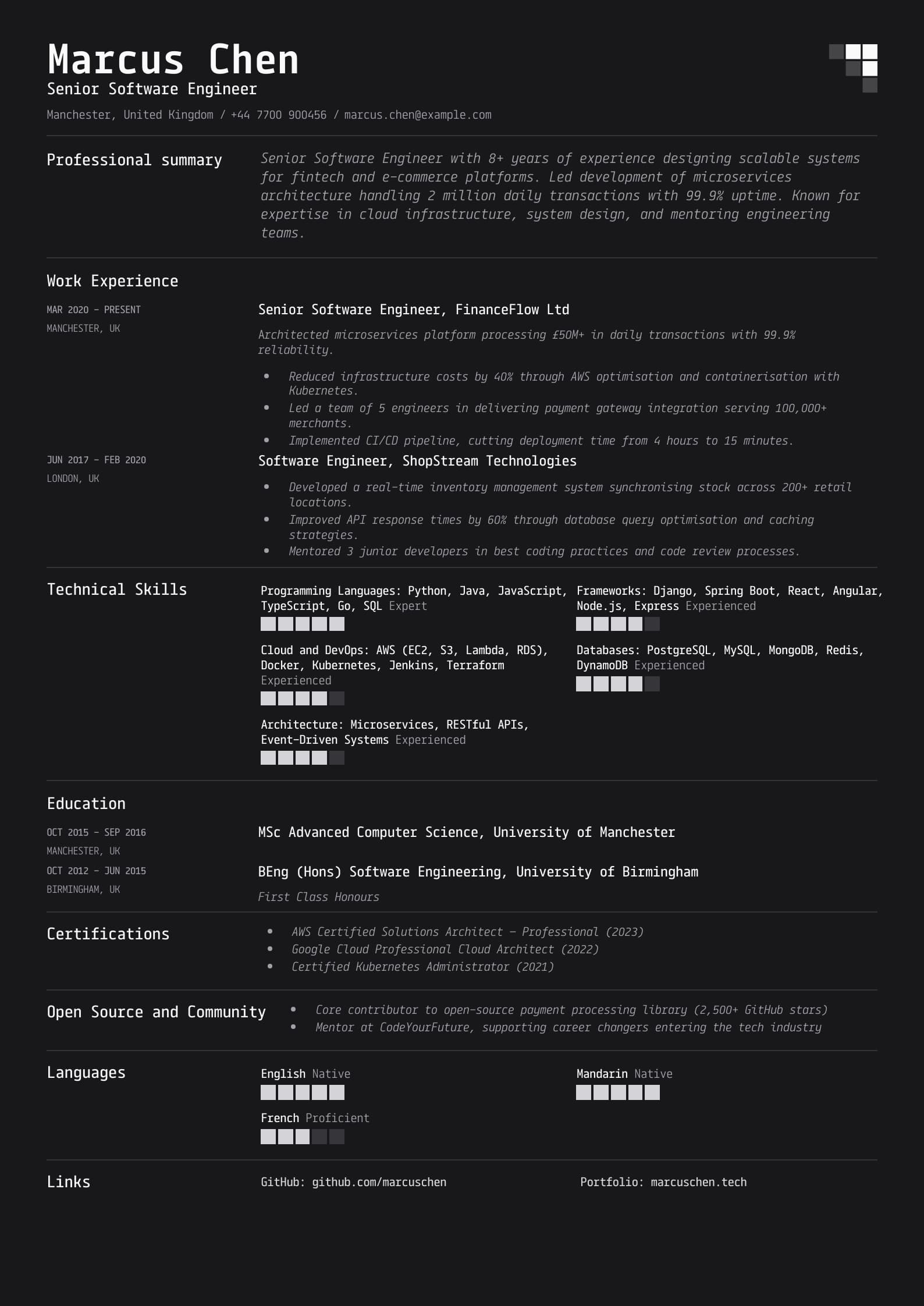
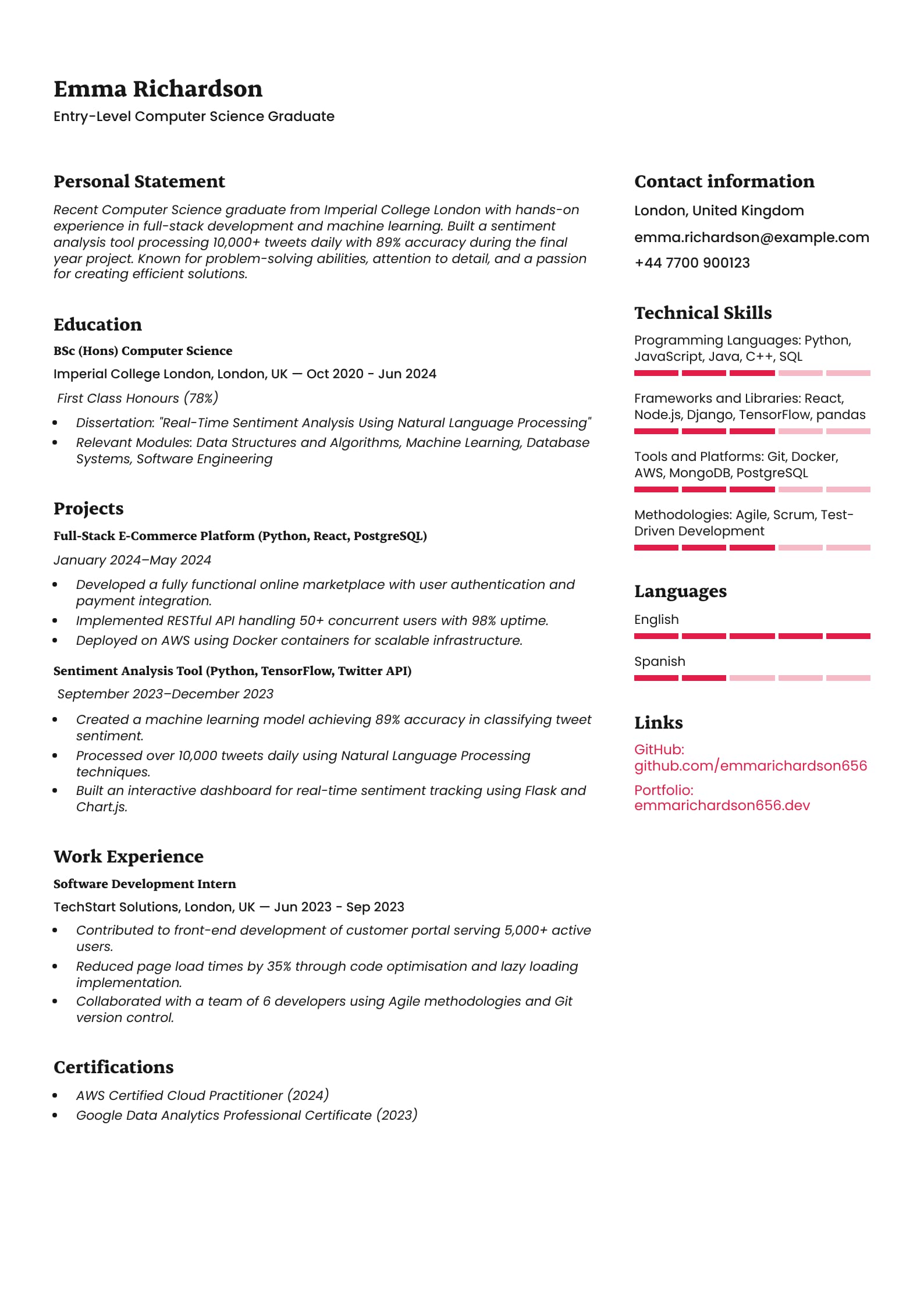
Before we start with writing tips and details, let's take a look at two computer science CV examples that can serve as a good guide for your own application document.
How to Write a Computer Science CV in 5 Simple Steps
To write a computer science CV, you should choose the right format, add contact details with a headline, highlight relevant skills, showcase work experience and projects, and include education and certifications. Additionally, you should add portfolio links and other relevant sections if necessary.
The best computer science CV format is reverse chronological, as is the case with application documents for most professions. This format is the most common and easiest to follow because it lists your past professional and academic experiences starting from the most recent and relevant one.
Now, let's examine how to write a computer science CV in more detail:
#1. Add Your Contact Details and Headline
Contact information is a crucial section of your CV because it provides recruiters with the details they need to reach you with an interview invitation. As a result, it's placed at the very top of the application, where they can immediately see it.
Typically, the header contains your name, address, phone number, email address, and, optionally, LinkedIn profile or professional website.
For computer science CVs, you should also include your GitHub profile, as it’s crucial for demonstrating your coding abilities. According to statistics, more than 100 million developers use this platform, and a decent portfolio on it could make you stand out.
Here is what this section could look like in practice:
Contact Information Section
Contact Information
Sarah Mitchell Edinburgh, United Kingdom sarah.mitchell@example.com +44 7700 900789 LinkedIn: linkedin.com/in/sarahmitchell555 GitHub: github.com/sarahmitchell555 Portfolio: sarahmitchell555.dev
Next is a personal statement; essentially, a brief snapshot of your key skills, achievements, and experiences. This section is very short (only 4–5 lines), so every word counts. As a result, many job seekers struggle to write an effective one that immediately hooks recruiters.
A good approach is to write down your job title, one relevant achievement, one or two traits that define your working style, and years of experience in the industry. Then, you need to combine these into a short story using action verbs and professional language.
Also, try to add measurable results to your achievement for additional impact. For instance, mention the number of users your application serves or the percentage improvement in system performance.
Take a look at our example if you're still not sure what to do:
CV Summary Example
Professional Summary
Full-stack developer with 5 years of experience building scalable web applications for e-commerce and SaaS platforms. Developed microservices architecture handling 500,000+ daily active users with 99.8% uptime. Known for clean code practices, performance optimisation, and creating intuitive user experiences.
#2. Highlight Relevant Skills
Though the skills section looks very simple, it's actually another one that employers are particularly interested in on computer science CVs. So, think carefully about what you have to offer and list your relevant capabilities as bullet points.
Standard practice is to start with hard, industry-specific skills and then move on to soft ones. So, for instance, your ability to program in Python would be a hard skill, while your problem-solving and communication abilities belong to the soft skills category.
Organise your computer science skills into clear categories for easy scanning:
Skills Section
Technical Skills
Programming Languages: Python, JavaScript, Java, C++, TypeScript, SQL
Frameworks and Libraries: React, Django, Node.js, Spring Boot, Express, TensorFlow
Tools and Platforms: Git, Docker, Kubernetes, Jenkins, AWS, Azure
Databases: PostgreSQL, MongoDB, MySQL, Redis, DynamoDB
Methodologies: Agile, Scrum, Test-Driven Development, CI/CD, Microservices
Soft Skills
Problem-solving
Technical communication
Team collaboration
Project management
Analytical thinking
#3. Showcase Work Experience and Projects
Work experience is the crucial section in a computer science CV, so you should pay particular attention to it and include all your relevant positions in reverse chronological order. Don't forget to include your job title, company name, and period of employment for each entry.
Furthermore, each experience should come with several bullet points elaborating on your achievements or responsibilities within the company. We suggest that you focus on accomplishments and back them up with measurable results, but if you can't think of anything, responsibilities can be just as helpful.
Don't go overboard with explanations, though. Each bullet point should be a brief sentence, and you shouldn't list more than six of these. If you have any additional information to share, you can include it in a cover letter.
This is what the work experience section should look like:
Work Experience Example
Work Experience
Software Engineer DataStream Technologies, London, UK January 2022–Present
Architected RESTful API handling 1M+ requests daily with 99.95% uptime using Python and FastAPI.
Reduced database query times by 60% through indexing optimisation and caching implementation.
Implemented CI/CD pipeline using Jenkins and Docker, cutting deployment time from 2 hours to 15 minutes.
Mentored 2 junior developers in code review practices and software design patterns.
For those with limited professional experience, the projects section becomes equally important. Treat substantial personal projects, university dissertations, and hackathon entries with the same level of detail you'd give a job role. Include links to GitHub repositories and live demos whenever possible.
When describing projects, include:
What problem you were solving
What technologies you used and why
What was the scale or complexity
What measurable outcomes you achieved
#4. Include Education and Certifications
The education section can go underneath the work experience or the skills section; it's up to you to decide what you want to emphasise. However, for recent graduates with limited or no work experience, education should be placed higher on the CV.
When writing about your education, include only your two latest degrees in the reverse chronological order. For example, if you have a master's degree, you don't need to add your GCSEs or A-levels to this section; your master's and bachelor's will suffice.
The education section on a computer science CV may look like this:
Education Section
Education
MSc Computer Science University of Edinburgh, Edinburgh, UK October 2022–September 2023 Distinction (Merit)
Dissertation: "Machine Learning Approaches to Network Security Threat Detection"
Relevant Modules: Advanced Algorithms, Distributed Systems, Artificial Intelligence
BSc (Hons) Computer Science University of Bristol, Bristol, UK October 2019–June 2022 First Class Honours (75%)
Certifications demonstrate ongoing professional development and specialised expertise in particular technologies. They're especially valuable in cloud computing, data science, and cybersecurity, where industry-recognised credentials matter. List certifications separately, like this:
Certifications Example
Certifications
AWS Certified Solutions Architect – Associate (2024)
Google Professional Cloud Architect (2023)
Microsoft Certified: Azure Developer Associate (2023)
Oracle Certified Professional: Java SE 11 Developer (2022)
Popular platforms offering valuable certifications include Coursera, edX, Google Cloud Skills Boost, AWS Training, and Microsoft Learn.
#5. Add Portfolio Links and Extras
Aside from these key sections, you can include others, like portfolio links, GitHub repositories, hackathons, open-source contributions, or anything else you find relevant. These can be especially useful if you don't have extensive work experience, as they can pad out your CV.
Your GitHub profile provides tangible proof of your capabilities beyond what words on a CV can convey. Before sending applications, audit your GitHub to ensure it reflects your best work:
Pin your 3-5 most impressive repositories to your profile
Write comprehensive README files explaining what each project does
Include screenshots or GIFs demonstrating functionality
Archive or make private any experimental or low-quality code
Beyond GitHub, consider including:
Live Demos: Deploy web applications using free hosting services like Vercel, Netlify, or Heroku
Portfolio Website: Showcase your best projects with detailed case studies
Technical Writing: Include links to articles you've written on Medium or Dev.to
Hackathons and Competitions: Include competition wins with brief descriptions and project repositories
Open-Source Contributions: Link to pull requests you've submitted to popular projects
Here is how you can showcase your portfolio:
Portfolio Example
Portfolio and Projects
Task Management Application – Full-stack app built with React, Node.js, and MongoDB Live Demo | GitHub
Machine Learning Price Predictor – Python model achieving 92% accuracy GitHub
Additional Experience
First Place, Manchester Tech Hackathon 2024 – Built a healthcare appointment system
Technical Mentor, CodeFirstGirls – Taught Python programming to 30+ women
Speaker, University Tech Society – Presented on "Building Scalable APIs"

How to Write a Computer Science CV With No Experience
If you have no prior experience in computer science, you obviously won't be able to emphasise your work experience section. Instead, you should focus on your education, skills, projects, and other strengths you might possess to compensate for what you lack.
It's particularly important to highlight soft and transferable skills, as they make you more employable in general. So, mention teamwork, communication, problem-solving, analytical thinking, and other skills that could help you thrive in the tech industry.
Here are some additional tips for writing a computer science CV without experience:
Focus on academic projects. Treat your university coursework and final year projects as work experience. Frame them professionally with measurable outcomes.
Include internships and placements. Even short summer internships provide legitimate professional experience that demonstrates you've worked in real development teams.
Volunteer your coding skills. Offer to build websites for local charities or community organisations. These real-world projects provide portfolio pieces.
Participate in hackathons. These events provide intensive project experience and networking opportunities, even if you don't win.
Contribute to open-source projects. Start with "good first issue" tags on GitHub to find beginner-friendly contribution opportunities.
Emphasise academic achievements. First-class honours, academic prizes, or particularly challenging modules with distinction prove intellectual capability and work ethic.
4 Common Mistakes to Avoid in Your Computer Science CV
Let's examine the most common mistakes to avoid in a computer science CV:
#1. Using Generic, Copy-Paste CVs
Though your skills and professional background remain the same, it's never a good idea to apply to multiple positions using one CV. If you do, your application will appear generic and won't stand out much from everyone else's.
Instead, tailor your CV for each application by highlighting the most relevant skills, experiences, and achievements that relate to the position. Adjust your personal statement to reflect the company's focus and reorder your skills to prioritise those mentioned in the job description.
#2. Listing Too Many Irrelevant Skills
Many candidates make the mistake of listing every programming language, framework, and tool they've ever encountered, thinking more equals better. This approach backfires by diluting your expertise and suggesting you lack depth in any particular area.
Be selective; list technologies you're genuinely proficient in and can discuss confidently during technical interviews. If you haven't used a technology in over two years, consider removing it unless it’s highly relevant to the role.
#3. Missing Measurable Results
Measurable results give weight to your claims and specificity to your CV. Avoid vague descriptions like "Developed web application using React and Node.js." Instead, write: "Developed customer portal using React and Node.js, reducing support ticket resolution time by 40% and serving 5,000+ monthly users."
You don't have to force yourself to include metrics in every bullet point, but don't entirely leave them out either.
#4. Poor Formatting and Non-ATS-Friendly Layout
Even if the content is excellent, poor formatting can significantly hurt your chances of securing an interview. Badly formatted CVs often don't reach recruiters; they get filtered out by the applicant tracking system (ATS), which may not be able to read them.
Common formatting mistakes that break ATS parsing include:
Using complex graphics, tables, or columns that confuse parsers
Saving in uncommon file formats rather than standard PDF or Word documents
Including information in headers or footers that systems can't read
Using fancy fonts or excessive formatting
Creating two-column layouts that scramble when parsed
Stick to clean, simple formatting with clear section headings, standard fonts like Calibri or Arial, and straightforward bullet points.
Create a Job-Winning CV With Ease
If you need additional help writing your computer science application, use our CV builder to generate one within minutes. All you need to do is enter the required information and choose a CV template that suits your needs; you'll have a submission-ready document in no time!
Final Thoughts
Your computer science CV is the first impression you make on hiring managers. Therefore, showcasing projects with measurable outcomes, highlighting relevant technical skills, and demonstrating real-world impact through quantified achievements helps you position yourself as a candidate worth interviewing.
A CV shouldn’t be static; it should evolve as you gain new skills and complete new projects. As you could see, the most successful computer science CVs don't just list technologies; they tell a coherent story about a developer who solves problems, builds solutions, and creates value through code.
Computer Science CV FAQs
#1. How long should a computer science CV be?
A computer science CV should be 1–2 pages long, depending on your experience level. Recent graduates and those with fewer than three years of experience should aim for one page, focusing on education, projects, and key skills. More experienced developers can extend to two pages to accommodate substantial work history and technical achievements.
#2. Should I include GitHub or portfolio links?
Yes, you should include your GitHub and portfolio links on your computer science CV. These provide tangible proof of your coding abilities and allow recruiters to assess your work quality before interviews. However, only include them if they showcase your skills positively.
#3. Which skills make a computer science CV stand out?
Skills that make a computer science CV stand out include proficiency in sought-after programming languages (Python, JavaScript, Java), cloud platforms (AWS, Azure, Google Cloud), containerisation (Docker, Kubernetes), and popular frameworks (React, Django, Spring Boot). However, technical skills alone aren't sufficient, as employers increasingly value developers who communicate effectively, collaborate well in teams, and approach problems analytically.
#4. How to list technical projects effectively?
To list technical projects effectively, use the same structured approach as professional work experience. Include project name, technologies used, dates, and 3-4 bullet points describing your contributions and measurable outcomes. Each bullet should follow this formula: action verb + specific technical contribution + quantifiable result.