
A chemist CV is your entry ticket to research laboratories, pharmaceutical companies, or industrial settings. It's more than just a list of qualifications; it's a strategic document that demonstrates your technical expertise, analytical capabilities, and contribution to scientific advancement.
Regardless of whether you're a recent graduate or an experienced research chemist, your CV must strike the right balance between your skills and achievements, demonstrating them in a clear, compelling way.
In this article, we'll show you how to write a chemist CV that gets noticed, provide two outstanding examples, and highlight common mistakes that could cost you an interview.
Key Takeaways
A chemist CV should emphasise laboratory techniques, research experience, and measurable scientific contributions.
Entry-level chemists can compensate for limited experience by highlighting coursework, internships, and transferable analytical skills.
The reverse-chronological format works best for laboratory CVs, as it allows recruiters to track your career progression and relevant experience.
Including publications, patents, and specialised certifications significantly strengthens your application in competitive fields like pharmaceuticals and research.
2 Real-World Chemist CV Examples
Before we examine writing strategies in detail, let's look at two chemist CV examples that demonstrate what works in practice. The first targets entry-level positions, whilst the second showcases how experienced professionals should present their credentials.
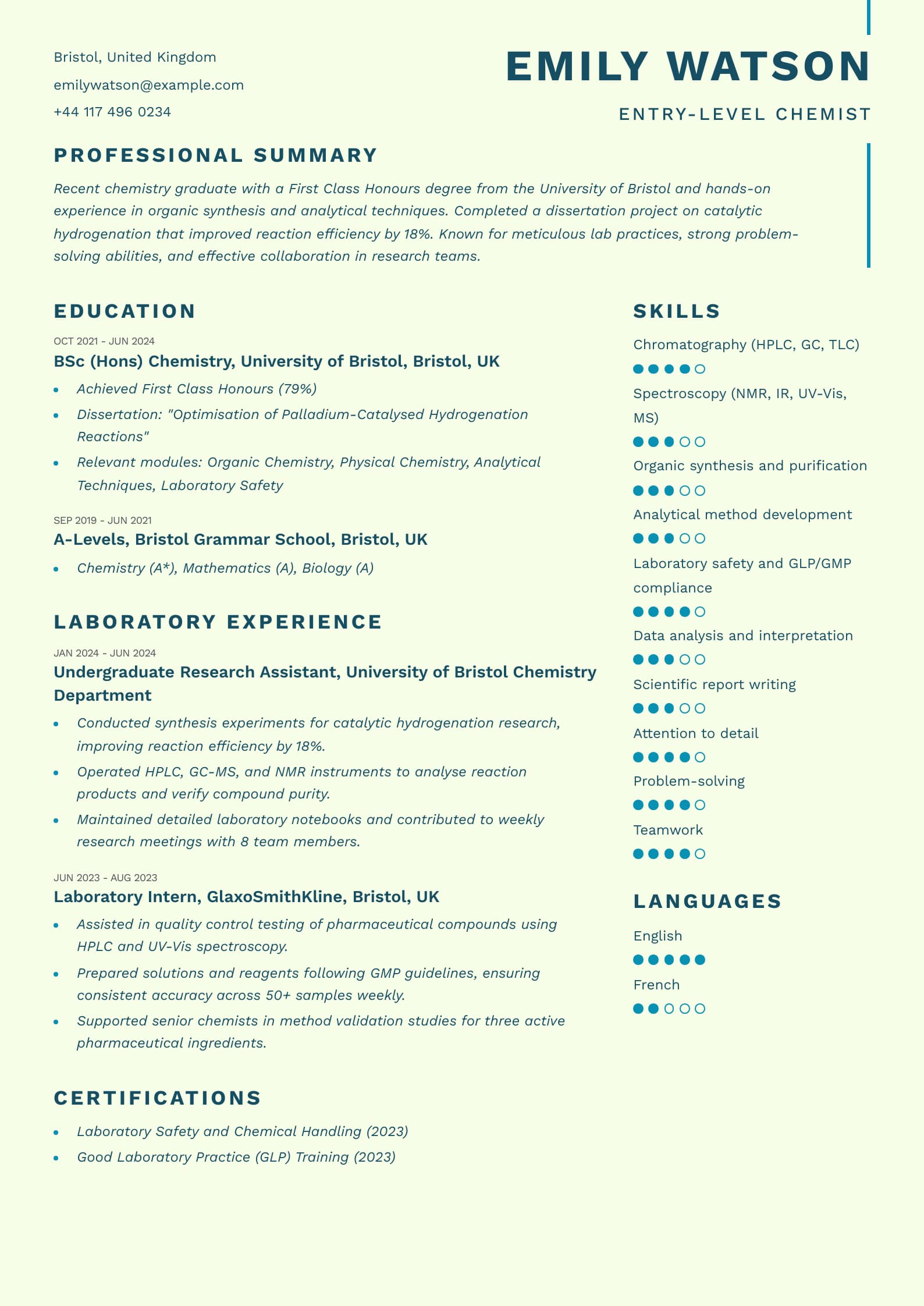
This CV example immediately establishes credibility through strong academic performance and relevant laboratory experience.
The quantified achievement in the dissertation (“18% efficiency improvement”) demonstrates practical impact, whilst the inclusion of specific instruments and techniques shows technical competency.
Additionally, the internship position at a pharmaceutical company adds industry exposure, making this candidate competitive despite limited professional experience.
Experienced Chemist CV
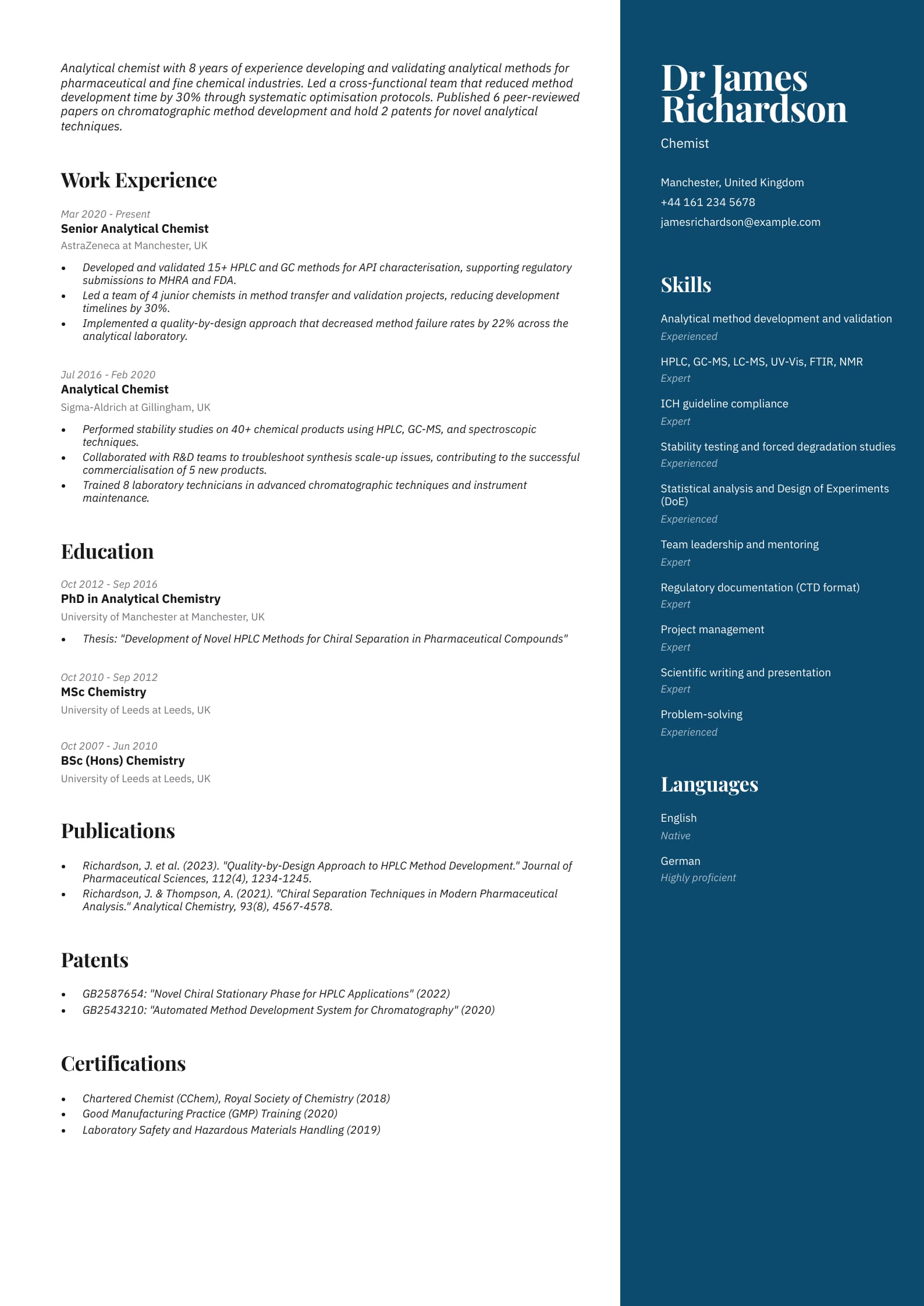
Here’s a seasoned analytical chemist CV you can use for inspiration:
This chemist CV example demonstrates career progress and leadership, with quantified achievements that prove impact (30% reduction in development time, 22% decrease in method failures).
The inclusion of publications and patents establishes scientific credibility, whilst the blend of technical skills and regulatory knowledge makes this candidate attractive to pharmaceutical employers.
How to Write a Chemist CV: A Step-by-Step Guide

To write a chemist CV that will help you land an interview, you need to highlight technical expertise and research contributions in a chemist CV format that's both scannable by recruiters and comprehensive.
The reverse chronological format works best for most chemistry roles because it showcases your career progression and allows employers to quickly assess your most recent and relevant experience.
Now, let's examine how to write each section effectively:
#1. Add Your Contact Details and Professional Headline
Your contact information should sit at the top of your CV header, where recruiters can immediately see it. For chemists, this section carries additional importance because you may need to include links to publications, research profiles, or online portfolios.
Include these essential details:
CV Header Details
Full name
Location (city and country)
Professional email address
Phone number
LinkedIn profile
ORCID or ResearchGate profile (for research positions)
Online portfolio or publication list (if relevant)
Avoid adding personal information like date of birth, marital status, or photograph unless specifically requested. These details aren't standard practice in the UK and can introduce unconscious bias.
Here's what a proper contact section looks like:
Contact Section Example
Contact Information
Dr Sarah Mitchell Cambridge, United Kingdom sarahmitchell@example.com +44 1223 456 789 LinkedIn: linkedin.com/in/drsarahmitchell ORCID: 0000-0002-1234-5678
Following your contact details, include a professional summary that captures your expertise in 3–4 lines. This isn't the place for vague statements about being "hardworking" or "passionate"—focus on your specialisation, years of experience, and one standout achievement.
A strong professional summary follows this formula:
Sentence #1: Your title, specialisation, and years of experience
Sentence #2: Your most significant achievement with measurable results
Sentence #3: Key skills or areas of expertise that match the role
Here's what that looks like in practice:
CV Summary Example
Professional Summary
Analytical chemist with 6 years of experience in pharmaceutical quality control and method development. Reduced testing turnaround times by 25% through the implementation of automated HPLC systems across three production sites. Specialised in chromatographic techniques, regulatory compliance, and cross-functional laboratory management.
#2. Highlight Relevant Skills
The skills section is where you demonstrate your technical capabilities and professional competencies. For chemists, this means balancing hard skills—the specific techniques, instruments, and methodologies you've mastered—with soft skills that show you can work effectively in research teams and communicate complex findings.
List 8–12 skills as bullet points, starting with technical competencies before moving to transferable abilities. Be specific: instead of writing "laboratory experience," specify "GC-MS analysis" or "protein purification using FPLC."
Hard skills for chemists include:
Hard Skills
Chromatography techniques (HPLC, GC, LC-MS, TLC)
Spectroscopy methods (NMR, IR, UV-Vis, mass spectrometry)
Synthetic chemistry and reaction optimisation
Analytical method development and validation
Laboratory safety and GLP/GMP compliance
Chemical characterisation and structure elucidation
Data analysis software (ChemDraw, MestReNova, Origin)
Quality control and assurance protocols
Meanwhile, some soft skills to emphasise would be:
Soft Skills
Attention to detail
Scientific writing and documentation
Problem-solving and troubleshooting
Collaboration and teamwork
Data interpretation and critical thinking
Communication of technical concepts
#3. Showcase Work Experience and Research Projects
Your work experience section is the cornerstone of your chemistry CV. This is where you prove you can apply theoretical knowledge in real-world settings, be it conducting research, developing pharmaceutical products, or ensuring quality control in industrial processes.
List your positions in reverse-chronological order, starting with your current or most recent role. Each entry should include your job title, employer, location, and dates of employment. Below that, add 3–6 bullet points describing your achievements, not just your responsibilities.
The difference matters. Saying "conducted HPLC analysis" tells recruiters what you did; saying "developed and validated 12 HPLC methods that reduced testing time by 40%" shows the impact you made.
You should also use action verbs like synthesised, analysed, developed, optimised, validated, and implemented to start each bullet point, and include quantifiable results whenever possible.
Here's what strong experience entries look like:
Work Experience Example
Work Experience
Research Chemist Pfizer UK, Sandwich, UK September 2019–Present
Synthesised and characterised 25+ novel compounds for oncology drug discovery programmes, contributing to 3 compounds advancing to preclinical studies.
Optimised synthetic routes that reduced reaction times by 35% and improved overall yields from 62% to 84%.
Collaborated with computational chemists and biologists on structure-activity relationship studies, presenting findings at 4 departmental seminars.
Analytical Chemist Johnson Matthey, Royston, UK June 2017–August 2019
Performed quality control testing on catalytic materials using XRD, BET, and ICP-MS techniques, processing 100+ samples monthly.
Developed a new analytical procedure for trace metal detection that improved sensitivity by 30% compared to existing methods.
Trained 5 junior technicians in proper instrument operation and safety protocols.
#4. Include Education and Certifications
For chemists, education credentials carry substantial weight, especially for research and pharmaceutical roles.
List your most recent degrees first, including the qualification type, dates, institution, and location. If you're a recent graduate, you can elaborate on your dissertation, relevant coursework, or academic achievements to compensate for limited work experience.
Here's how to structure your education section:
Education Section Example
Education
PhD in Organic Chemistry October 2016–September 2020 University of Oxford, Oxford, UK
Thesis: "Development of Asymmetric Catalytic Methods for C-H Activation"
Published 4 peer-reviewed papers during candidature
MSc Chemistry October 2014–September 2016 Imperial College London, London, UK
Distinction (78%)
BSc (Hons) Chemistry October 2011–June 2014 University of Edinburgh, Edinburgh, UK
First Class Honours (81%)
Certifications demonstrate your commitment to professional development and regulatory compliance. For chemists working in pharmaceuticals or regulated industries, certifications in GMP, GLP, or laboratory safety are highly valued.
Furthermore, if you hold professional designations like Chartered Chemist (CChem) from the Royal Society of Chemistry, include these prominently; they signal recognised expertise in your field.
List certifications like this:
Certifications Example
Certifications
Chartered Chemist (CChem), Royal Society of Chemistry (2021)
Good Manufacturing Practice (GMP) Training (2022)
Advanced NMR Spectroscopy, RSC Short Course (2020)
Laboratory Safety and Chemical Handling (2019)
#5. Add Publications, Patents, and Extras

This section sets you apart from other candidates, particularly in research-heavy roles.
Publications demonstrate your ability to conduct rigorous scientific work and communicate findings to the broader scientific community. Meanwhile, patents show innovation and practical application of your research.
List publications in a standard academic format (author names, year, title, journal, volume, pages). If you have numerous publications, include only the most relevant or impactful ones on your CV and note that a complete list is available upon request.
Here's how to format this section:
Publications, Patents, and Extras Example
Publications
Watson, E. M. et al. (2024). "Novel Approaches to Asymmetric Hydrogenation Using Palladium Catalysts." Chemical Communications, 60(12), 1567-1570.
Watson, E. M. & Davies, R. J. (2023). "Mechanistic Insights into C-H Activation Reactions." Journal of Organic Chemistry, 88(6), 3421-3435.
Patents
GB2598765: "Improved Catalytic System for Selective Hydrogenation" (2024)
Conference Presentations
"Catalytic Hydrogenation: New Methodologies and Applications" – RSC Organic Division Meeting, Manchester (2024)
Other optional sections worth considering include:
Professional memberships (e.g., Royal Society of Chemistry, American Chemical Society)
Awards and honours (academic prizes, research grants, scholarships)
Relevant coursework (for recent graduates emphasising specific technical training)
Languages (particularly valuable for international pharmaceutical companies or research collaborations
These additions help round out your profile, but only include them if they're genuinely relevant to the position you're targeting. A focused, concise CV typically performs better than one padded with tangential information.
Common Mistakes to Avoid in Your Chemist CV
Even strong candidates can undermine their applications through easily avoidable CV errors. Here are the most frequent mistakes we see in chemist CVs:
Using generic chemist CV templates that don't showcase technical skills. Many generic versions don't allow sufficient space to detail laboratory techniques, instrumentation, or research methodologies. Chemistry roles require demonstration of specific technical competencies, so ensure your template has room for a robust skills section and detailed project descriptions.
Failing to highlight lab techniques and research experience. Some chemists mistakenly assume that simply listing job titles or degrees is sufficient, but that’s not true. Recruiters need to see exactly which instruments you can operate, which techniques you've mastered, and what type of research you've conducted.
Poor formatting that makes your CV difficult to scan. Dense paragraphs, inconsistent formatting, or unusual CV fonts can cause them to move on before they grasp your qualifications. Use clear headings, bullet points, and adequate white space. Plus, stick to professional fonts like Calibri, Arial, or Times New Roman, and keep your CV length to 2 pages for most positions.
Omitting measurable achievements or notable projects. Describing responsibilities without showing impact makes your CV blend into the pile. Therefore, numbers, percentages, and specific outcomes transform generic descriptions into compelling evidence of your capabilities.
Create a Professional CV Within Minutes
If you need additional support crafting your chemistry job application, use our CV builder to create a polished document in under 15 minutes. Our platform offers templates optimised for scientific roles, ensuring your technical skills and research experience get the attention they deserve!
Final Thoughts
Writing an effective chemist CV requires balancing technical precision with clear communication. Your document should showcase laboratory skills, research contributions, and analytical capabilities whilst remaining accessible to recruiters who may not share your chemical expertise.
Your CV must demonstrate both your scientific competence and your ability to contribute meaningful results. Therefore, you need to follow the structure we've outlined, learn from the examples provided, and avoid common pitfalls. This way, you'll significantly improve your chances of landing interviews for your ideal chemistry position!
Chemist CV FAQs
#1. How long should a chemist CV be?
A chemist CV should typically be up to 2 pages long, which provides sufficient space to detail your technical skills, work experience, education, and relevant projects. Recent graduates can often fit everything on a single page, whilst senior chemists with extensive publications or patents may even extend to 3 pages.
#2. Should I include lab techniques and instruments?
Yes, you should include specific laboratory techniques and instruments because these details demonstrate your practical capabilities and help you pass applicant tracking system (ATS) scans that search for technical keywords. For example, you can list chromatography methods (HPLC, GC-MS), spectroscopic techniques (NMR, IR, mass spec), and any specialised equipment you're qualified to operate.
#3. What skills make a chemist CV stand out?
Skills that make a chemist CV stand out include advanced analytical techniques, method development, validation experience, regulatory compliance knowledge (GMP/GLP), and demonstrated ability to publish or patent research findings. Additionally, highlighting cross-functional collaboration, project management, and the ability to communicate complex chemical concepts to non-specialist audiences is a plus.