
A receptionist CV is your first chance to make a brilliant impression on potential employers—and in a role that's all about first impressions, that matters more than you'd think. Whether you're greeting visitors, managing phone lines, or keeping an office running smoothly, your CV needs to showcase the organisational skills, professionalism, and warm personality that make receptionists indispensable.
In this guide, we'll walk you through everything you need to know about creating a compelling receptionist CV, share real-world examples, and highlight the mistakes that could cost you an interview.
Key Takeaways
A receptionist CV should emphasise customer service skills, organisational abilities, and communication expertise, as these form the foundation of front-of-house roles.
The reverse chronological format works best for most receptionist applications, as it clearly demonstrates your career progression and most relevant experience.
Entry-level candidates can compensate for limited work experience by highlighting transferable skills, volunteer work, internships, and relevant coursework.
Common CV mistakes include using the same template for multiple applications, listing responsibilities rather than achievements, and poor formatting that fails ATS scans.
2 Receptionist CV Examples That Actually Work
Before we break down the writing process, let's look at two receptionist CV examples that demonstrate what employers actually want to see. The first shows how to present yourself as an entry-level candidate, whilst the second illustrates a more experienced professional's approach.

This CV works because it immediately addresses the potential concern of limited experience by leading with a strong volunteer role that demonstrates relevant skills. The professional summary doesn't just list qualities—it backs them up with a concrete achievement, while the work experience section uses specific numbers that make the work more tangible.
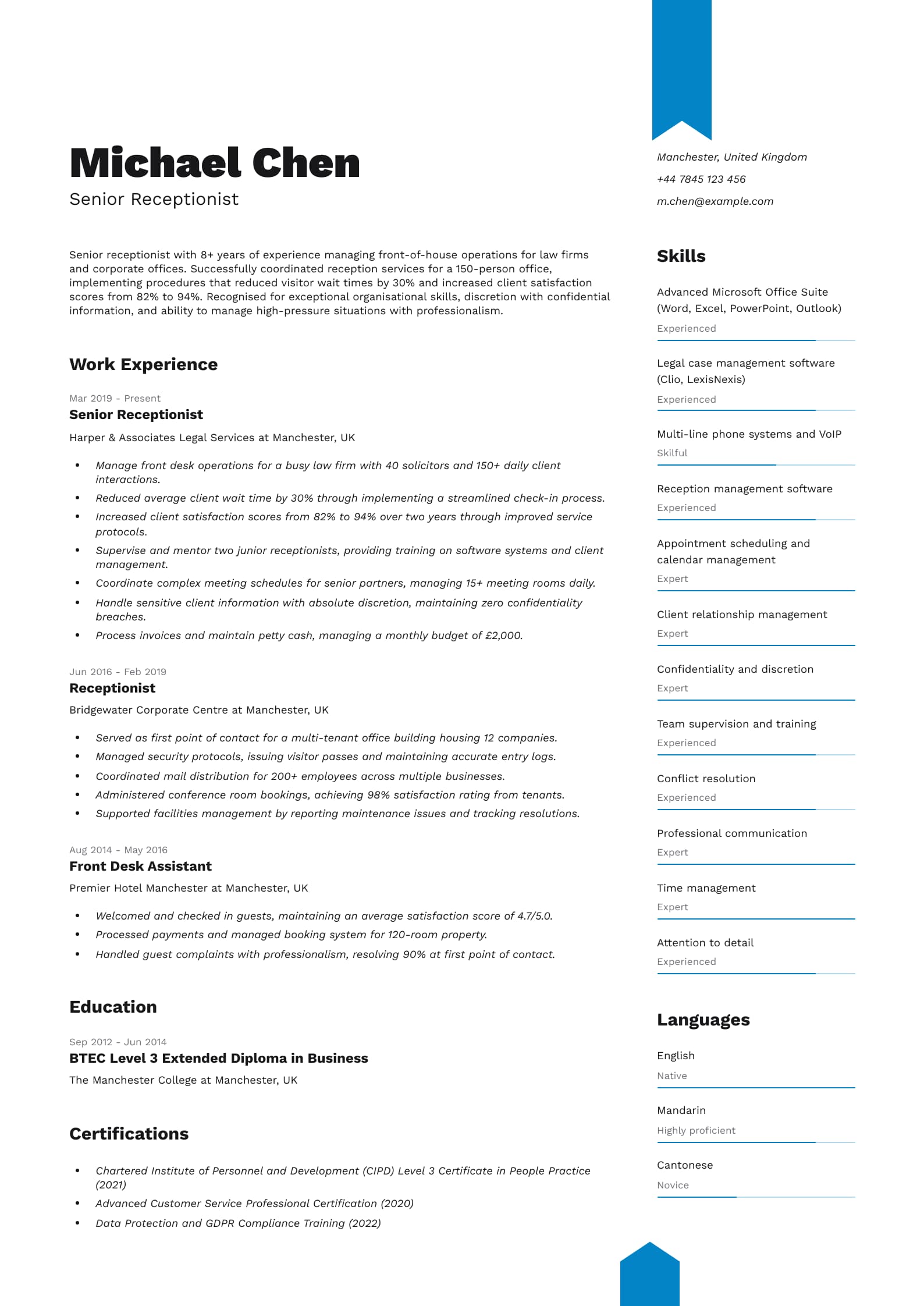
This CV example demonstrates exactly what senior-level receptionist applications should look like. Rather than simply listing duties. However, these aren't just numbers for show; they tell a story about someone who actively improves processes rather than just maintaining them.

How to Write a Receptionist CV: A Step-by-Step Guide
Writing a receptionist CV that actually gets you interviews isn't about following a rigid template. According to research, recruiters spend an average of 7.4 seconds on an initial CV review, so clarity and impact matter enormously. For receptionists specifically, the reverse chronological format works best because it immediately highlights the most relevant and recent experience.
Now, let's break down each essential section of your receptionist CV and look at what makes each one effective.
#1. Add Your Contact Details and a Headline
Your contact information represents the CV header, and whilst it might seem straightforward, you'd be surprised how many people get this wrong. Make sure to include:
CV Header
Full name
City and country
Phone number
Professional email address
LinkedIn profile (many recruiters will check it)
If your email address is something like "partygirl99@hotmail.com" or "footiefan123@yahoo.co.uk," create a new one using some variation of your name. First impressions matter in reception work, and your email address is part of that impression.
Here's what this looks like in practice:
Contact Information Example
Contact Information
Sarah Thompson London, United Kingdom sarah.thompson@example.com +44 7912 456 789 linkedin.com/in/sarahthompson-reception
Right beneath your contact details, you'll want a professional summary (sometimes called a headline or profile). This is your elevator pitch—3-4 sentences that capture who you are professionally, what you've achieved, and what you bring to a reception role.
If you’re an entry-level candidate, focus on your relevant education, any customer service experience (even if it's retail or hospitality), and key soft skills. On the other hand, if you're an experienced receptionist, lead with your years of experience, the types of environments you've worked in, and one or two quantifiable achievements.
That said, let's see a difference between a weak and a strong CV summary.
Weak Summary
Hardworking receptionist looking for a new opportunity. Good at answering phones and greeting visitors. Friendly and organised person who works well with others.
Strong Summary
Professional receptionist with 5 years' experience in corporate and medical environments. Streamlined patient check-in procedures at Riverside Medical Centre, reducing wait times by 25% whilst maintaining a 96% patient satisfaction rating. Known for remaining composed during high-pressure situations and creating welcoming first impressions that reflect positively on organisations.
The strong version doesn't just list qualities—it demonstrates them through specific examples and outcomes. It also uses industry-appropriate terminology (patient satisfaction rating, check-in procedures) that shows familiarity with reception work.
#2. Highlight Relevant Skills
The skills section is where you demonstrate that you understand what reception work actually involves. Many applicants make the mistake of listing vague soft skills like "good communicator" or "team player" without any context. Whilst these qualities matter, you need to be more specific—and you need to balance soft skills with hard, technical abilities.
For receptionists, hard skills might include:
Receptionist Hard Skills
Proficiency in Microsoft Office Suite (Word, Excel, Outlook)
Experience with multi-line phone systems
Appointment scheduling software (Calendly, Microsoft Bookings)
Basic bookkeeping or invoice processing
Touch typing speed (if particularly fast)
Specific reception management software used in your industry
Data entry and database management
Soft skills should focus on the interpersonal and organisational abilities that make reception work run smoothly, such as:
Receptionist Soft Skills
Professional communication (written and verbal)
Customer service excellence
Time management and prioritisation
Attention to detail
Discretion with confidential information
Remaining calm under pressure
Multitasking abilities
Problem-solving
Don't just list these randomly—organise them thoughtfully, starting with the most relevant technical skills, then moving to interpersonal abilities. Scan the job description for keywords and make sure your skills section reflects the specific requirements mentioned. Many companies use Applicant Tracking Systems (ATS) that scan for certain terms before a human ever sees your CV.
#3. Showcase Work Experience and Projects
This is the heart of your receptionist CV—the section where you prove you can actually do the job. The biggest mistake people make here is listing responsibilities rather than achievements. Recruiters already know what receptionists do; they want to know how well you did it.
Structure each role with your job title, company name, location, and dates of employment. The important thing is to show the impact you’ve made using action verbs and quantifiable results.
Now, let’s compare two examples:
Weak Example
Receptionist ABC Company, Leeds, UK January 2020–Present
Answered phones and transferred calls
Greeted visitors and signed them in
Scheduled meetings and managed calendars
Handled mail and deliveries
Maintained reception area
Strong Example
Receptionist ABC Company, Leeds, UK January 2020–Present
Managed front desk operations for a 100-person office, serving as first point of contact for 50+ daily visitors and 100+ phone enquiries.
Implemented a digital visitor management system that reduced check-in time by 40% and improved security compliance.
Coordinated complex calendar schedules for five senior executives, managing 30+ weekly meetings across three time zones with zero scheduling conflicts.
Increased customer satisfaction scores from 78% to 91% through improved telephone manner and more efficient query resolution.
Trained and mentored two junior receptionists on company protocols and software systems.
Notice how the strong example uses specific numbers (50+ visitors, 100+ calls, 40% reduction) and action verbs (managed, implemented, coordinated, increased, trained). Each bullet point tells a little story about initiative and impact rather than just describing duties.
If you're early in your career and don't have extensive reception experience, include relevant roles from retail, hospitality, or customer service. Frame these experiences through a reception lens, highlighting the skills that transfer.
#4. Include Education and Certifications
For most reception roles, you don't need an advanced degree—but you should list whatever formal education you have. Recent graduates should place education near the top of their CV (just after the professional summary), whilst experienced professionals can move it further down since work experience becomes more relevant.
List your qualifications in reverse chronological order, including the qualification name, institution, location, and dates attended. For A-levels and GCSEs, you can simply list the subjects and grades without going into detail unless they're particularly relevant to the role.
If you completed any reception-related courses or projects during your studies, mention them. For instance:
Receptionist CV Education Section
Education
Level 3 Diploma in Business and Administration City College Manchester, Manchester, UK September 2021–June 2023
Achieved Distinction in Customer Service module
Completed project: "Optimising Reception Processes in Healthcare Settings"
A-Levels: Business Studies (B), English Language (A), Psychology (C) Manchester Grammar School, Manchester, UK September 2019–June 2021
Certifications can give you an edge, particularly if you're competing with candidates who have similar experience levels. Relevant certifications for receptionists include:
Relevant Certifications
Customer Service Excellence certificates
First Aid at Work
CIPD qualifications (particularly Level 3 in People Practice for those in HR-adjacent roles)
Microsoft Office Specialist certifications
Data Protection and GDPR training
Even if a certification isn't mandatory for the role, it demonstrates initiative and professional development—qualities that employers value. Online courses from LinkedIn or FutureLearn count too, especially if they're relevant to the specific industry you're targeting.
#5. Consider Adding Other Sections
Once you've covered the essentials, you might have room for additional sections that make you stand out. These are particularly useful for entry-level candidates who need to pad out their CV, but even experienced professionals can benefit from showcasing achievements beyond standard work history.
Language skills are incredibly valuable for reception roles, especially in international businesses or diverse urban areas. If you speak multiple languages, list them with your proficiency level:
Other Sections
Languages
English – Native
Polish – Fluent
French – Conversational
Furthermore, volunteer work can demonstrate initiative and community involvement whilst also showcasing transferable skills. If you've volunteered at events, helped with school fundraisers, or assisted at community centres, these experiences often involve the same skills receptionists use daily.
Awards and recognition deserve their own section if you've received formal acknowledgements—Employee of the Month, Customer Service Excellence awards, or commendations for specific achievements.
Professional memberships might be relevant if you're part of organisations like the Institute of Administrative Management or similar professional bodies.
Don't include hobbies and interests unless they're directly relevant to the role or demonstrate leadership (like captaining a sports team) or community involvement. The days of listing "reading, socialising, and watching films" on your CV are long gone—use that space for information that actually strengthens your application.
4 Common Mistakes to Avoid on a Receptionist CV
Even strong candidates sometimes undermine their applications through avoidable mistakes. Here are the four most common CV pitfalls and how to sidestep them.
Generic templates that look outdated. Whilst you don't need an elaborate design, your CV should look clean, professional, and current. Use a simple, modern layout with clear headings, consistent formatting, and plenty of white space. Professional CV templates can give you a good starting point—just make sure you customise them rather than filling in a template and calling it done.
Writing about responsibilities instead of achievements. We've touched on this already, but it bears repeating because it's such a common error. Every bullet point in your work experience section should answer the question: "So what?" If a statement could appear on anyone's CV, it's not specific enough.
Ignoring ATS optimisation. Applicant Tracking Systems scan for keywords from the job description, so if your CV doesn't include relevant terms, it might never reach a recruiter's desk. This doesn't mean stuffing your CV with keywords randomly—that's obvious and off-putting. Also, keep your formatting simple, i.e. avoid tables, text boxes, headers, and footers (beyond basic contact information). Stick to standard fonts, use bullet points rather than symbols, and save your CV as a .docx or PDF file unless the job listing specifies otherwise.
Failing to tailor your application. Read each job description carefully and adjust your CV accordingly. If the listing emphasises discretion and confidentiality, make sure your CV highlights experiences where you've handled sensitive information. If they want someone with strong IT skills, emphasise your software proficiencies. This doesn't mean rewriting your entire CV each time—just tweaking the emphasis to align with what that particular employer values.
For more advice on crafting a standout resume, read our CV tips guide.
Create Your Professional Receptionist CV
If you're still feeling stuck or want to save time whilst ensuring your CV meets professional standards, use our CV builder to create a polished application in minutes. It guides you through each section, suggests industry-specific phrases, and formats everything properly—no design skills or technical knowledge required.
Final Thoughts
Writing a receptionist CV that actually gets you interviews isn't about having the perfect career history—it's about presenting your genuine strengths in a clear, professional way that immediately shows employers you understand what the role involves.
Remember that reception work is fundamentally about people—greeting them warmly, solving their problems efficiently, and creating positive first impressions. If your CV creates that same positive first impression of you as a candidate, you're already halfway to landing the interview. Take the time to craft each section thoughtfully, write a good receptionist cover letter to strengthen your case, and make sure to avoid the common mistakes we've discussed.
Receptionist CV FAQs
#1. How do you describe a receptionist on a resume?
Describe your reception work through specific achievements rather than generic duties. Focus on the scale of your responsibilities, the skills you used, and any measurable improvements you made.
#2. Should I include volunteer work?
Absolutely—volunteer work is particularly valuable for entry-level candidates or those changing careers, as it demonstrates initiative and often involves directly relevant skills. Treat volunteer reception or customer service roles exactly as you would paid employment, with the same level of detail about your responsibilities and achievements. Just be clear about the voluntary nature of the role.
#3. What's the ideal length for a receptionist CV?
For most reception roles, one page is ideal if you have less than five years' experience; two pages maximum for senior positions or extensive career histories. If you're struggling to fit everything on two pages, you're probably including information that isn't relevant to the role you're applying for.