
Knowing how to write a nurse CV can help you secure a job even in a field as competitive as healthcare in the UK. The key is to focus on your skills, qualifications, and measurable achievements; these can help you stand out more than discussing your past responsibilities.
In this article, we will show you how to write a CV for a registered nurse, provide a good example, and share some tips to help you gain an edge over the competition.
Key Takeaways
Employers want to see clinical experience, soft skills, measurable achievements, and relevant qualifications in a nurse CV.
Key sections of a nurse CV are contact information, a personal statement, professional experience, education, skills, and certifications. Others can be added when relevant.
To make your nurse CV stand out, you should include quantifiable patient care outcomes, pay attention to formatting, discuss mentorship experiences, avoid writing too much, and follow ATS-friendly practices.
What Employers Look For in a Nurse CV
In a nurse CV, employers look for clinical experience, relevant qualifications, highly developed soft skills, and proof of success through measurable patient outcomes.
In this regard, a nurse CV is similar to other CVs, but it focuses on patient care. As a result, you should discuss the skills related to it, such as empathy, communication, problem-solving, and teamwork, as well as relevant achievements, like patient satisfaction and reduced wait times.
Furthermore, this kind of CV should always include the Nursing and Midwifery Council (NMC) registration details. These are mandatory for practising nurses in the UK, so employers look for this information immediately when reviewing your CV.
Nurse CV Example
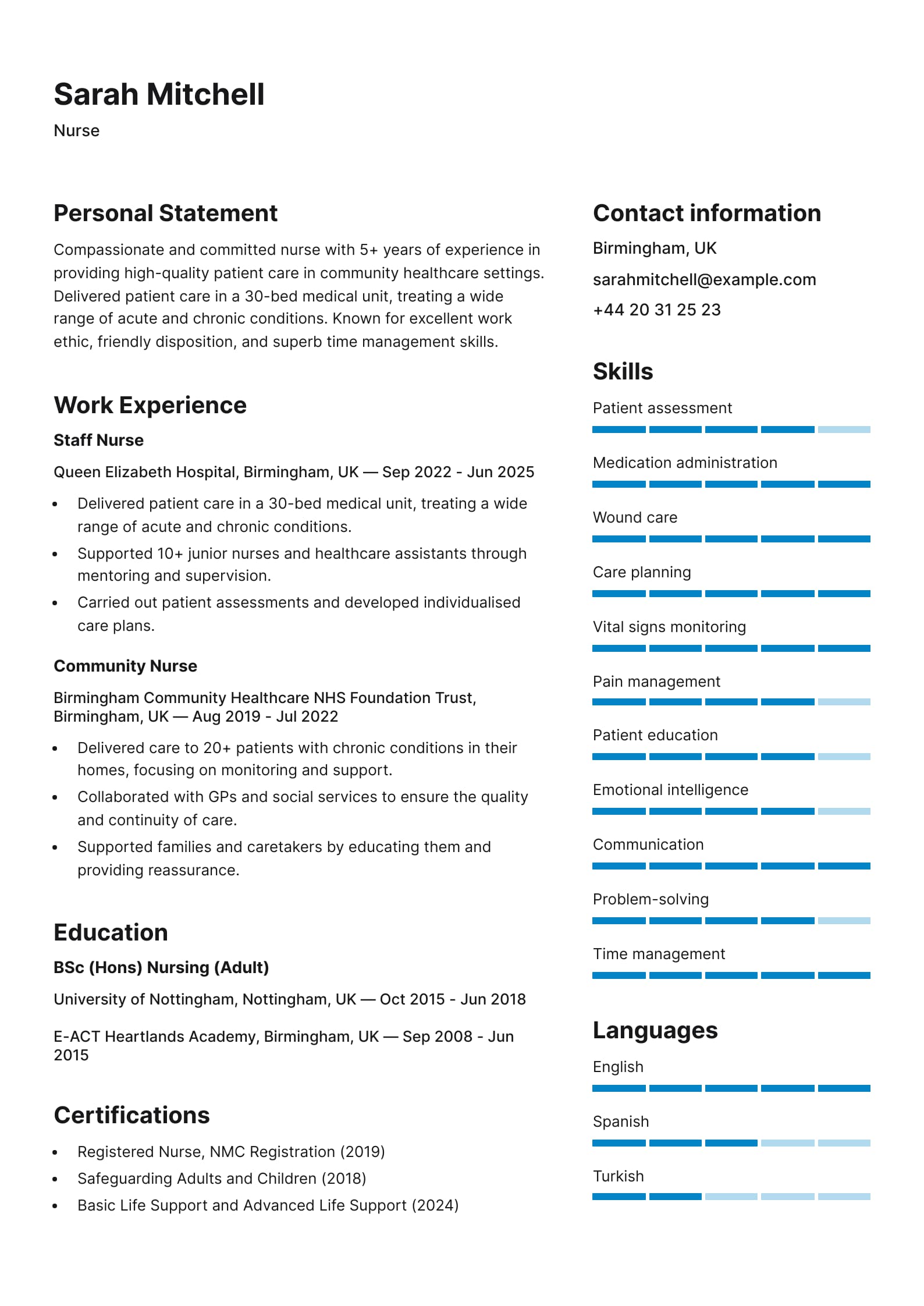
Before we examine writing tips in detail, we’ll provide a nurse CV example to serve as inspiration and illustrate the points we will make in the next section:
Key Sections of a Nurse CV and How to Write Them
Key sections of a nurse CV include contact information, personal statement, skills, professional experience, education and qualifications, and certifications and training. Additionally, you may add projects, references, languages, or anything else you deem relevant.
That said, let’s take a look at each section in more detail:
#1. Contact Information and Personal Statement
Contact information and a personal statement should be placed at the top of your CV, where recruiters can immediately see them, even before they start reading through the document. These two sections give basic information about you, so you should consider carefully what to include.
For starters, contact information should contain the following details:
Mandatory Details
Full name
Address
Email address
Phone number
LinkedIn profile (optional)
NMC registration
NMC PIN
In general, nurses are advised to include their NMC registration details in their contact information. That way, potential employers can immediately see that you are qualified to work as a nurse, and your chances of being invited for an interview increase exponentially.
As for the personal statement, you should keep it short (4–5 lines at most) and still pack it with information. Think of it as a concise overview of your CV; it should summarise its most essential parts and convince recruiters to keep reading.
So, make sure to include your title, relevant experience, skills, and the most significant achievement. When writing about your accomplishments, be as specific as possible; it’s best to support them with measurable results to give validity to your claims.
Here’s what these two sections should look like in practice:
Contact Information and Personal Statement Example
Contact Information
Sarah Mitchell Birmingham, United Kingdom sarahmitchell@example.com +4420312523 NMC Registration: Adult Nurse PIN: 13D23112F
Personal Statement
Compassionate and committed nurse with 5+ years of experience in providing high-quality patient care in community healthcare settings. Delivered patient care in a 30-bed medical unit, treating a wide range of acute and chronic conditions. Known for my excellent work ethic, friendly disposition, and superb time management skills.
#2. Skills Section
The skills section should contain 6–10 of your most relevant capabilities, typically starting with hard skills and ending with soft skills. These should be presented in bullet points; short, straightforward, and without further elaboration.
Here is what a nurse’s skill section should look like:
Nurse CV Skills Example
Skills
Patient assessment
Medication administration
Wound care
Care planning
Vital signs monitoring
Pain management
Patient education
Emotional intelligence
Communication
Problem-solving
Time management
Organisation
#3. Professional Experience
Along with the skills section, professional experience is typically the part employers are particularly interested in. After all, this section demonstrates how you applied your skills in past roles and the contributions you made.
The work experience section should be organised in a reverse chronological order, meaning that you should start from your most recent job and work your way back. That way, recruiters can easily track your career progression and immediately see the most relevant information.
Each entry should come with bullet points listing some of your most significant achievements, accompanied by measurable results. However, you shouldn’t write too much; 3–6 bullet points and one sentence per accomplishment is enough.
Considering your space is limited, ensure each word counts. That’s why it’s best to use strong action verbs when describing your accomplishments; for instance, “provided,” “delivered,” or “administered”.
In fact, here is a more comprehensive list of possible verbs to use:
Advised
Assisted
Analysed
Managed
Operated
Monitored
Facilitated
Performed
Diagnosed
Conducted
Coordinated
Collaborated
Implemented
Here’s a good example of the work experience section on a nurse CV:
Work Experience Example
Work Experience
Staff Nurse Queen Elizabeth Hospital Birmingham, UK September 2022–June 2025
Delivered patient care in a 30-bed medical unit, treating a wide range of acute and chronic conditions.
Supported 10+ junior nurses and healthcare assistants through mentoring and supervision.
Carried out patient assessments and developed individualised care plans.
#4. Education and Qualifications
The education and qualifications section should contain your two most recent nursing degrees, along with the institutions where you’ve obtained them and graduation dates. In other words, if you have a master’s and a bachelor’s degree, you don’t have to mention your secondary school, as it’s generally irrelevant and may only take up space.
As a rule, you should keep this section short and simple if you have sufficient work experience; but if not, it can be your trump card. In such a case, you can elaborate on your education by adding bullet points here and discussing your grades, projects, awards, or anything else that might boost your chances.
Here’s an example of a good education section:
Education Section Example
Education
BSc (Hons) Nursing (Adult) University of Nottingham, Nottingham, UK October 2015–June 2018
E-ACT Heartlands Academy Birmingham, UK September 2008–June 2015
#5. Certifications and Training
The most important thing to mention in the certifications and training section is, without a doubt, your NMC registration. In fact, since it’s mandatory for practice, you can place it in the education section instead; ultimately, it’s your choice.
Other certifications for nurses are optional but may significantly enhance your application. You don’t need to elaborate much on them, though; their names and years of obtaining them should be sufficient. However, if you believe some need to be clarified further, you can briefly explain what they entail.
The following is an example of a certifications section on a nurse CV:
Certifications Section
Certifications
Registered Nurse, NMC Registration (2019)
Safeguarding Adults and Children (2018)
Basic Life Support and Advanced Life Support (2017)
#6. Projects/Additional Experience (Optional)
We’ve covered all mandatory sections, but you can add more than just that to your CV. Anything that could boost your application is welcome, as long as it doesn’t make your document too long.
Keeping that in mind, here are a few sections you may use to demonstrate your additional experience:
Additional Sections
Projects, which can include your personal and academic ventures that relate to your nursing career
Volunteering, which may be particularly useful for nurses, as it demonstrates your empathy and willingness to help the community
Publications, which should contain the papers and articles that you’ve written or co-authored during or after your studies
#7. References (Optional)
Lastly, the references section can be useful if you can provide good references; in that case, aim for two. However, most candidates choose to either write “available upon request” or omit this section entirely. This is also perfectly acceptable, as it is certainly not mandatory to include.

How to Make Your Nurse CV Stand Out
To make your nurse CV stand out, you should pay particular attention to its content, format, style, and design. Given the acute shortages—with over 36,000 nursing vacancies across England—a well-written CV can significantly boost your chances of being shortlisted.
Let’s take a look at a few CV tips for nurses to help you achieve this:
Nurse CV Tips
Include quantifiable patient care outcomes. When discussing your achievements, particularly those related to patient care, make sure to include concrete numbers. For instance, mention how many beds on average you were responsible for in your unit or the patient satisfaction percentage rate.
Discuss mentorship experience. If you’ve ever mentored younger nurses or healthcare assistants, make sure to talk about it in your CV. Bullet points in the work experience section are a perfect place for that; you can briefly mention your responsibilities and the number of people you’ve mentored.
Pay attention to formatting. Your CV should be readable and visually appealing, meaning that the content should be organized using clear headings, bullet points, and paragraphs. Also, make sure to use a professional font; simple ones like Calibri or Times New Roman will do.
Don’t write too much. Your CV shouldn’t be longer than two pages, and ideally, it should stick to one. You may be tempted to elaborate on specific points, but only do so when it’s absolutely necessary. Everything else can be saved for the cover letter or the interview.
Aim to be ATS-friendly. Most recruiters nowadays use applicant tracking system (ATS) scans to select the most suitable applications before even reading them. So, you need to make sure your document passes the scan by including keywords from the job description, optimising the format, and picking the ideal CV template.
Make a Professional CV Within Minutes
If you still need help writing a nurse application, use our professional CV builder to create one within 15 minutes. All you need to do is enter the required information, follow our AI assistant’s instructions, and select a suitable template at the end.
You can also browse through our selection of CV examples for various industries and career levels to see what your application should look like. This is particularly helpful if you want to write a compelling document by yourself from scratch.
Final Thoughts
Hopefully, this article has given you enough guidance to write a compelling nurse CV on your own. Remember to focus on your qualifications, soft skills, and achievements; these will help you prove your worth as an employee and stand out among other candidates.
Nurse CV FAQ
#1. What is the best CV format for a nurse?
The best CV format for a nurse is the reverse chronological format, where the entries in the work experience and education sections are arranged starting with the most recent one. This highlights your most relevant experiences and allows recruiters to easily track your career progression.
#2. What is a good CV headline for a nurse?
A good CV headline for a nurse should provide a concise overview of their key achievements, skills, and experience. Make sure to include strong action verbs, skills relevant to the position you’re applying for, and numbers to illustrate your accomplishments; all these will significantly boost your headline’s impact.
#3. What key skills should a nurse highlight in the CV?
Key skills a nurse should highlight in the CV are soft skills, such as communication, empathy, critical thinking, problem-solving, and time management. However, they should also include some hard skills; for instance, patient assessment, medication administration, emergency response, medical equipment operation, and more.
#4. Can I use the same CV for NHS and private sector roles?
You shouldn’t use the same CV for NHS and private sector roles simply because it’s wiser to tailor your application for each position you’re applying for. If you don’t do that, your CV might be overlooked by recruiters, who could deem it too generic.
#5. Do I need to include NMC registration on my CV?
You need to include your NMC registration on your CV, preferably at the very top of the document in the contact information section. This identifies you as a registered nurse in the UK and ensures recruiters read your application; otherwise, they might not consider you a competent candidate at all.