
Writing a marketing CV isn't just about listing past jobs—it's your chance to prove you can deliver results, think strategically, and communicate value. In marketing, competition is fierce, so your CV needs to demonstrate that you understand what makes campaigns succeed and audiences engage.
Whether you're fresh out of university or managing multi-channel strategies, this guide will show you how to structure your marketing CV and which common mistakes to avoid. Furthermore, with our examples and tips, you’ll have all the inspiration to write your own CV.
Key Takeaways
Marketing CVs should emphasise measurable achievements like conversion rates, engagement metrics, and ROI to demonstrate real impact.
Include both hard skills (SEO, Google Ads, analytics) and soft skills (creativity, communication, project management) relevant to the role.
Entry-level candidates can strengthen their CVs by highlighting internships, university projects, volunteer work, and transferable skills.
Common mistakes include neglecting metrics, ignoring ATS formatting, listing outdated skills, and overusing buzzwords without substance.
2 Marketing CV Examples That Get Interviews
Before we show you how to write your CV, let's look at the two that work. Both CV examples follow best practices whilst showcasing different career stages.
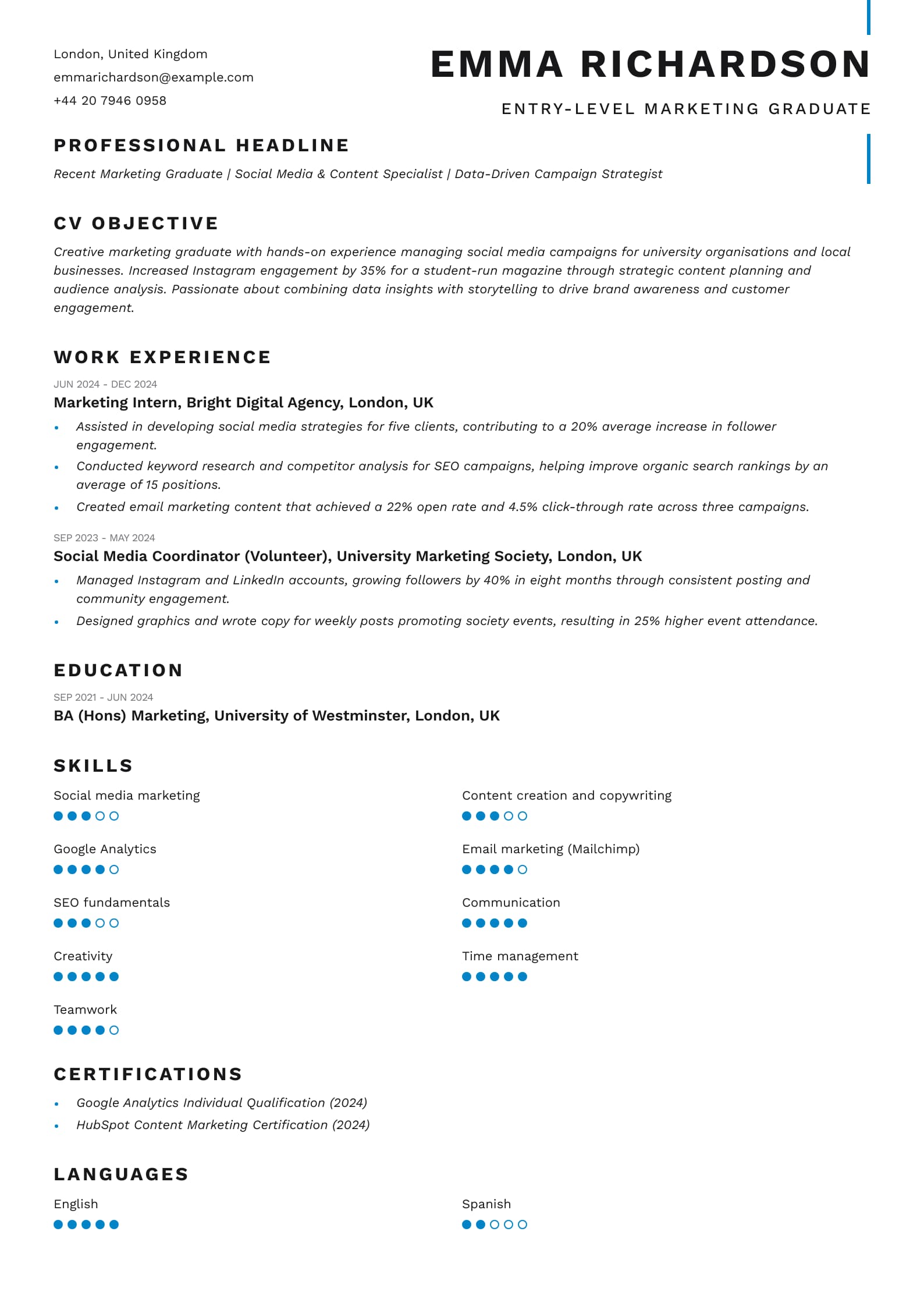
This marketing CV example includes specific metrics (35% engagement increase, 22% open rate) that prove impact. Volunteer work and certifications fill experience gaps effectively, whilst the CV objective clearly states career direction and key strengths.
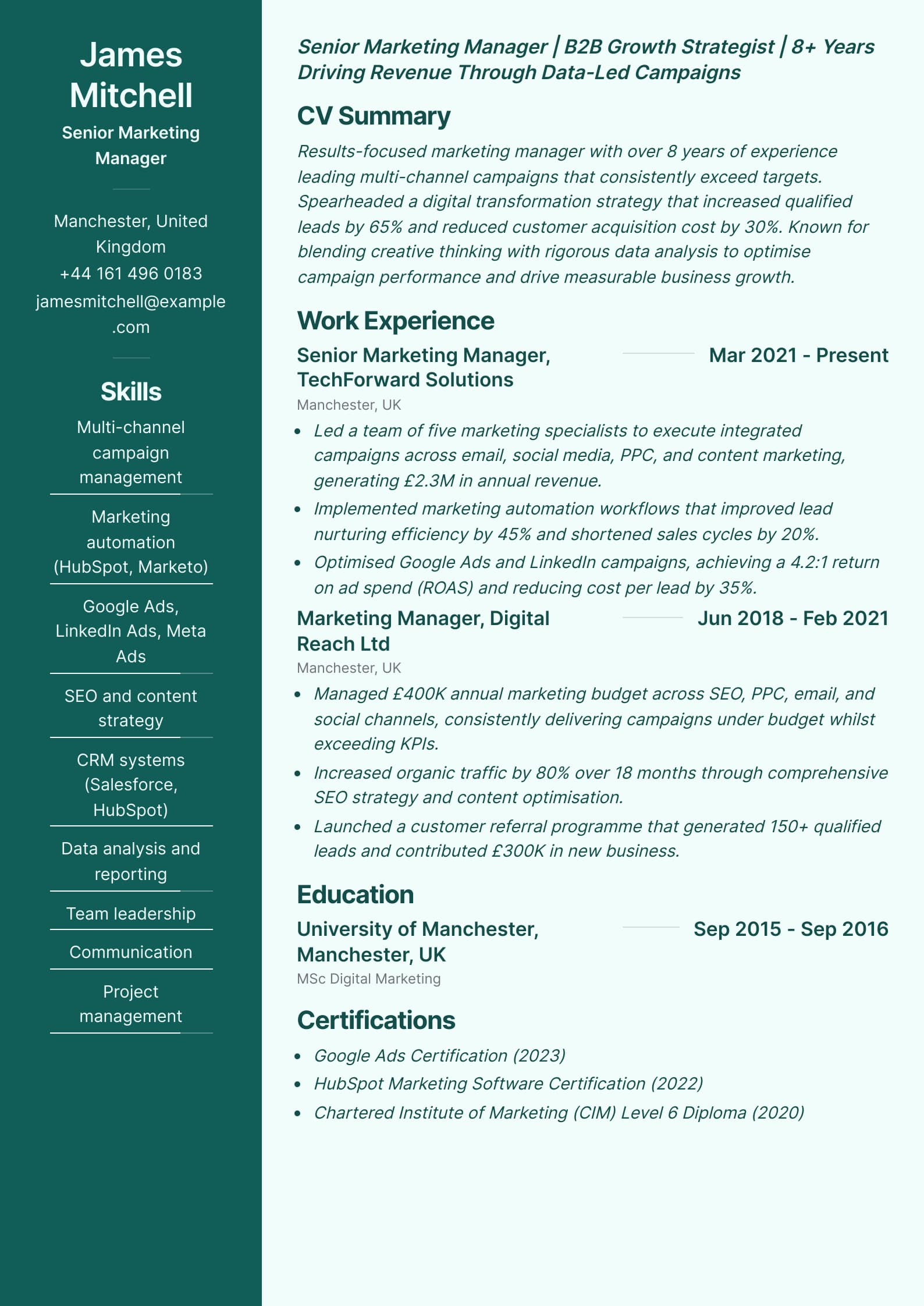
In this CV example, every bullet point includes tangible metrics—revenue figures, percentage improvements, ROAS—that prove the candidate delivers results. The skills section balances technical expertise with management abilities, whilst certifications show commitment to staying current.
How to Write a Marketing CV: A Step-by-Step Guide
Writing a good marketing CV is all about following a structure that highlights your results first, skills second, and background third. It's important to stand out quickly as marketing roles attract plenty of applicants. For instance, CVs with quantifiable achievements are significantly more likely to progress to the interview stage because employers want evidence of your impact, not just participation.
The best CV format to showcase all of this is reverse chronological. This way, you emphasise the most important things first. That said, let’s see how to write a marketing CV step by step.
#1. Make a Professional Headline
Your headline sits just below your contact details in the CV header, and acts as a tagline for your professional brand. A strong one includes three elements:
Job title or level
Specialism
Let’s a good example of a professional headline:
CV Headline Example
Performance Marketing Manager | PPC & Paid Social Expert | £500K+ Ad Spend Managed | 5:1 Average ROAS
#2. Write a Results-Driven CV Summary or Objective
This part of your marketing CV is your elevator pitch. It's typically 3–5 lines, enough to capture your experience, skills, and what you've achieved. However, there’s a difference between a summary and objective. Here’s when to use one over the other:
CV summary. Use this one if you have work experience in marketing. Focus on your years in the field, key specialisms, and one or two standout achievements with metrics.
CV objective. If you're entering marketing for the first time or changing careers, this your best choice. Explain your background, transferable skills, and what you're aiming to achieve. Metrics matter here as numbers provide proof and make your claims credible.
Here’s a good example you can use for inspiration:
CV Summary or Objective Example
Growth-focused marketing specialist with 4 years of experience executing multi-channel campaigns that consistently exceed targets. Launched an email nurture sequence that improved lead-to-customer conversion by 25% and generated £150K in revenue. Skilled in Google Ads, SEO, and marketing automation.
#3. Demonstrate Your Marketing Work Experience

The work experience section is where you prove your value. For each role, include your job title, company name, location, and dates. Then add 3–6 bullet points that describe what you achieved, not just what you did.
Start each bullet with a strong action verb: increased, optimised, launched, grew, analysed, developed, managed, implemented. Follow that with a specific result and, where possible, a metric, such as: engagement rates, conversion improvements, revenue generated, time saved, costs reduced. If you've worked on recognisable brands or high-budget campaigns, mention them as well. They add context and credibility.
That said, here's a strong example:
Marketing Work Experience Example
Digital Marketing Executive Horizon Media Group, Birmingham, UK August 2022–Present
Managed PPC campaigns across Google and Meta with a monthly budget of £25K, achieving an average 4:1 return on ad spend.
Increased website conversions by 32% through landing page optimisation and targeted audience segmentation.
Developed a content calendar that grew blog traffic by 65% and improved search rankings for 20+ target keywords.
#4. Highlight Essential Marketing Skills
Marketing requires a mix of technical know-how and interpersonal abilities, so your skills section should reflect both. Recruiters often scan this area quickly to check you've got the basics covered, and applicant tracking systems (ATS) look for specific keywords here.
Hard skills are the tools, platforms, and techniques you use day-to-day. For marketing roles, these might include:
Hard Skills for Marketing Roles
SEO and keyword research
Google Ads and Meta Ads Manager
Google Analytics and data analysis
Social media strategy
Email marketing platforms (Mailchimp, HubSpot)
CRM systems (Salesforce)
Marketing automation
Copywriting
On the other hand, soft skills demonstrate how you work and collaborate. The essential ones include:
Essential Soft Skills
Communication
Creativity
Teamwork
Adaptability
Time management
However, don't just list every marketing skill you've ever touched. Tailor this section to the job description and structure it with bullet points:
Tailor Skills to the Job Description
Skills
SEO and content optimisation
Google Ads, LinkedIn Ads, Meta Ads
Google Analytics
Email marketing (HubSpot, Mailchimp)
Social media management
Marketing automation
Communication
Creativity
Project management
#5. Add Education, Certifications, and Extra Sections
Your education section should include your degree, institution, location, and dates. If you graduated recently, you can add relevant modules or dissertation topics. However, marketing doesn't always require a specific degree—what matters is demonstrating you understand the principles.
On the other hand, recognised certifications, such as Google Ads Certification and HubSpot Content Marketing, are especially valuable because the industry evolves quickly. Also, additional sections can strengthen your CV if they're relevant. Consider adding languages, awards, publications, and portfolio links which are essential for content marketers.
Here's a good example:
Education and Certifications Example
Education
BA (Hons) Marketing University of Bristol, Bristol, UK September 2019–June 2022
Certifications
Google Analytics Individual Qualification (2023)
HubSpot Inbound Marketing Certification (2023)
Portfolio
www.yourname.com/portfolio
How to Write a Marketing CV With No Experience
If you're new to marketing, i.e. with no experience, focus on what you have done rather than what you haven't. Highlight internships, university projects, and volunteer work—maybe you managed social media for a student society or helped a local charity with email campaigns. These count as real experience.
Also, mention digital campaigns completed during coursework. Many marketing degrees include practical assignments where you plan and execute campaigns. Focus on transferable skills like communication, research, analytical thinking, and creativity.
Add extracurriculars that show marketing-related skills, such as managing social media for a club, creating content for a magazine, or organising events that required promotion. Don't undersell yourself—even unpaid work demonstrates capability and enthusiasm.
4 Common Mistakes to Avoid in Your Marketing CV
Even a strong CV can get overlooked if it contains avoidable errors. Here are the most common pitfalls and how to sidestep them.
Not including measurable results. Wherever possible, quantify your achievements with percentages, revenue figures, conversion rates, or audience growth. If exact numbers aren't available, provide estimates—anything that shows impact.
Ignoring ATS formatting rules. Many companies use applicant tracking systems to filter CVs, and these systems struggle with complex formatting, so avoid tables, text boxes, headers/footers for key information, and graphics embedded in text. Stick to standard fonts like Calibri or Arial, use clear headings, and save your CV as a Word document or PDF.
Listing outdated skills. Marketing moves quickly—mentioning Google+ marketing or outdated software won't help. Focus on current platforms: TikTok, LinkedIn Ads, marketing automation, SEO for 2025. Only include older tools if they're still relevant.
Overloading with buzzwords. Words like "synergy," "thought leader," and "guru" are overused and don't add value. Instead, show your value by describing a challenge and how you solved it with measurable outcomes.
Create Your Marketing CV
Download your polished, ATS-friendly marketing CV in minutes.Final Thoughts
Writing a marketing CV that gets noticed comes down to clarity, proof, and relevance. Show what you've achieved with specific metrics, highlight the skills that match the role, and structure your CV in a way that's easy to scan.
Whether you're just starting out or managing campaigns at scale, focus on results, avoid common mistakes, and tailor your application. With the right approach, your CV can open doors to the marketing roles you're aiming for.
Marketing CV FAQs
#1. Do marketing CVs need a portfolio?
Not every marketing CV requires a portfolio, but it depends on the role. If you're applying for content marketing, social media, or creative positions, a portfolio strengthens your application significantly. On the other hand, for strategic or analytical roles like PPC management, a portfolio is less critical, but case studies can still add value.
#2. How long should a marketing CV be?
Your marketing CV should be one to two pages long, depending on your experience. If you're early in your career or applying for junior roles, aim for one page. For mid-level to senior positions, two pages work better because you'll have more campaigns and achievements to describe. Just ensure every point adds value.
#3. What skills should I put on a marketing CV?
Include a mix of hard and soft skills tailored to the role. Hard skills might include SEO, Google Ads, social media management, email marketing platforms, Google Analytics, CRM systems, and content creation tools. Soft skills such as communication, creativity, project management, and teamwork are equally important. Prioritise skills mentioned in the job description and back them up with examples.