

An architect CV combines creativity and professionalism to help you secure a job in this exciting and ever-changing field. The best applications are those that demonstrate achievements through measurable results and contain portfolios that showcase skills practically.
In this article, we will provide two architect CV samples, explain how to successfully write your own document, and discuss common mistakes to avoid. We will also show you what to do if you’re writing a CV for this role with no experience.
Key Takeaways
An architect CV should demonstrate your skills practically and impress potential employers with both your creativity and professionalism.
The best architect CV templates contain contact information, a professional headline, a work experience section, your education details, skills, certifications, and portfolio links.
If you have no official work experience, you can write about your coursework and projects, include volunteering and freelancing in your CV, emphasise your transferable skills, and build your personal portfolio.
You should avoid being too vague, using generic templates, making grammatical mistakes and typos, and formatting the document incorrectly.
2 Outstanding Architect CV Examples
Before we discuss specific writing tips, we’ll share two architect CV examples to help you create a job-winning application for junior and senior positions.
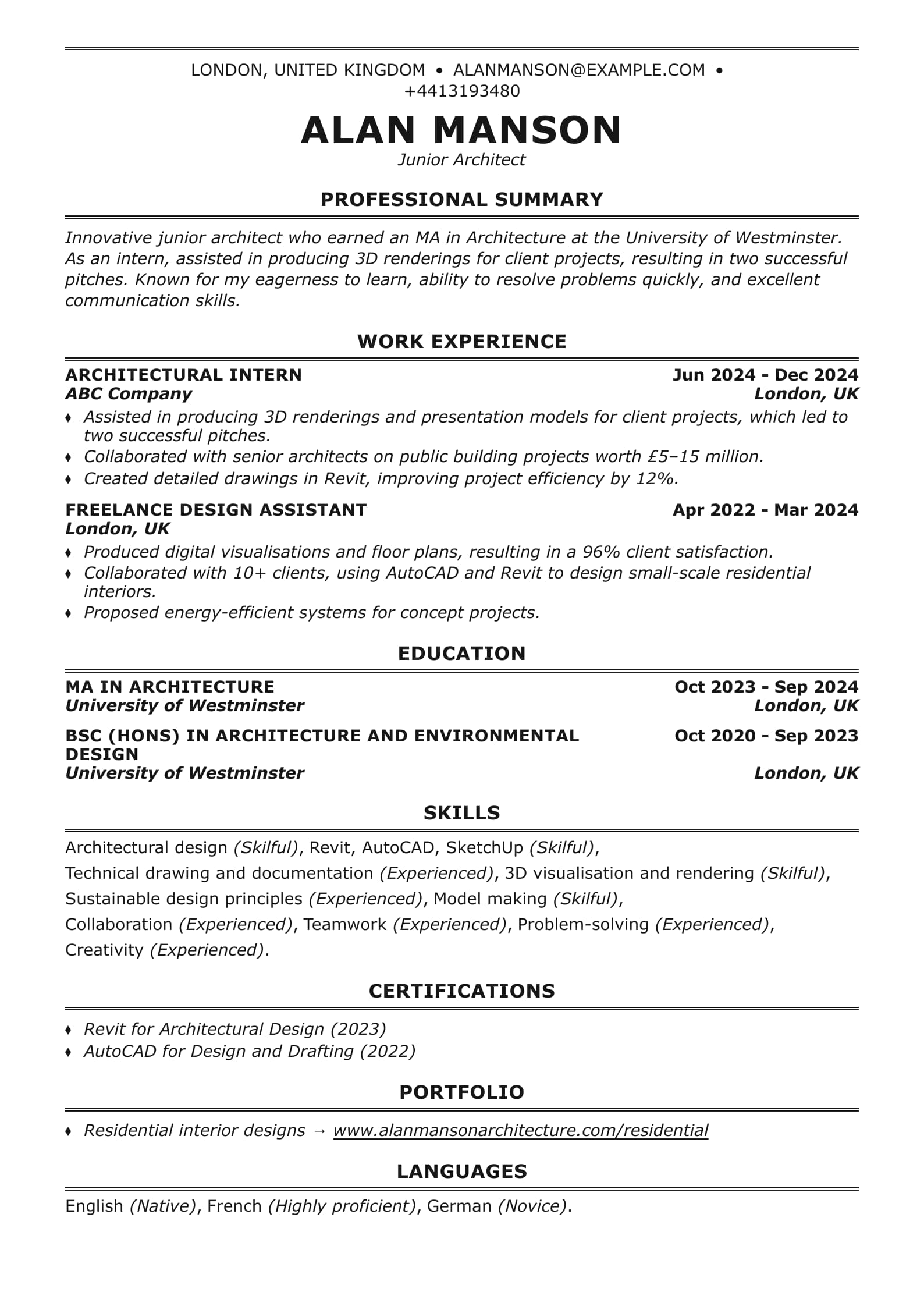
How to Write an Architect CV in 5 Simple Steps
To write an architect CV, you should:
#1. Add Your Contact Details and a Creative Headline
First and foremost, you should add your contact details to the very top of your architecture CV, in the header, where employers can immediately see them. This is crucial, as they won’t be able to reach you with an interview invitation if they don’t have your information.
These are the details you should include in this section:
Header Details
Full name
Address
Email address
Phone number
LinkedIn profile (optional)
Professional website (optional)
This information should be sufficient; there’s no need to add social media, personal blogs, or anything else that may damage your image. Also, make sure to use a professional email address and not an old one you made when you were a teenager.
Here’s what this section should look like in practice:
Header Example
Contact Information
Alan Manson London, United Kingdom alanmanson@example.com +4413193480
Right under the contact information section, you should include your personal statement, which briefly summarises your CV. This section shouldn’t be too long; 4–5 lines at most, but it should be packed with details and impactful.
Here’s a formula we recommend using:
Sentence #1, where you should include your job title, years of experience, and the basic responsibilities you’ve performed at your past positions. If you don’t have work experience, add your degree and university name instead.
Sentence #2, which should highlight your most impressive career achievement using action verbs and measurable results.
Sentence #3, where you can mention some of your soft skills and relevant traits.
This is how all this comes together:
CV Summary Example
Professional Summary
Creative and results-driven architect with 10+ years of experience leading commercial, residential, and industrial redevelopment projects across the UK. Introduced sustainable design strategies, reducing project energy use by 24%. Known for my architectural expertise, collaboration skills, and willingness to mentor younger colleagues.
#2. Showcase Work Experience and Projects
The work experience section is the most important and typically the longest section on your CV, so you should make it as engaging and informative as possible. To achieve this, add your relevant positions, the companies you’ve worked for, and several achievements with measurable results under each entry.
These achievements are crucial, as they personalise your application and help it stand out from the competition. They are typically listed as short bullet points with strong action verbs that demonstrate proactivity and show how you’ve contributed to each company that employed you.
This is what the work experience section should look like:
Architect Work Experience Example
Work Experience
Project Architect XYZ Company, London, UK August 2019–March 2025
Introduced sustainable design strategies, which helped reduce project energy use by 24%.
Managed the technical and construction phases of commercial and retail development projects worth up to £20 million.
Coordinated multi-disciplinary teams of 20+ people, ensuring consistency and efficiency.
Junior Architect ABC Company, London, UK July 2015–June 2019
Developed 3D models and visual presentations, improving stakeholder engagement by 33%.
Collaborated with engineers and interior designers to achieve a cohesive design, resulting in 98% customer satisfaction.
Supported senior architects during design phases, improving efficiency by 14%.
#3. Highlight Relevant Skills
The skills section is one of the most important sections on your CV, and it can be placed directly underneath the personal statement or moved lower, beneath the work experience and education sections.
Wherever you choose to place it, make sure it stands out, as many employers specifically skim the document looking for it. The best approach is to simply list all your capabilities as bullet points, starting with hard skills and ending with soft ones.
There’s no specific requirement or limit when it comes to the number of skills you should include, but we recommend 6–10 to cover as many as possible.
Here’s what the skills section should look like on an architect CV:
Architect Skills Section
Skills
Architectural design
Revit, AutoCAD, SketchUp
Technical drawing and documentation
3D visualisation and rendering
Sustainable design principles
Project leadership
BIM coordination and implementation
Client and stakeholder communication
Mentorship
Teamwork
Problem-solving
Creativity
#4. Include Education and Certifications
The education section should contain two of your most recent degrees, the institution where you earned them, and the period of attendance. So, if you have a master’s degree, you’ll include that and your bachelor’s, but leave GCSEs and A-Levels out.
Architects with extensive work experience should only mention basic information in the education section, but entry-level candidates can add more details. If you don’t have much to say about your professional background, you can include significant achievements here.
Keeping that in mind, here’s what a typical education section should look like:
Education Section Example
Education
MA in Architecture October 2023–September 2024 University of Westminster, London, UK
BSc (Hons) in Architecture and Environmental Design October 2020–September 2023 University of Westminster, London, UK
As for certifications, they should be short and to the point; simply include a certificate’s name and the year when you obtained it. There’s no need to write more unless the title isn’t clear enough; in that case, you can add a short description.
This is what the certification section looks like in practice:
Certifications Example
Certifications
CITB Health & Safety Certification (2018)
RIBA Chartered Architect (since 2016)
Revit for Architectural Design (2015)
AutoCAD for Design and Drafting (2014)
#5. Add Portfolio Links and Extras
Lastly, portfolio links can be extremely useful in an architect CV, as they demonstrate your skills and experience more practically. So, you should consider making a website to showcase your work, especially if you’ve worked in the field for a while.
The portfolio section should be very short and straightforward; simply add the link to your website and a short description of what can be found on the page.
Here’s what that should look like:
Additional Sections Example
Portfolio
Residential interior designs → www.alanmansonarchitecture.com/residential
Aside from this, you can write extra sections, like languages, publications, volunteering, and more. Just keep them brief, detailed, and relevant to the company you’re applying to.

How to Write an Architect CV With No Experience
To write an architect CV with no experience, you should focus on skills and experiences outside of your professional background that set you apart. Here is what those might entail:
Internships, coursework, and projects. Even if you haven’t been officially employed, you likely gained some experience over the course of your studies. Include the most relevant examples in your CV; for instance, the courses in which you excelled or particularly impressive projects. Internships are also highly relevant, as they demonstrate that you do have some rudimentary experience with work.
Volunteering and freelancing. Freelance and volunteer work can quickly set you apart from other candidates, as it shows initiative and proactivity. So, you can include these in the work experience section and use achievement bullet points to elaborate on your accomplishments and responsibilities.
Transferable skills obtained at university. At the beginning of your career, you might not possess all the job-specific abilities experienced architects have, but you can compensate for this with transferable skills. Mention communication, collaboration, teamwork, and problem-solving; employers always appreciate candidates who bring such abilities to the table.
Personal portfolio. If you’ve worked on any personal architecture projects for practice, include them in your CV to showcase what you’re capable of. That’s the most effective way to demonstrate your skills.
4 Common Mistakes to Avoid in Your Architect CV
Common mistakes to avoid in your architect CV include the following:
Using a generic template. For architects, CV design and style matter more than they do in many other professions because that’s how they can demonstrate their creativity. So, avoid using a basic template and look into more interesting ones that are still professional, clear, and ATS-friendly.
Not proofreading the finished document. Lack of proofreading can result in typos and grammatical mistakes that may make your application look unprofessional and damage your chances of getting hired. Therefore, make sure to read your CV once again when you finish writing or paste it into a grammar checker to catch any errors you might have missed.
Being vague and unspecific. Without specific details, your CV might sound generic and get lost in the sea of similar applications. That’s why it’s important to include achievements instead of responsibilities, add measurable results, and list portfolio links. However, keep in mind that you shouldn’t overload your application with information; you must thread the line between too much and not enough.
Failing to format it properly. Your CV should be readable and scannable, with clear headings, paragraphs, and bullet points. A wall of text certainly won’t leave a good impression; in fact, it might not reach recruiters at all, as an ATS scan might reject it outright.
Write a Professional Job Application Document With CV.co
If you need extra help writing your architect job application, use our CV builder to craft one within minutes. All you need to do is enter your information, follow the instructions, select a CV template, and finalise the document. Then, you can immediately submit it to your potential employer.
And if you still want to write an application from scratch, you can take a look at one of our CV examples for inspiration. We offer a variety of options for various industries, so you’re sure to find something that suits your needs.
Final Thoughts
Hopefully, this article has helped you understand how to write an effective architect CV to secure a position of your dreams. The key is to include a portfolio and focus on practical skills and achievements, while simultaneously demonstrating your creativity through style and design. If you tick all these boxes, you’re sure to receive an interview invitation soon!
Architect CV FAQ
#1. How long should an architect CV be?
An architect CV should be 1–2 pages long, which is a standard length for most job applications. This should be enough to include all relevant information, such as your experience, skills, and education. The only exception is senior architects, who may have an extensive enough background to fill more pages than that, but even they should try to keep it short.
#2. Should I include my portfolio in my CV?
You should include your portfolio in your CV, as it’s a concrete, visual demonstration of your skills. Add links to a few of your most impressive projects and short descriptions; that should be enough to impress recruiters.
#3. What skills make an architect CV stand out?
Skills that make an architect CV stand out are job-specific abilities, like architectural design, 3D rendering, and proficiency in relevant software, such as AutoCAD or Revit. However, soft skills are equally important; communication skills, problem-solving, and collaboration can give you an edge over other candidates.
#4. What’s the best CV format for architects?
The best CV format for architects is the reverse-chronological format, where information in the work experience and education sections is listed from most recent to the oldest. In other words, you should place your latest job first and then slowly work your way backwards through your career.
#5. Should I list design software on my architect CV?
You should list design software on your architect CV; programmes like Revit, SketchUp, and ArchiCAD are crucial in the drafting and modelling process. In fact, computer-assisted design (CAD) has largely replaced manual drafting, so architects nowadays have to be familiar with it.