
A teacher CV focuses on skills and experiences relevant to roles in education, such as communication, classroom management, safeguarding, and patience. So, as long as you include these in your document and follow standard CV writing practices, you should be able to create an outstanding job application in no time.
In this article, we will show you how to write a teacher CV for the UK market, what mistakes to avoid, and which skills to highlight. Furthermore, we will provide an excellent example to demonstrate how our tips work in practice.
Key Takeaways
A teacher CV highlights your expertise in the classroom, ability to communicate with students of different ages and backgrounds, and knowledge of safeguarding practices.
Every teacher CV should include contact information, a personal statement, key skills, teaching experience, education, and qualifications.
You should avoid using a generic CV, listing duties instead of achievements, writing a weak personal statement, poor formatting, and missing essential information.
What Employers Look For in a Teacher CV
In a teacher CV, employers look for classroom experience, communication and management skills, and safeguarding expertise that helps them ensure students’ well-being in school. Essentially, they look for well-rounded individuals who can handle a highly responsible job, as teaching surely is one.
That, of course, doesn’t mean that newly trained teachers with limited experience stand no chance. However, they do need to emphasise the knowledge and skills they possess to make up for the lack of real practice.
Outstanding Teacher CV Example
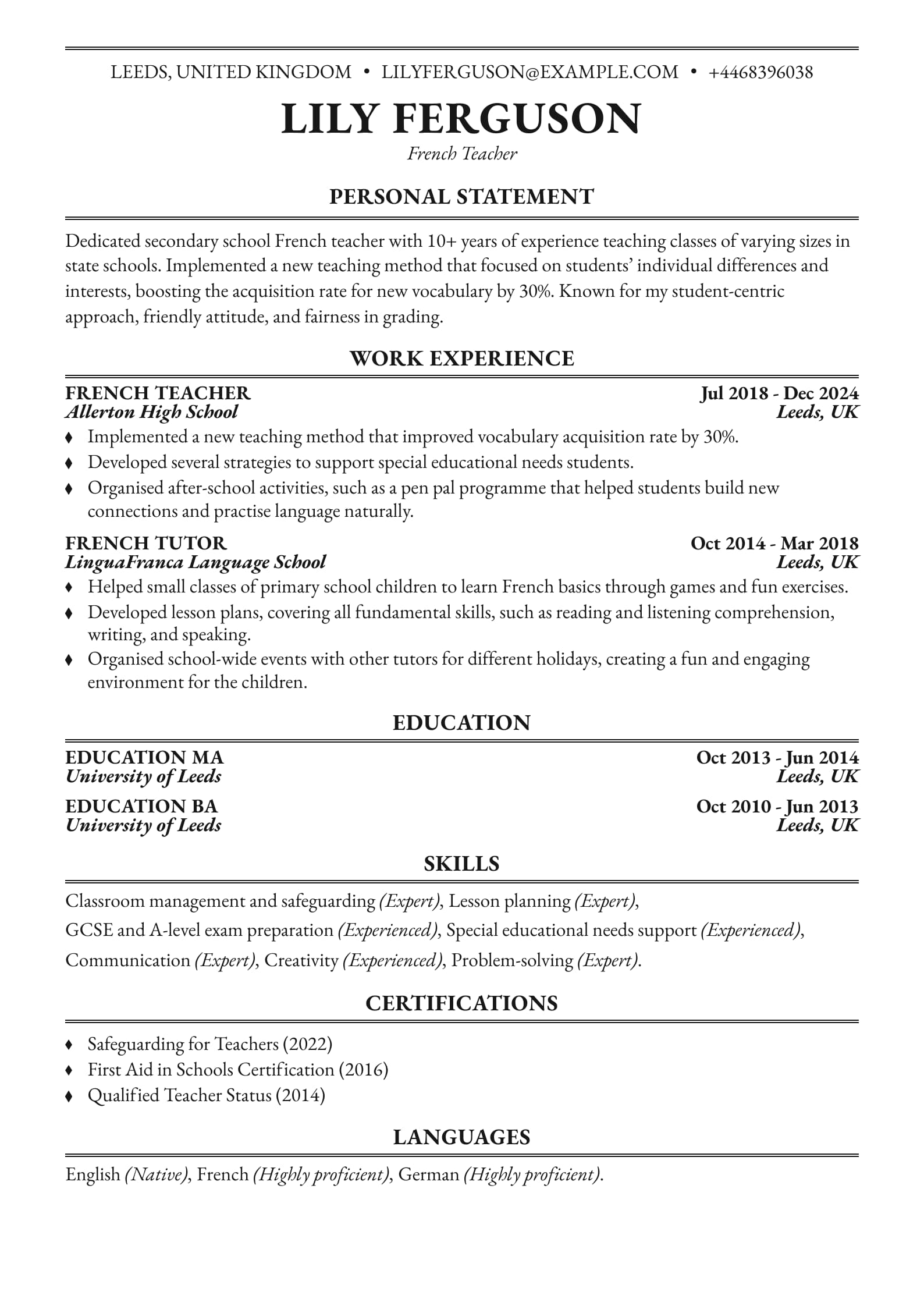
Let’s start with the most important part—a teacher CV example—to illustrate what your application should look like. This will help you understand what each section should contain and serve as inspiration for your own document.
How to Write a CV for Teaching Jobs: Key Sections and What to Include
To write a CV for teaching jobs, you should follow a similar format to other types of applications, including sections like contact information, personal statement, key skills, work experience, education, and qualifications.
Furthermore, you can add some optional sections, like languages, hobbies and interests, or anything else you deem relevant.
Below, we will examine the standard teacher CV format and its key parts:
#1. Contact Information
Contact information is a crucial section to include in your CV because it allows recruiters to reach out to you if they believe your professional profile matches their requirements. It should be placed at the top of your document so that it’s instantly visible and easy to find.
Typically, this section should contain the following:
Mandatory Details
Full name
Address (street name and number are optional)
Email address
Phone number
LinkedIn profile (optional)
Professional website or blog (optional)
Avoid adding unnecessary details, social media accounts, personal websites, or anything that doesn’t contribute to your professional image.
Here’s an example of a good contact information section:
Contact Information Example
Lily Ferguson Leeds, United Kingdom lilyferguson@example.com +4468396038
#2. Personal Statement/CV Profile
A personal statement is, essentially, a snapshot of your CV that’s meant to give recruiters an overview of your most significant accomplishments and skills. As a result, it’s placed right underneath the contact information section, where they can immediately read it.
This part is one of the trickier sections to write, as it should say a lot in a very limited space. As a rule, it shouldn’t be longer than 4–5 lines, yet it should mention your title, experience, skills, and one key achievement.
This is what a strong personal statement for your teacher CV can look like:
CV Statement Example
Personal Statement
Dedicated secondary school French teacher with 10+ years of experience teaching classes of varying sizes in state schools. Implemented a new teaching method that focused on students’ individual differences and interests, boosting the acquisition rate for new vocabulary by 30%. Known for my student-centric approach, friendly attitude, and fairness in grading.
#3. Key Skills Section
The key skills section is where you should list your most relevant capabilities as bullet points, starting from hard skills and ending with soft skills. Typically, 6–10 entries will suffice, but you can add more if you think they may contribute to your application.
Avoid including unnecessary explanations in this section; it’s enough to briefly list the skills and leave elaborations for other sections or the interview.
Here’s an example:
Key Skills Example
Skills
Classroom management and safeguarding
Lesson planning
GCSE and A-level exam preparation
Special educational needs support
Communication
Creativity
Problem-solving
#4. Teaching Experience
Your teaching experience is one of the most important sections to include on your CV, so it typically goes right underneath the personal statement. Of course, if you’re at the beginning of your career and don’t have a significant professional background, you can put education or skills first.
This section should contain a list of your teaching achievements under each entry, preferably supported by measurable results. Ideally, this section should look like this:
Work Experience Example
Work Experience
French Teacher Allerton High School, Leeds, UK July 2018–December 2024
Implemented a new teaching method that improved vocabulary acquisition rate by 30%.
Developed several strategies to support special educational needs students.
Organised after-school activities, such as a pen pal programme that helped students build new connections and practise language naturally.
#5. Education & Qualifications
In the education section, you should include two of your most recent degrees, along with the university or school at which you’ve obtained them. More than that isn’t necessary; if you mention a master’s or bachelor’s degree, it’s easy to conclude that you have a secondary school diploma, too.
Generally speaking, you don’t need to elaborate on your degrees in this section, unless you feel further explanations are relevant. Some candidates add their teacher qualifications here, but you can also do that in the certifications section.
Here’s what a typical education section should look like:
Education Example
Education
Education MA October 2013–June 2014 University of Leeds, Leeds, UK
Education BA October 2010–June 2013 University of Leeds, Leeds, UK
#6. Additional Sections
Once you write the core sections listed above, you can add optional ones to pad out your teacher CV and impress recruiters further.
These are some sections you should consider including:
Optional Sections
Certifications, where you can list the courses and additional training you’ve completed
Languages, where you should add the languages you speak, along with your fluency level
Publications, where you should include any works you’ve published during or after your studies
Here is an example of what additional sections can look like:
Additional Section Example
Certifications
Safeguarding for Teachers (2022)
First Aid in Schools Certification (2016)
Qualified Teacher Status (2014)
Languages
English – Native
French – Near Native
German – Fluent

Best Skills to Highlight on a Teacher CV
The best skills to highlight on a teacher's CV are usually soft skills, as teachers need to possess these to communicate with students and manage classrooms effectively. However, hard skills are also quite important and deserve a prominent place in the document.
Let’s examine the top skills for teachers in more detail:
Soft Skills
Soft skills are traits that determine how a person interacts with others, so they typically aren’t learned in classes or through courses. Instead, they are acquired over time through experiences with other people. These are also transferable; they can be applied across many different fields.
The vital soft skills that should be added to a teacher's CV include:
Soft Skills Section
Empathy
Creativity
Teamwork
Adaptability
Organisation
Active listening
Communication
Time management
Emotional intelligence
Hard Skills
Unlike soft skills, hard skills are industry-specific abilities that are obtained through education, training, and work experience. Without these skills, you can’t be considered a professional in your field, so they are essentially requirements.
Some of the most relevant hard skills for teachers include:
Hard Skills Section
Data analysis
Lesson planning
Subject expertise
Computer literacy
Student safeguarding
Technology integration
Curriculum development
Classroom management
5 Common Mistakes to Avoid in a Teacher CV
Let’s examine the most common mistakes to avoid in a teacher's CV:
#1. Using a Generic CV
Though your skills and professional background remain the same, it’s never a good idea to apply to multiple positions using one CV. If you do, your application will appear generic and won’t stand out much from everyone else’s.
Instead, highlight the most relevant aspects of your professional person, such as the skills, experiences, and achievements that relate to the position you’re applying for.
#2. Listing Duties Instead of Achievements
Many candidates make the mistake of listing duties in the work experience section, but this is entirely unnecessary. After all, recruiters already know what a teacher’s job entails, and including that information in your CV doesn’t tell them anything about you.
So, focus on your achievements instead; make them as specific as possible and add measurable results to improve their impact and validity.
#3. Weak Personal Statement
A personal statement serves as a hook on your CV, so it needs to be engaging enough to prompt recruiters to keep reading. If it’s generic, vague, or rambling, it won’t leave a good impression and might even lead hiring managers to believe that the rest isn’t worth reading.
#4. Poor Formatting and Errors
Even if the content is excellent, poor formatting can significantly hurt your chances of securing an interview. That’s because badly formatted CVs often don’t reach recruiters; they get filtered out by the applicant tracking system (ATS), which may not be able to read them.
Also, grammar mistakes aren’t a good look either; they make you appear unprofessional and careless, which is the opposite of the impression you want to leave.
#5. Missing Essential Details
Ensure that you’ve included all essential details, such as contact information. You also shouldn’t forget to add your most relevant certificates, particularly those related to safeguarding and child protection training. These can improve your chances of receiving an interview invitation drastically.
Create a Job-Winning CV With Ease
If you need additional help writing your teacher application, use our CV builder to generate one within minutes. All you need to do is enter the required information and choose a CV template that suits your needs; you’ll have a submission-ready document in no time.
Final Thoughts
Thanks to our writing tips and examples, you should be able to create a teacher CV in no time. Just remember to highlight your soft skills, professional experience, and relevant certificates that prove your expertise in the field.
If you’re still struggling, though, take a look at our CV examples for inspiration. We offer a wide range of options for various professions, including teaching, so you should be able to find something that suits your needs quickly.
Teacher CV FAQ
#1. How long should a teacher CV be?
A teacher CV should be 1–2 pages long, as this is the standard for most application documents. If possible, try to limit yourself to one page; this is an even better option.
#2. Should I include references on a teacher CV?
You don’t have to include references on a teacher's CV, unless the school specifically requests them or they are particularly impressive. Otherwise, they’ll only take up space and won’t mean as much as concrete achievements and skills listed in your document.
#3. Do I need to list safeguarding training on my CV?
You should list safeguarding training on your CV; after all, teachers need to be well-versed in child protection policies. If possible, add it to the certifications section and emphasise the particular course you’ve attended and the year of obtaining the certificate.
#4. How to write a CV for a newly qualified teacher?
To write a CV for a newly qualified teacher (NQT), you should primarily focus on your education and relevant certifications. You also want to emphasise your transferable skills, as your lack of experience in creating lesson plans can be compensated for if you are communicative, adaptable, and an excellent listener.