
A finance CV is your professional calling card in one of the UK's most competitive sectors—a document that showcases your numerical prowess, analytical capabilities, and business acumen to potential employers. With over 1.1 million people employed in financial services across Britain, crafting an application that immediately captures attention isn't just helpful—it's essential.
In this guide, we’ll walk you through everything you need to know about creating a finance CV that stands out, from structuring your header to quantifying achievements that prove your worth. We'll show you real examples that work, explain what recruiters actually look for, and help you avoid the pitfalls that sink most applications.
Key Takeaways
Finance CVs should emphasise quantifiable achievements, technical proficiencies, and relevant certifications to demonstrate tangible value to employers.
The reverse chronological format works best for finance roles, highlighting your most recent and relevant experience first, whilst maintaining ATS compatibility.
Entry-level candidates can compensate for limited experience by showcasing academic projects, internships, transferable skills, and relevant coursework.
Including specific metrics—percentage improvements, cost savings, revenue increases—transforms generic job descriptions into compelling evidence of your capabilities.
Common mistakes like vague language, missing numbers, technical overload, and poor proofreading can derail even strong applications, so careful review is crucial.
2 Job-Winning Finance CV Examples
Before we examine the finer points of writing a finance CV, let's look at two examples that demonstrate what works. These aren't theoretical exercises; they're built around the principles that actually get finance professionals hired.
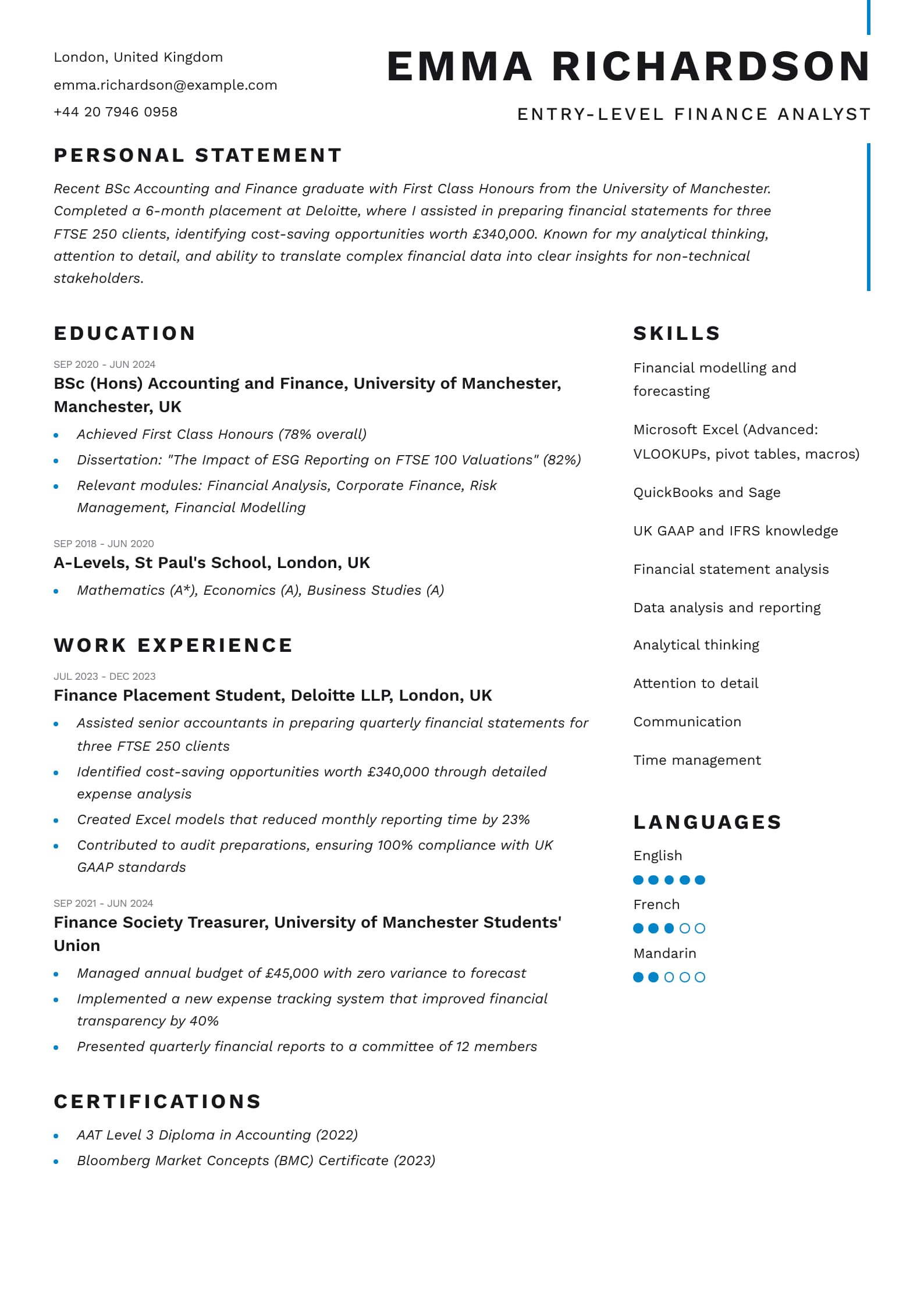
This CV example immediately establishes academic credentials whilst demonstrating practical application through the candidate’s placement. The quantified achievements—£340,000 in savings, 23% efficiency improvement—show tangible results, not just theoretical knowledge. The skills section balances technical proficiency with the soft skills finance teams actually need.
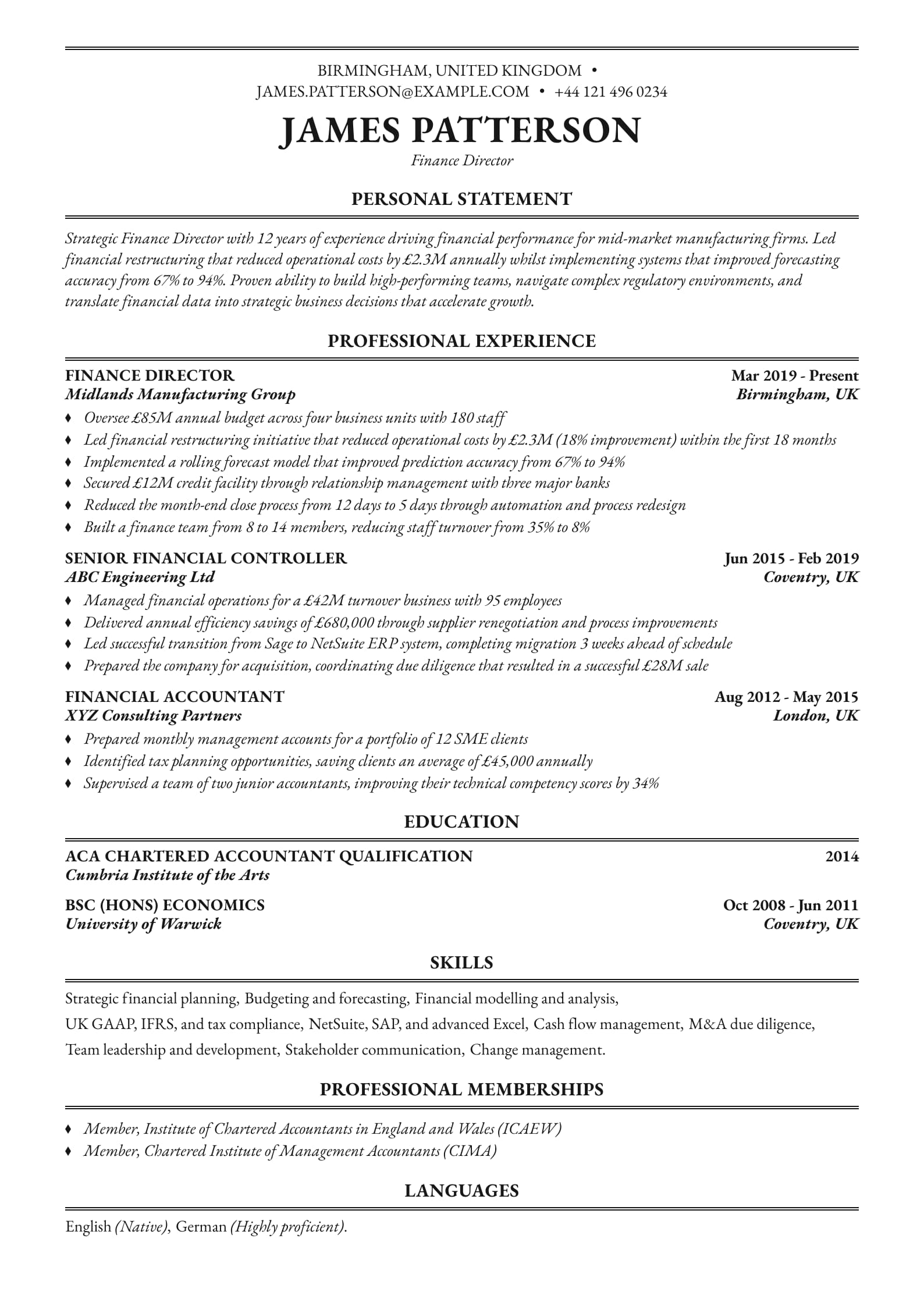
This finance CV demonstrates the impact expected at the director level. Every bullet point includes specific, quantifiable achievements—£2.3M cost reduction, 94% forecasting accuracy, £12M facility secured.
The progression from accountant to controller to director tells a coherent story of increasing responsibility and proven results. Furthermore, the candidate’s professional memberships signal an ongoing commitment to the field.
How to Write a Finance CV: A Step-by-Step Guide

Writing a good finance CV is all about balancing detailed financial expertise with readability. The reverse chronological format is your best choice here as it clearly shows career progression. More importantly, it's easily parsed by applicant tracking systems (ATS) that screen applications before human eyes ever see them.
Let's see how to write a compelling finance CV section by section.
#1. Start with a Professional Header
Your header isn't just contact details—it's the first impression that signals professionalism before anyone reads a word. Place this information at the top where it's immediately visible:
Header Details
Full name (largest text on the page)
Location (city and country suffice; full address isn't necessary)
Professional email address (firstname.lastname@email.com format)
Phone number (UK format with +44 prefix)
LinkedIn profile URL (optional but recommended)
Professional website or portfolio (if relevant)
Avoid outdated elements like "CV" as a heading, your photograph (unless specifically requested), date of birth, marital status, or nationality. UK employers don't need this information, and including it can actually work against you.
Here's what works:
CV Header Example
Sarah Mitchell London, United Kingdom sarah.mitchell@example.com | +44 20 7123 4567 linkedin.com/in/sarahmitchell
#2. Write a Compelling Professional Summary
Your professional summary—those 4-5 lines directly under your header—might be the only part of your CV that gets read in those crucial first seconds. It's your value proposition that explains what you bring to the table.
The formula that works: [Your professional identity] + [Years of experience or key qualification] + [One standout achievement with numbers] + [What you're known for or what you bring].
Let's see this in action:
Summary Example
Results-driven Management Accountant with 5 years of experience in the manufacturing sector. Implemented cost-accounting system that identified £420,000 in annual savings and improved variance analysis accuracy by 31%. Known for translating complex financial data into strategic insights that drive operational decisions and for building strong relationships across commercial teams.
#3. Showcase Key Skills for Finance
The skills section does double duty. First, it helps you pass ATS screening (which searches for specific keywords). Second, it gives recruiters a quick reference point for your capabilities. Structure it with technical proficiencies first, followed by the soft skills that determine how effectively you'll work within a team.
Essential hard skills for finance CVs would be:
Financial analysis and reporting
Budgeting and forecasting
Financial modelling
Microsoft Excel (specify level: intermediate or advanced)
Accounting software (QuickBooks, Sage, Xero, NetSuite, SAP)
UK GAAP and IFRS knowledge
Tax compliance and planning
Cash flow management
Data analysis and visualisation
ERP systems experience
Meanwhile, critical soft skills to include are:
Attention to detail
Communication (both written and verbal)
Time management
Teamwork and collaboration
Stakeholder management
Commercial awareness
Adaptability
Integrity and ethics
However, don't just list every conceivable finance skill, hoping something sticks. Choose 10-12 that genuinely reflect your strengths and match what the job description emphasises. Quality trumps quantity here.
#4. Detail Your Professional Experience
The work experience section is where you prove your value through concrete examples. Employers care less about what your job title was and more about what you actually accomplished—and crucially, the measurable impact of those accomplishments.
Use a reverse chronological order, and list the most recent role first, working backwards. For each position, include:
Job title
Company name and location
Dates (month and year)
3-6 bullet points focusing on achievements, not responsibilities
The difference between a responsibility and an achievement is the difference between "Prepared monthly financial reports" and "Redesigned monthly reporting process, reducing preparation time from 8 days to 3 days whilst improving data accuracy by 27%."
Structure your bullets using this framework: [Action verb] + [What you did] + [Measurable outcome]. For example:
Professional Experience Example
Implemented a rolling 12-month cash flow forecasting model that improved prediction accuracy from 71% to 93%, enabling better capital allocation decisions
Led year-end audit preparation for a £24M turnover business, achieving a clean audit opinion with zero material adjustments for the third consecutive year
Renegotiated terms with 12 key suppliers, delivering annual cost savings of £340,000 (8% reduction in procurement spend)
Automated invoice processing using RPA tools, reducing processing time by 62% and eliminating a backlog of 450+ outstanding invoices
Avoid passive constructions, and use strong action verbs instead, such as implemented, delivered, achieved, reduced, improved, increased, streamlined, developed, led, coordinated, negotiated, identified.
#5. Include Education and Certifications
Your qualifications for finance roles matter, so this section will prove you have the technical foundation for the work.
List your education in reverse chronological order, including:
Education Section Details
Degree type and subject (e.g., BSc Accounting and Finance)
University name and location
Dates attended
Classification/grade (if 2:1 or above)
Relevant modules or dissertation topic (optional, useful for recent graduates)
Professional certifications, such as ACCA and CIMA, carry substantial weight in UK finance. Include them prominently, with the awarding body and year obtained. List in-progress qualifications with expected completion date.
For recent graduates, the education section might sit above your work experience since it's a primary qualification. Once you have 2-3 years of professional experience, flip the order—your work history becomes more relevant than where you studied.
If you completed your A-Levels with exceptional results (3 A-grades or better), you can include them briefly. Otherwise, once you have a degree, they're generally redundant. Similarly, GCSEs rarely need mentioning unless you're very early in your career and they're particularly impressive.
#6. Consider Additional Sections
Once the core sections are solid, strategic additions can differentiate you from candidates with similar qualifications and experience. Keep these sections concise and relevant. Every line should reinforce your candidacy for a finance position.
Languages
In international finance hubs like London, language skills matter. List languages beyond English with your proficiency level (conversational, professional working proficiency, or native). Even basic knowledge of Mandarin, Arabic, French, or German can be relevant for roles involving international clients or reporting.
Professional Memberships
Membership in bodies like ICAEW, ACCA, CIMA, or IFS demonstrates ongoing professional development and commitment to the field. Include your membership number if you're a full member.
Awards and Recognition
Industry awards, performance bonuses (if you can mention them without breaching confidentiality), or internal recognition programmes show you've been acknowledged for exceptional work. "Quarterly Performance Award for 15% efficiency improvement in reconciliation process" is worth including.
Volunteering
Relevant volunteer work—particularly if it involves financial management—demonstrates your values and can fill gaps for less experienced candidates. "Treasurer, Local Community Centre (2022-Present): Managing £35,000 annual budget and providing financial guidance to the board of trustees" shows real-world application of your skills.
Publications or Speaking Engagements
If you've written articles for finance publications, presented at industry conferences, or contributed to professional journals, include them. This establishes thought leadership and expertise beyond your day job.
5 Common Mistakes to Avoid on a Finance CV
Even strong candidates hinder themselves with avoidable errors. Here are the five most frequent CV mistakes and how to fix them.
Using vague, generic descriptions. Finance is about specificity and precision—your CV needs to reflect that. For example, you can say: "Managed accounts payable function processing 650 monthly invoices with average payment time of 28 days, maintaining vendor relationships across 85 suppliers" to paint a clear picture of scope and competence.
Forgetting to include metrics. Numbers are the language of finance, such as revenue growth, cost savings, percentage improvements, budget sizes, team sizes, number of clients, timeframe reductions, accuracy improvements, compliance rates, and audit outcomes. Even approximate figures are better than none, e.g, "Reduced invoice processing time by approximately 40%" beats "Made invoice processing more efficient."
Overloading with technical jargon. Balance is key. Use technical terms where they add value and are industry-standard (IFRS, UK GAAP, management accounts, variance analysis), but explain what you did in terms that non-specialists can understand.
Ignoring ATS optimisation. The key is to keep formatting simple: standard fonts (Arial, Calibri, or Times New Roman), clear headings, conventional section names (Work Experience, Education, Skills—not "My Journey" or "What I Bring to the Table"). Save as .docx or PDF (check which the application system specifies) and include keywords from the job description naturally throughout your CV.
Neglecting thorough proofreading. Financial roles demand accuracy. A CV with typos, inconsistent formatting, or mathematical errors suggests you lack attention to detail. It's an immediate disqualifier for many employers. Read your CV backwards to catch spelling errors your brain autocorrects when reading forward. Check that all dates align and don't overlap impossibly. Verify that your maths is correct. Also, get someone else to review it—preferably someone working in finance who can spot both content and technical issues.
Create Your Job-Winning Finance CV
If you're staring at a blank page wondering where to begin, our CV builder will walk you through each section step-by-step, offer industry-specific CV templates, and ensure your formatting is both professional and ATS-compatible—all within about 15 minutes.
Create Your Finance CV in Minutes
Build My CV NowFinal Thoughts
Finance roles are competitive, but a well-crafted finance CV improves your odds of landing interviews. Focus on quantifiable achievements that demonstrate business impact, balance technical proficiency with communication skills, and ensure every line reinforces your suitability for the specific role you're pursuing.
Remember that your CV is a living document. As you gain experience, complete certifications, or deliver notable projects, update it. Keep a "master CV" with everything, then tailor it for each application—pulling out the 2-3 most relevant achievements for each previous role and adjusting your skills emphasis based on what the job description prioritises.
The finance cover letter you write should complement your CV, expanding on one or two key achievements and explaining why you're specifically interested in that company and role. Together, these documents tell the story of your professional capabilities and career direction—and with them properly crafted, you're well-positioned to secure the finance position you're after.
Finance CV FAQs
#1. How long should a finance CV be?
For most UK finance roles, your CV should be two pages long maximum. Entry-level candidates or those with under 5 years of experience should target one page if possible. More senior professionals with extensive experience may need two pages, but resist the temptation to exceed this—recruiters won't read beyond it, and the ability to prioritise key information is itself a valuable skill you're demonstrating.
#2. Should I list non-finance jobs on a finance CV?
Yes, you should include non-finance roles if they're recent (within the last 5 years) or demonstrate transferable skills relevant to finance. A part-time retail job during university shows work ethic, responsibility, and customer service capabilities. However, you can condense older or less relevant positions into a single line: "Various part-time roles (2015-2018): Retail, hospitality, and administrative positions while completing undergraduate degree."
#3. How do I make my finance CV stand out to recruiters?
You can make your finance CV stand out through specific, quantified achievements rather than generic claims. Additionally, tailoring your CV for each application—using language from the job description, emphasising achievements most relevant to that specific role, and demonstrating knowledge of the company—shows genuine interest rather than a scattergun approach.