
A well-written career change CV is essential when switching industries, yet not all general CV rules apply to this type of document. This is because it should focus less on your work history and more on your transferable skills and experiences to present you as a strong candidate for the job, even when you’re new to the field.
If you’re making a career switch, you aren’t alone. Many professionals in the UK are seeking more fulfilling roles, higher earnings, and fresh challenges. The good news is that a top-notch job application can help anyone smoothly transition into a new field, including you! So, in this article, we’ll discuss everything you should know to write a standout career change CV.
Let’s begin!
Key Takeaways
A career change CV is essential when switching to a different career path.
The best CV format for career changers is the combination one, which stresses transferable skills and relevant experiences equally.
To create a compelling career change CV, stress your transferable skills in the personal statement, skills summary, work experience, and additional sections.
Some common mistakes you should avoid include submitting a one-size-fits-all CV and not including a cover letter.
What Is a Career Change CV, and When Do You Need It?
A career change CV is a type of curriculum vitae candidates use when transitioning to a new field. It differs from traditional CVs in that it focuses on transferable skills and experiences that translate well into the new career path instead of highlighting career progression within a single industry.
Generally, you need a career change CV when switching professions and/or industries (e.g., transitioning from hospitality to education). Most commonly, this happens when you are:
Aspiring to turn a hobby into a career
Moving from freelance work to employment
Taking a new career direction following redundancy
Switching careers following a long break, such as maternity leave
Seeking better pay, work-life balance, new challenges, or growth opportunities
In the UK, changing careers is more common than you think. In 2024, over 30% of workers reported wanting to change careers in the next year, primarily due to a limited earning potential and a wish to pursue a more meaningful career.
And while switching careers can be daunting, it’s more lucrative than staying in the same job for years; job changers experience an average hourly earnings growth of 6.6% compared to stayers.
2 Job-Winning Career Change CV Examples
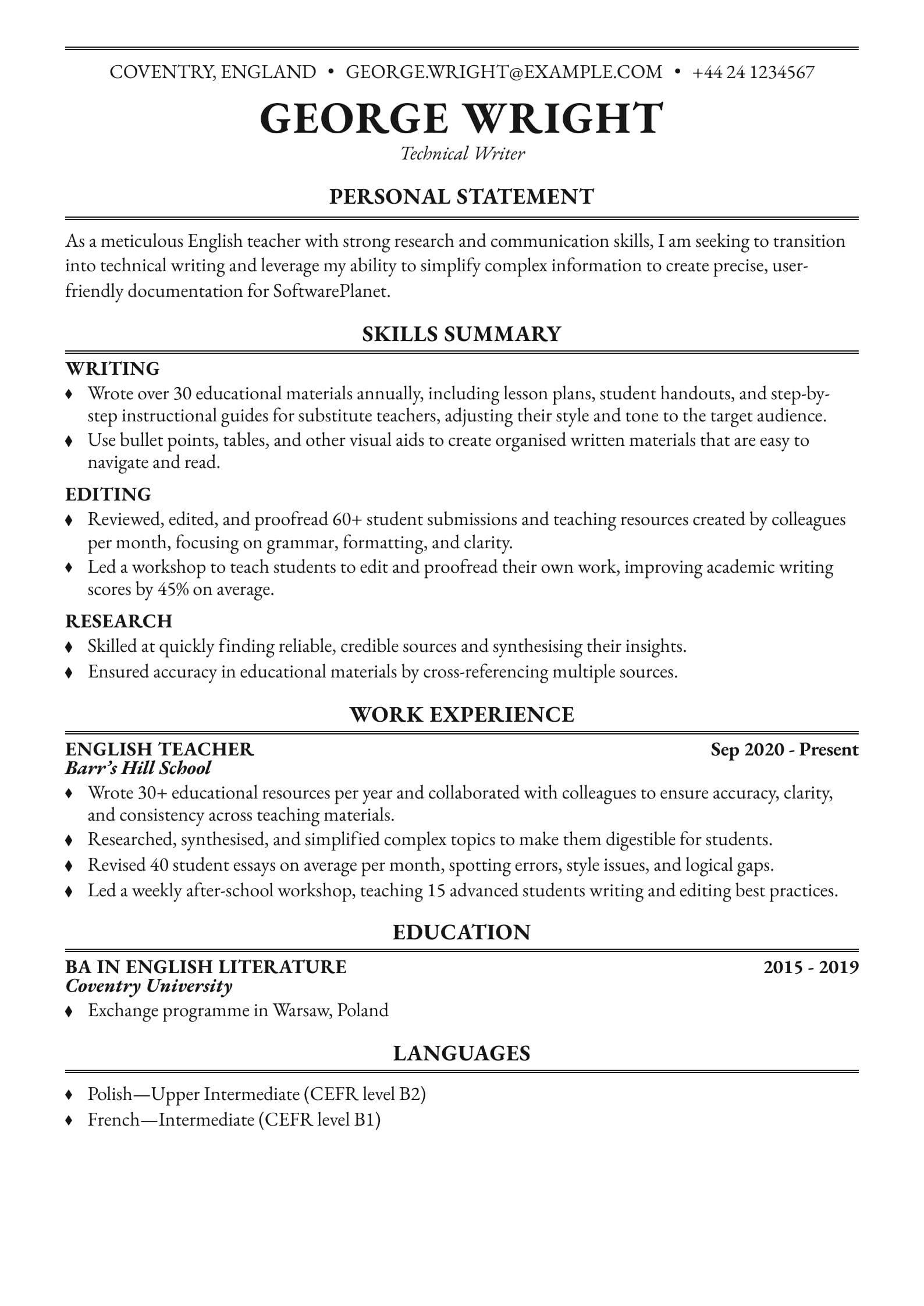
Here are two job-winning career change CV examples:
How to Format Your Career Change CV: What Are the Recruiters Looking For?
To format your career change CV correctly, remember that recruiters are looking for transferable skills and qualifications, rather than relevant work experience, in candidates switching careers.
So, while the reverse-chronological format is the gold standard for CV writing, this isn’t the case when writing one for a career change because it heavily focuses on work history. This is perfect for most people, but not for job changers, as it might shift focus to the lack of relevant work experience.
This leaves you with two options:
Functional (skills-based) format, which accentuates abilities and accomplishments rather than work experience
Combination (hybrid) format, which emphasises skills and work experience equally
Both of these formats are suitable for creating a career change CV. However, most recruiters in the UK favour the combination one, as it is more detailed and ATS-friendly than the functional format. The main difference between them is that the functional format provides little information on your work experience, which can come off as a lack of transparency.
With this in mind, let’s discover how to make a winning CV for a career change.
How to Create an Impactful Career Change CV

Here’s a step-by-step guide on how to create an impactful career change CV:
#1. Write a Powerful CV Header
To capture the recruiter’s interest and ensure they can contact you, you should first craft a CV header containing the following information:
Header Details
Your name and surname
Professional title (the one mentioned in the job description)
Mobile number
Email address
Location (city and country)
Relevant links, such as LinkedIn (optional)
Personal statement
Now, to write a powerful personal statement for a career change CV, follow this simple structure:
Personal Statement Structure
Introduce yourself to the recruiter and explain the new direction you’re taking.
Highlight transferable skills or any relevant experience.
Emphasise your motivation, career goals, or value proposition.
Here’s an example of a career change CV header:
CV Header Example
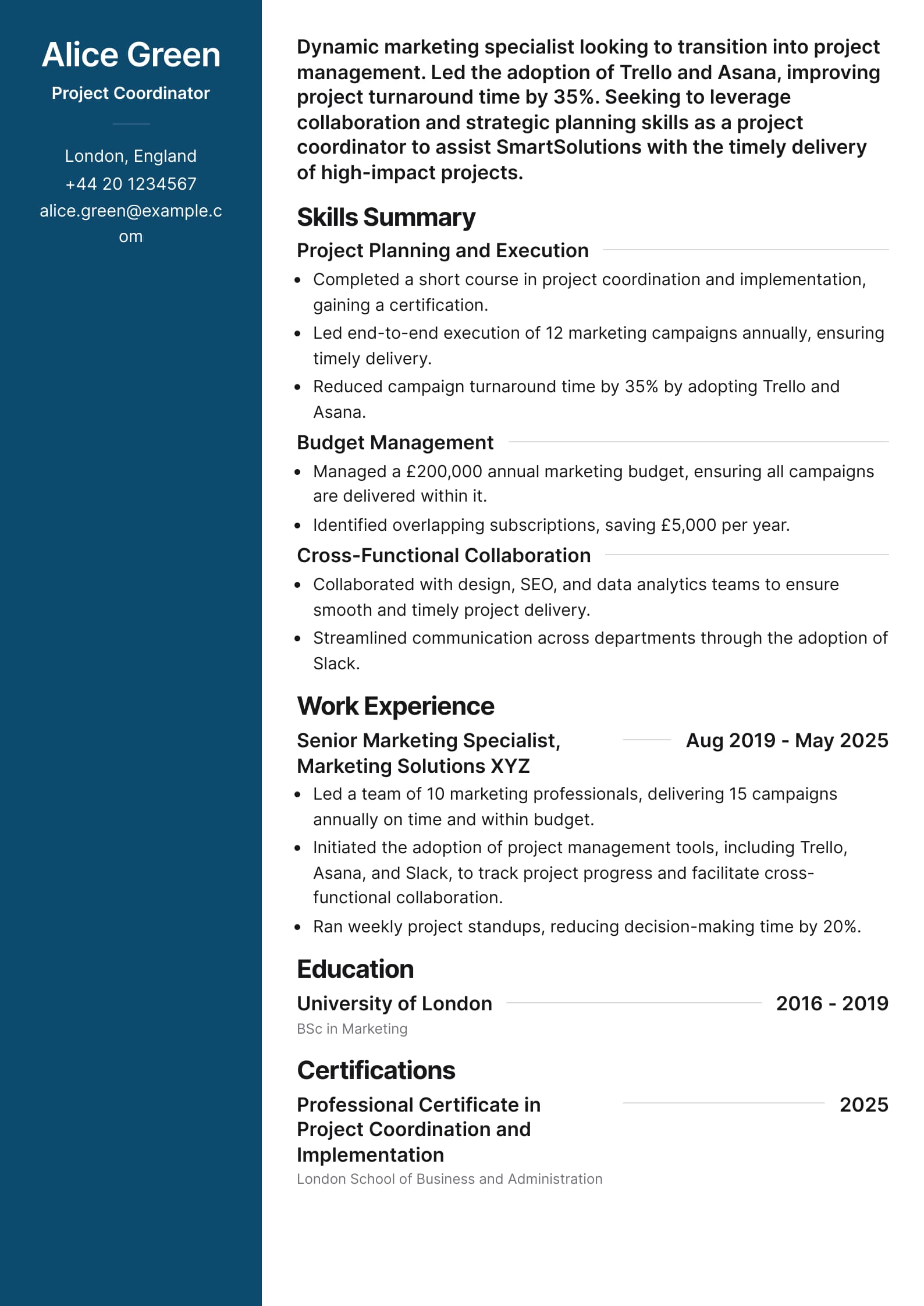
Alice Green
Project Coordinator +44 20 1234567 alice.green@example.com London, England linkedin.com/in/alicegreen892
Dynamic marketing specialist looking to transition into project management. Led the adoption of Trello and Asana, improving project turnaround time by 35%. Seeking to leverage collaboration, budget management, and strategic planning skills as a project coordinator to assist SmartSolutions with the timely delivery of high-impact projects.
#2. Highlight Transferable Skills
Next, you should add a skills summary to show the recruiter you’re qualified for the job, even if you come from a different professional background. Transferable skills are your main selling point in a career change CV, so make sure you present them clearly.
To write this section, check the job description and identify any soft and hard skills you’ve picked up in previous roles that align with the job you’re applying for.
Then, list them along with a few bullet points describing how you’ve acquired these skills or used them in the past. If possible, use numbers to illustrate your qualifications or quantify your achievements.
Your skills summary should look something like this:
Skills Summary Example
Skills Summary
Project Planning and Execution
Completed a short course in project coordination and implementation, gaining a certification.
Led end-to-end execution of 12 marketing campaigns annually, ensuring timely delivery.
Reduced campaign turnaround time by 35% by adopting Trello and Asana.
Budget Management
Managed a £200,000 annual marketing budget, ensuring all campaigns are delivered within budget.
Identified overlapping subscriptions, saving £5,000 per year.
Cross-Functional Collaboration
Collaborated with design, SEO, and data analytics teams to ensure smooth and timely project delivery.
Streamlined communication across departments through the adoption of Slack.
#3. Detail Your Work Experience
Writing a CV with no experience in the industry can be challenging, but it doesn’t mean you should simply skip this section. The key to writing an impressive work experience section in a career transition CV is to underscore transferable skills and relevant experiences.
Ask yourself, what does your current job have in common with the career you’re aspiring to pursue?
In other words, forget about the job title; focus on the tasks, skills, and achievements relevant to both positions, and emphasise them. If possible, add numbers, percentages, etc., to make this section more impactful and illustrate your accomplishments.
Here’s an example you can follow to write a well-formatted work experience section:
Work Experience Section Example
Work Experience
Senior Marketing Specialist Marketing Solutions XYZ 08/2019–05/2025
Led a team of 10 marketing professionals, delivering 15 campaigns annually on time and within budget.
Initiated the adoption of project management tools, including Trello, Asana, and Slack, to track project progress and facilitate cross-functional collaboration.
Ran weekly project standups, reducing decision-making time by 20%.
#4. Present Your Educational Background
Next, you should write an education section. Given that you’re switching careers, your educational background will likely have little to do with the industry you’re looking to enter. As such, it won’t be nearly as important as your transferable skills and experiences.
If your degree has helped you gain relevant skills, you can detail them with bullet points. Otherwise, keep this section short and sweet by listing your degree, academic institution, and attendance years like this:
Education Section Example
Education
BSc in Marketing University of London 2016–2019
#5. Leverage Additional Sections to Your Advantage
Although they’re generally optional, additional sections can take your career change CV from mediocre to phenomenal by helping you stand out among your competitors. They can also show the recruiter the steps you’ve taken to transition into the new field.
Some additional sections you can add to your CV include:
Optional Sections
Awards
Courses
Languages
Publications
Certifications
Volunteer work
Personal projects
You don’t have to include all of them; remember that the recommended CV length is one or two pages, so you don’t want to go overboard. Just mention anything that aligns with the job you’re looking to land.
Here’s an example of a job switch CV that leverages additional sections:
Additional Section Example
Certifications
Professional Certificate in Project Coordination and Implementation London School of Business and Administration 2025
Career Change CV Template
Here’s a handy career change CV template you can fill out in a word processor:
CV Template
[First name and surname]
[Job title]
[Mobile number]
[Email address]
[City, country]
[LinkedIn, portfolio, or other relevant links]
[Previous industry] professional looking to transition into [new industry]. [List relevant soft and hard skills and/or include a quantifiable achievement]. Seeking to leverage [relevant skills] as a [job title] to help [company’s name] achieve [company goals].
Skills Summary
[Skill #1]
Use 2–3 bullet points to describe how you acquired or used the skill in the past.
If possible, emphasise your achievements with numbers, percentages, etc.
[Skill #2]
Add a short bulleted list demonstrating this skill.
Work Experience
[Job title]
[Company’s name]
[Start date in mm/yyyy format–End date in mm/yyyy format]
If you’ve held more than one job, list each entry in this section in reverse-chronological order, starting with your most recent role.
Describe your responsibilities and achievements in 3–5 bullet points, highlighting transferable skills.
Use metrics, percentages, etc., to illustrate your skills, achievements, and value as a candidate.
Education
[Academic degree]
[Institution]
[Start year–End year]
Additional Sections
Add any extra sections that may enhance your CV.
Instead of ‘Additional Sections’, add the title of the section (e.g., ‘Languages’, ‘Personal Projects’, etc.).
Highlight transferable skills whenever possible.
5 Mistakes to Avoid When Creating a Career Change CV
To create a stellar career change CV, avoid the following mistakes:
#1. Making the CV Too Generic
One-size-fits-all CVs rarely work and are even more ineffective when transitioning into a different field. If your application is broad, generic, or irrelevant, recruiters will immediately reject it.
To ensure your CV isn’t overlooked, tailor it to the job by accentuating transferable skills and relevant experiences. Also, use the keywords mentioned in the job description to make it ATS-friendly.
#2. Not Explaining the Reason for the Switch
Recruiters want to know why you’re making the career change, so don’t leave them guessing; explain your motivation from the get-go. You can briefly mention why you’re making the transition or what excites you about the new field in the personal statement or detail it in a cover letter.
#3. Not Including a Cover Letter
Cover letters are usually optional, but not submitting one as a career changer can hurt your chances of landing your dream job.
While your CV outlines your professional background, a cover letter allows you to expand on it, tell your story, and show what makes you the perfect fit for the role, even if you’re new to the field. So, do yourself a favour and attach one to your job application!
#4. Not Showcasing Your Transferable Skills Clearly
Transferable skills are the cornerstone of a powerful career change CV, so sprinkle them throughout the document, from your personal statement to additional sections.
Even if you’re writing a career change CV with no experience that directly relates to the new industry, you probably have some skills that align with the job you’re looking to secure. You can always compensate for a lack of technical skills by highlighting relevant soft skills, as these can be applied across different industries.
#5. Leaving Out Relevant Unpaid Experiences
As a career changer, you won’t have relevant work experience, and that’s alright. However, if you have any unpaid experiences (internships, volunteering, personal projects, etc.) that helped you gain transferable skills, you’d be underselling yourself by leaving them out. So, include them in your CV and highlight the skills they helped you acquire!
Kickstart Your Career Change With CV.co’s Builder
Accelerate your career change with our CV maker, which comes with a built-in AI helper to help you craft an outstanding CV in minutes!
Final Thoughts
Hopefully, our guide has given you the confidence to write a career change CV that shows your true potential!
The bottom line is that you don’t need to discard your past experience when switching careers. Instead, reframe it to highlight the skills and achievements that align with your target role. This way, you can show recruiters you’re a strong candidate prepared for new challenges!
Career Change CV FAQ
#1. How do you explain a career change on a CV?
To explain a career change on a CV, write a strong personal statement that details your motivation for the transition. You can do this by emphasising your interest in the field, long-term goals, or the value you bring from your previous roles.
#2. What is a skills-based CV for a career change?
A skills-based CV is one of the most popular formats for a career change. Also known as the functional CV format, it accentuates your transferable skills. However, most UK recruiters prefer the combination format because it gives more insight into your work history.
#3. Should I explain the reason for my career change on my CV?
You should explain the reason for your career change briefly on your CV, as recruiters value transparency. If you have employment gaps, you can also address them. To explain your motivation in greater depth, it’s best to write a career change cover letter to go with your CV.