An artist CV is a specialised document that showcases your creative achievements, exhibitions, skills, and artistic projects to help you secure gallery representation, grants, residencies, or commissions. Unlike standard CVs, artist CVs emphasise visual work, collaborations, and creative output rather than traditional employment history.
In this guide, we'll show you how to write an artist CV that captures your unique creative voice and presents your work in a way that resonates with galleries, curators, and arts organisations. We'll also provide real examples and practical tips to help you stand out in the competitive art world.
Key Takeaways
Artist CVs differ from traditional CVs as they focus on exhibitions, creative projects, residencies, and artistic achievements rather than conventional work experience.
A strong artist CV should include contact details, a professional headline, relevant skills, exhibition history, education, and a portfolio.
When you lack professional experience, highlight student exhibitions, personal projects, freelance commissions, and transferable creative skills.
Use reverse chronological artist CV format, include measurable achievements, and always link to your online portfolio.
2 Professional Artist CV Examples to Follow
Before we dive into the writing process, let's examine two compelling artist CV examples that demonstrate effective approaches for different career stages. These samples illustrate how to present your creative work professionally whilst maintaining your artistic identity.
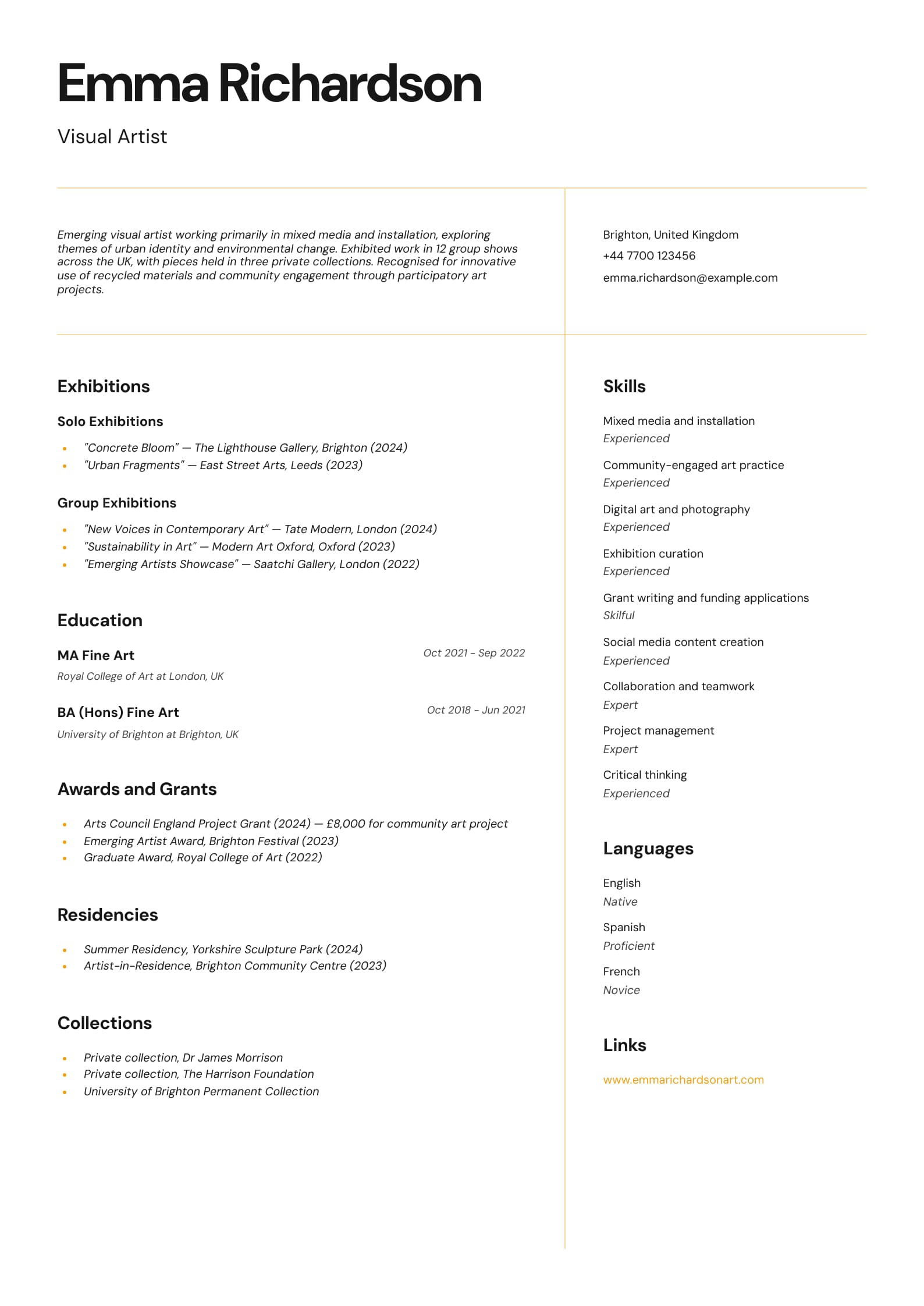
This CV works because it immediately establishes artistic focus and achievements whilst maintaining a professional structure.
The exhibitions section is particularly strong—it separates solo and group shows, making the candidate’s reputation clear. Including specific grant amounts and collection details adds credibility, whilst the skills section balances technical abilities with soft skills that matter to collaborators and commissioners.
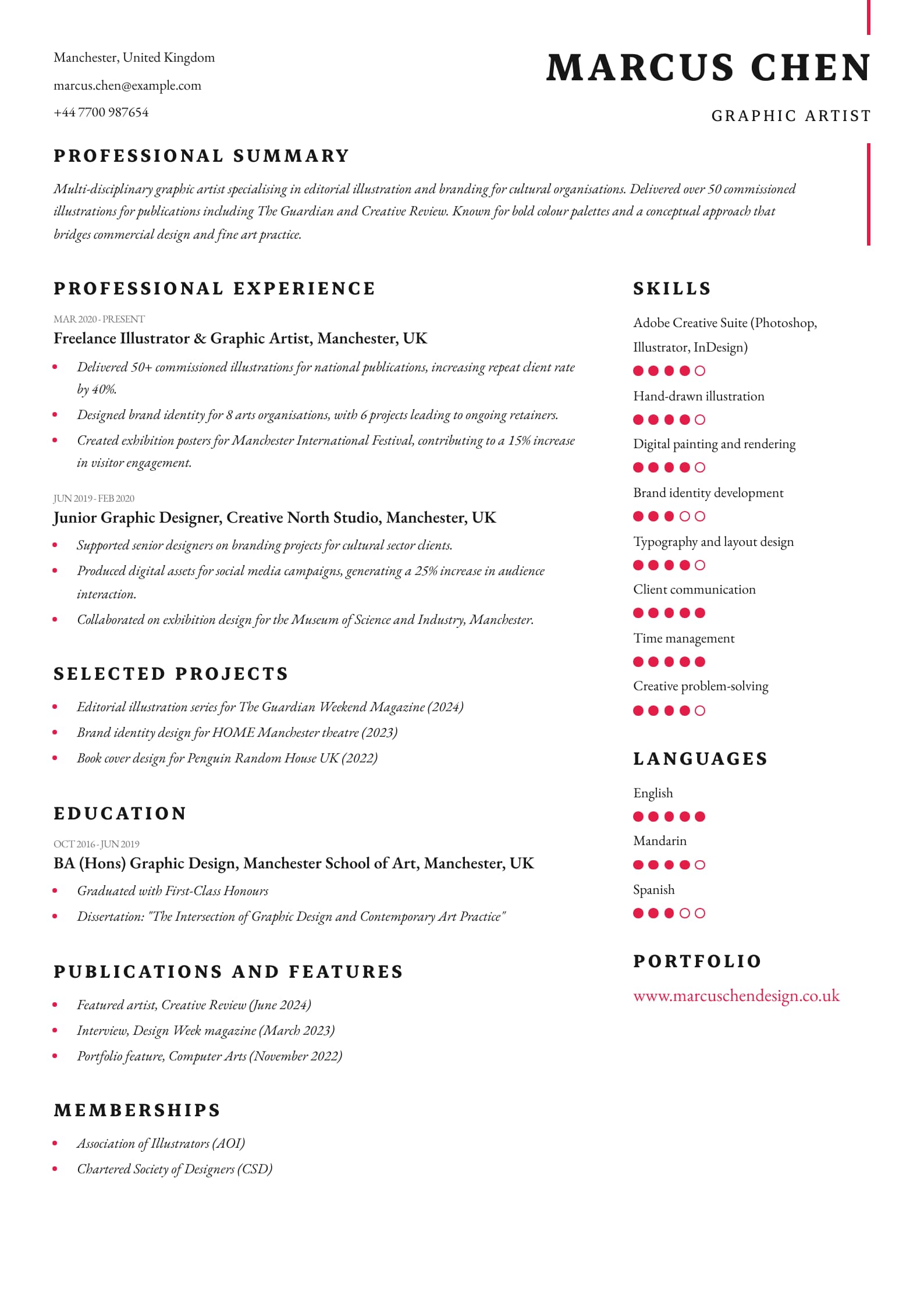
This CV example bridges the gap between commercial practice and artistic credibility. The professional experience section uses specific metrics (50+ commissions, 40% increase in repeat clients) that demonstrate business acumen alongside creative talent.
Including publications and professional memberships adds legitimacy, whilst the selected projects section highlights prestigious clients without overwhelming the reader.
5-Step Guide to Crafting Your Artist CV

Creating an effective artist CV requires balancing creative authenticity with professional presentation. The reverse chronological format works best for artists because it immediately showcases your most recent and relevant achievements—whether that's exhibitions, commissions, or completed projects.
Now, let's examine each essential section and how to write it effectively:
#1. Add Your Contact Details and a Headline
Every artist CV begins with clear contact information placed prominently at the top, where galleries, curators, and commissioners can immediately find it. This isn't just an administrative detail—it's your first opportunity to present yourself professionally whilst maintaining your creative identity.
Your contact section should include:
Contact Section Details
Full name
Location (city and country)
Professional email address
Phone number
Portfolio website or online gallery
LinkedIn profile (optional)
The key here is using a professional email address—ideally something like firstname.lastname@email.com rather than creative handles that might seem unprofessional. Save your artistic personality for the work itself; your contact details should simply make you easy to reach.
Directly beneath your contact information, include a professional summary that captures your artistic practice in 3-4 sentences. This should mention your medium, themes, notable achievements, and what makes your work distinctive.
Here's what an effective contact information section looks like:
Contact Information and Summary Example
Contact Information
Sophia Williams Edinburgh, United Kingdom sophia.williams@example.com +44 7700 456789 www.sophiawilliamsart.com
Professional Summary
Contemporary painter exploring memory and place through abstract landscapes. Exhibited in 15 group shows across Scotland, with work featured in two solo exhibitions at Edinburgh galleries. Recipient of Creative Scotland Award (2024) for a series examining post-industrial Scottish landscapes.
#2. Highlight Relevant Skills
The skills section demonstrates both your technical abilities and the soft skills that make collaborations successful. For artists, this means balancing medium-specific expertise with transferable capabilities like interpersonal skills and communication.
Start with your hard skills—the technical competencies specific to your artistic practice:
Medium-specific techniques (oil painting, ceramics, printmaking, digital illustration)
Software proficiency (Adobe Creative Suite, 3D modelling, video editing)
Exhibition installation and curation
Grant writing and funding applications
Photography and documentation
Social media and digital marketing in art
Then include soft skills that demonstrate your professionalism:
Collaboration and teamwork
Time management and deadline adherence
Client communication
Critical thinking and conceptual development
Adaptability to different creative briefs
Problem-solving under constraints
Don't just list these mechanically—consider which artist skills genuinely strengthen your practice and are relevant to opportunities you're pursuing. An installation artist applying for public art commissions should emphasise project management and community engagement; a gallery artist might focus on exhibition curation and art writing.
Here's an effective skills section:
Artist Skills Example
Skills
Oil painting and mixed media techniques
Large-scale canvas work (up to 3m)
Adobe Photoshop and Lightroom for documentation
Exhibition curation and installation
Public speaking and artist talks
Grant proposal writing
Social media content creation (Instagram, TikTok)
Collaboration with community groups
Project management
Critical analysis and art writing
#3. Showcase Work Experience and Projects
This is the heart of your artist CV, but it looks quite different from traditional work experience sections. Rather than job titles and companies, it should focus on exhibitions, commissions, residencies, and collaborative projects that demonstrate your artistic development and professional credibility.
Structure this section using action verbs that capture the creative process, such as created, developed, exhibited, designed, collaborated, curated, and facilitated. These words convey active engagement rather than passive participation.
Where possible, add measurable impact to give context to your achievements. This doesn't always mean numbers—artistic impact can be qualitative—but specifics strengthen your claims:
Work Experience and Projects Example
Exhibited in 'New Voices' group show at Tate Modern, with work viewed by over 15,000 visitors
Created a 4-metre sculpture for Manchester City Council, now a permanent feature in Piccadilly Gardens
Selected for a three-month residency at the Yorkshire Sculpture Park, resulting in a solo exhibition
For artists with traditional employment (teaching, gallery work, design roles), include this too, but frame it through the lens of your artistic development. Don't just list responsibilities—explain how these experiences informed your creative practice.
Here's what this looks like in practice:
How to Frame Traditional Employment on Your CV
Exhibitions and Projects
Solo Exhibitions
"Industrial Memory" — The NewBridge Project, Newcastle (2024)
Exhibited 12 large-scale mixed-media works exploring post-industrial landscapes
Generated media coverage in The Guardian and BBC Newcastle
3 pieces acquired for private collections
"Fragments of Place" — Backlit Gallery, Nottingham (2023)
First solo show featuring 8 paintings and installation work
Attended by 200+ visitors over a three-week run
Group Exhibitions
"Emerging Artists 2024" — Royal Academy of Arts, London
"Northern Voices" — BALTIC Centre for Contemporary Art, Gateshead (2023)
"New Work" — Dundee Contemporary Arts (2022)
Public Art Commissions
Community Mural Project, Edinburgh City Council (2024)
Designed and executed a 10-metre mural with input from 50+ local residents
Featured in the Edinburgh Evening News and BBC Scotland coverage
Artist Residencies
Summer Residency, Cove Park, Argyll (2024)
Three-month residency resulting in a new body of work exploring coastal landscapes
Community Artist Residency, Camden Arts Centre, London (2023)
Delivered weekly workshops alongside personal studio practice
#4. Include Education and Certifications
The education section should list your two most recent degrees or qualifications, along with the institutions where you studied and your dates of attendance. For most artists, this means including art school degrees, though the level of detail depends on your career stage.
Recent graduates should expand this section with relevant coursework, dissertations, and academic achievements:
Education Section Example for Recent Art Graduates
Education
MA Fine Art October 2022–September 2023 Goldsmiths, University of London, London, UK
Graduated with Distinction
Dissertation: "Material Memory: Using Found Objects in Contemporary Installation"
Final exhibition received 'Outstanding Achievement' award
Studied under the mentorship of Turner Prize nominee Sarah Lucas
BA (Hons) Fine Art October 2019–June 2022 Glasgow School of Art, Glasgow, UK
Established artists can keep education more concise, as professional achievements speak louder:
Education Section Example for Established Artists
Education
MA Fine Art Royal College of Art, London, UK October 2015–September 2016
BA (Hons) Fine Art Edinburgh College of Art, Edinburgh, UK October 2012–June 2015
Beyond formal degrees, include relevant certifications and professional development:
Specialist workshops (printmaking, ceramics, digital media)
Business training (art entrepreneurship, intellectual property)
Teaching qualifications if you deliver workshops
Technical certifications (Adobe Certified Professional, etc.)
These demonstrate an ongoing commitment to developing your practice and expanding your capabilities.
#5. Consider Adding Other Sections
Once you've covered the essentials, additional sections can strengthen your CV by showcasing achievements that don't fit neatly elsewhere. These extras are particularly valuable for artists, where grants, publications, and collections carry considerable weight.
Consider including:
Awards and Grants
List funding received, competition wins, and professional recognition
Include amounts for grants (e.g., "Arts Council England Grant — £5,000")
Mention selection rates if particularly competitive (e.g., "Selected from 400+ applicants")
Collections
Note where your work is held (museums, corporate collections, prominent private collectors)
This demonstrates market recognition and institutional validation
Publications and Media Features
Articles you've written about your practice
Interviews or features in art magazines, newspapers, and online publications
Catalogue essays that discuss your work
Professional Memberships
Membership in artists' organisations (e.g., SAA membership)
Professional bodies relevant to your practice
Public Speaking and Artist Talks
Guest lectures at universities
Panel discussions
Gallery talks about your work
Portfolio Links
Perhaps most crucially for artists, always include a link to your online portfolio. This can be in your contact section or as a separate line:
Portfolio Links Example
Portfolio
View complete portfolio: www.yourname.com Instagram: @yourartisthandle
These additional sections shouldn't bloat your CV—be selective about what genuinely strengthens your application. A teaching artist might emphasise workshops delivered; a gallery artist might focus on collections and reviews. Tailor these sections to support the specific opportunities you're pursuing.
How to Write an Artist CV Without Professional Experience
Creating an artist CV without formal gallery representation or major exhibitions can feel daunting, but early-career artists have more to showcase than they often realise. The key is reframing what "counts" as professional experience and highlighting the creative work you've genuinely accomplished.
Follow these four strategies to write an artist CV without professional experience:
Focus on projects, coursework, and student exhibitions. Your degree show isn't less valuable because it happened at university—it's still a curated exhibition of your work. Similarly, coursework projects that pushed your practice forward deserve mention, especially if they explored themes you continue developing professionally.
Include freelance commissions and volunteer work. Designing posters for local theatre companies, creating murals for community centres, or illustrating for small publications all demonstrate your ability to work to briefs, meet deadlines, and collaborate with clients. These experiences build credibility and show you're actively practising your craft.
Highlight transferable skills. Perhaps your retail job honed your customer service and communication abilities—valuable when dealing with gallery visitors or commissioners. Maybe you've managed social media for a student society, demonstrating digital marketing skills increasingly crucial for contemporary artists.
Emphasise enthusiasm, willingness to learn, and the unique perspective you bring. Emerging artists often tackle themes and approaches that more established practitioners have moved beyond—your fresh perspective is an asset, not a limitation.
3+ Tips For Writing Your Artist CV
Beyond following the basic structure, these practical tips will help your artist CV stand out:
Tailor your CV for each application. Read what the opportunity requires and adjust which achievements you foreground accordingly. This doesn't mean fabricating experience—just reorganising emphasis.
Use consistent, professional formatting throughout. Whilst you might be tempted towards creative layouts, remember that many opportunities use applicant tracking systems (ATS) to process applications—overly designed CVs may not parse correctly.
Include concrete details that bring achievements to life. Specific details make your experience tangible and memorable whilst demonstrating the scale of opportunities you've accessed. For example: "exhibited two paintings in 'Northern Voices' at BALTIC Centre, viewed by 8,000+ visitors over a six-week run."
Proofread before submitting. Typos and grammatical errors undermine the professionalism you're working to convey. Ask someone else to review your CV—preferably someone who understands the art world but isn't so close to your practice that they'll overlook mistakes.
Create Your Artist CV in Minutes
Use our CV builder to create a polished, ATS-friendly document in under 15 minutes. Simply enter your exhibitions, education, and skills—our platform handles the formatting automatically. Choose from professionally designed CV templates that balance creativity with clarity, ensuring your artistic achievements shine through.
Plus, you can generate a tailored artist cover letter to complement your CV and showcase your artistic vision to galleries and commissioners.
Start Building Your Artist CV
Build My CV NowFinal Thoughts
Writing an artist CV requires balancing creative authenticity with professional presentation—a challenge that mirrors the broader task of navigating the art world whilst staying true to your practice. The most effective artist CV format allows you to present information clearly without sacrificing personality and to demonstrate both artistic vision and professional reliability.
Remember that your CV is a living document. As you gain experience, complete new projects, and develop your practice, regularly update your CV to reflect these developments. What felt like a significant achievement two years ago might be eclipsed by more recent work—that's growth, and your CV should evolve alongside your practice.
Artist CV FAQs
#1. How long should an artist CV be?
An artist CV should typically be 2-3 pages long, though this increases with career progression. Unlike standard CVs, artist CVs are expected to comprehensively document your professional trajectory rather than highlighting only recent achievements.
#2. Should I include a photo on my artist CV?
You shouldn’t include a photo on your artist CV unless specifically requested by the opportunity you're applying for. Some international applications or teaching positions may request photos, but UK galleries and funding bodies typically don't expect them.
#3. How do I list exhibitions and residencies?
You can list exhibitions and residencies in reverse chronological order (most recent first), separating solo and group exhibitions into distinct subsections. Include the exhibition title in quotation marks, venue name, location, and year. For significant shows, add brief context: visitor numbers, press coverage, or works sold.