
An acting CV is a specialised document that showcases your performance credits, training, and skills to casting directors, agents, and producers. Unlike traditional CVs, it prioritises your acting experience across film, television, and theatre, alongside physical attributes relevant to casting decisions.
Casting directors skim dozens of applications daily, and a poorly formatted or cluttered CV gets binned immediately. Therefore, your document needs to communicate your experience, range, and professionalism within seconds. This guide walks you through everything, from writing, real-world CV examples and industry-standard formatting to what to include and what to leave out.
Key Takeaways
An acting CV follows a unique format: credits first, then training, skills, physical attributes, and links to your showreel and profiles.
List your acting experience by medium (Film, TV, Theatre), with production name, role, director, and company clearly formatted.
Include acting training from drama schools, workshops, and online courses; casting directors value continuous development.
Highlight hard skills like accents, stage combat, and singing, plus physical details like height, build, and playing age.
Keep your CV to one page, include a professional headshot, and link to your showreel, Spotlight, and IMDb profiles.
2 Acting CV Examples That Get You Cast
Most actors want to see what a good acting CV looks like before they write their own. Therefore, the following CV examples show the structure, tone, and level of detail expected in the industry:
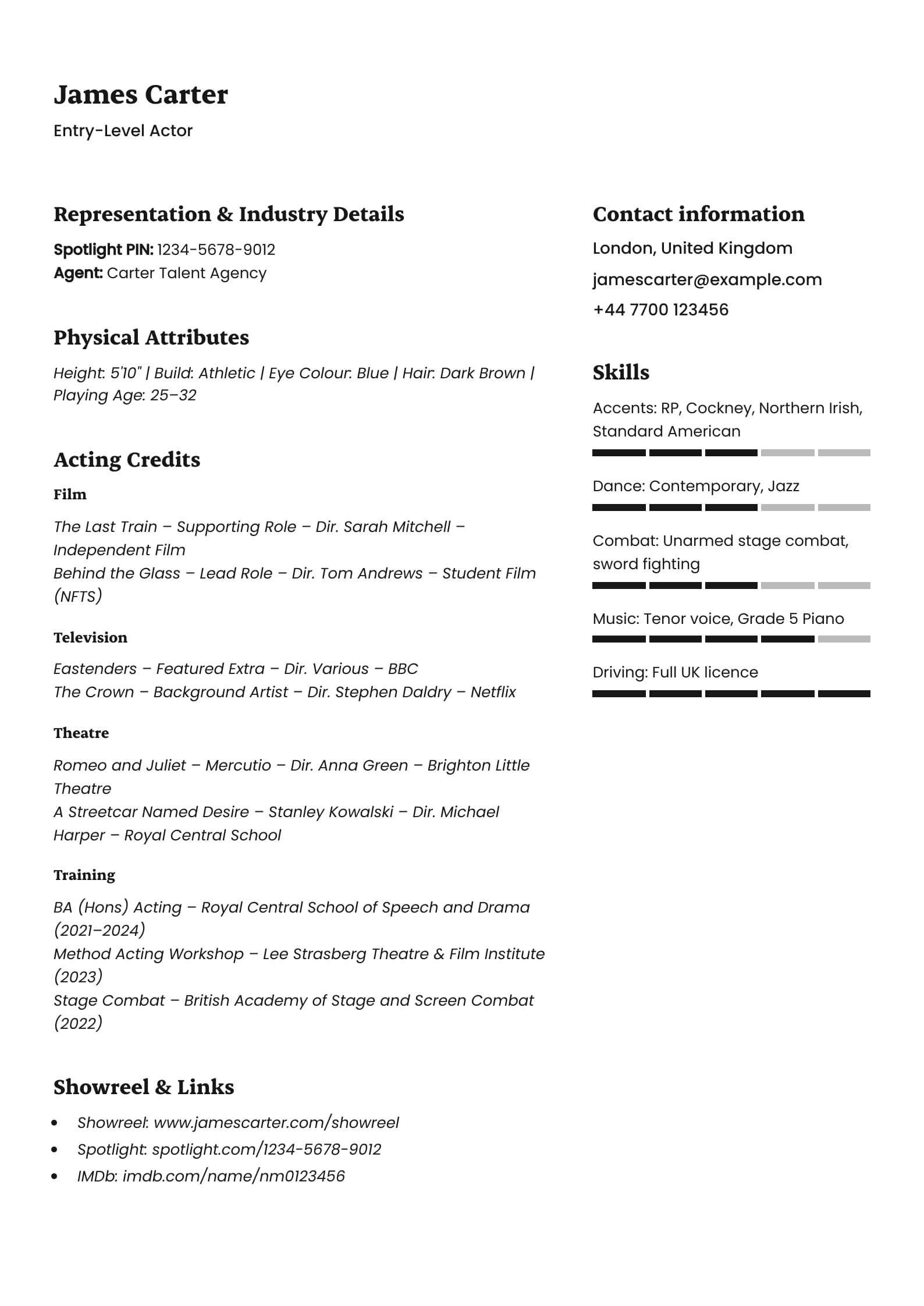
This CV example is clean, industry-standard, and immediately tells casting directors what they need to know. The candidate lists acting credits by medium, includes training from a recognised drama school, and highlights specific skills like accents and stage combat. Their physical attributes are front and centre, and the showreel link is easy to find.
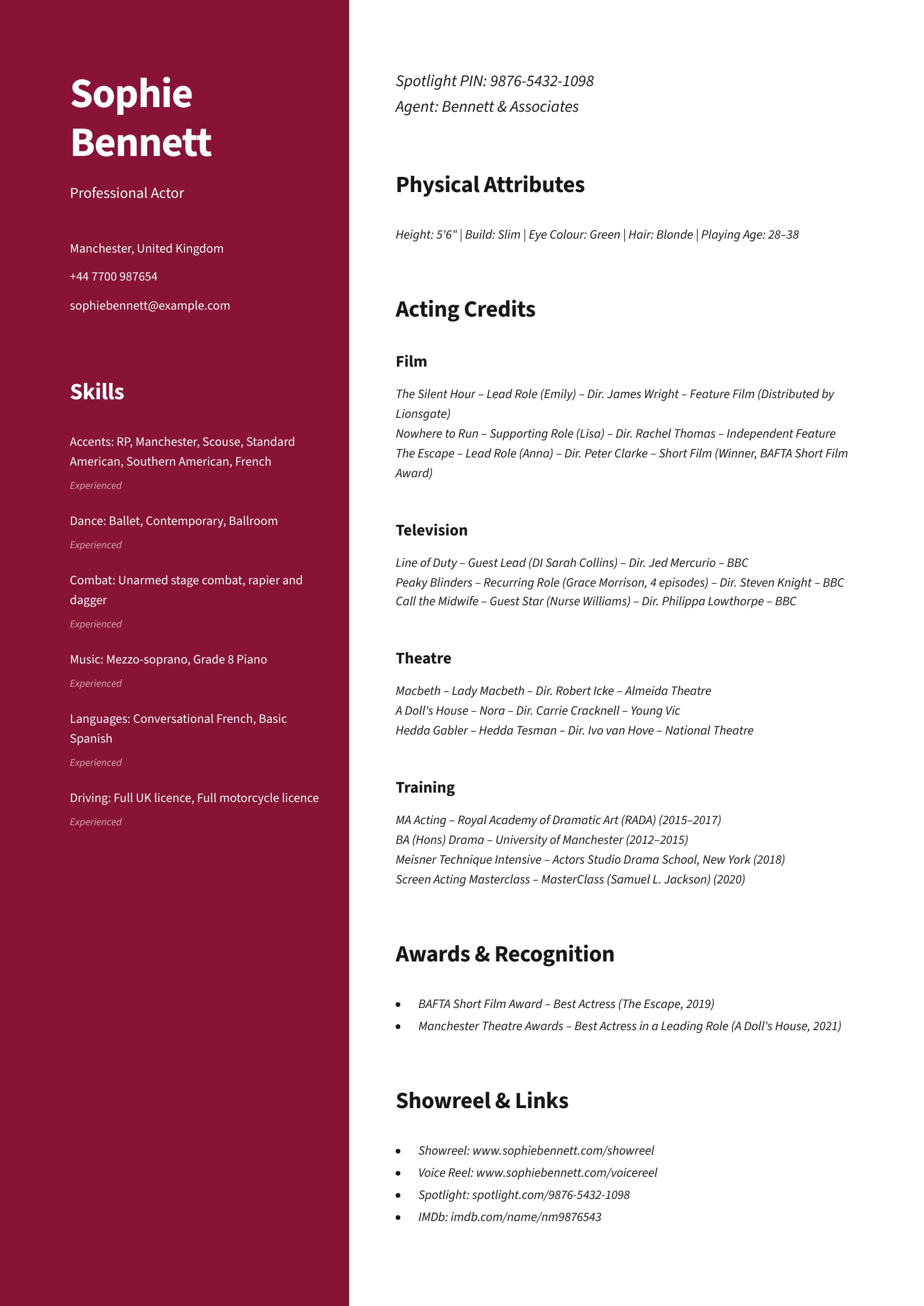
This CV demonstrates what a well-established actor's application looks like. The candidate lists recognisable credits across film, TV, and theatre, including major productions and award-winning performances. The training section includes prestigious institutions like RADA, and her skills are extensive, covering accents, combat, languages, and driving qualifications.
Acting CV Format: Here’s What You Need to Look Out For
Acting CVs follow a completely different structure from traditional CVs. The format reflects the priorities of casting directors, who care far more about your performance history and physical suitability than your education or work experience.
Industry-standard order for an acting CV is:
Acting CV Structure
Contact details, representation, and headshot
Physical attributes (height, build, eye colour, playing age)
Acting credits (Film, TV, Theatre)
Training and education
Skills (accents, combat, dance, instruments)
Showreel, Spotlight, and IMDb links
Casting directors want to see immediately what you've done, who you've worked with, and whether you're right for the role they're casting. Everything else—training, skills, physical details—supports that primary information.
Reverse chronological order is standard for listing your credits, so start with your most recent work and go backwards. This approach highlights your current activity and career progression, indicating that you're actively working and developing your craft.
Acting CVs are typically one page long—two at most if you have extensive credits across multiple mediums. Unlike traditional CVs, where you might stretch to two pages to showcase achievements, these need to be scannable.
Headshots are often included directly on acting CVs, usually in the top right corner, and the photo should be recent, professional, and match your current look. If you're submitting digitally and the platform doesn't support embedded images, attach your headshot separately or link to it on your Spotlight profile.
Lastly, acting CVs don't follow the same ATS rules that corporate CVs do, as casting directors don't use applicant tracking systems to scan your CV for keywords. That said, clean formatting, clear section headers, and logical structure still matter. Stick to a clean, text-based layout with clear section headings; the focus should be on your credits and skills, not on design elements that distract from the content.
How to Write an Acting CV in 5 Easy Steps
Writing an acting CV isn't complicated, but it does require following industry conventions. Miss a key section or format your credits incorrectly, and casting directors will assume you're inexperienced. To avoid this, follow these five steps and create a professional, industry-standard acting CV that gets you noticed:
#1. Start With Your Contact Details, Representation, and Headshot
Your contact information sits at the top of your CV, in the header, and it needs to include more than just your name and email. Casting directors and agents need to know how to reach you and whether you're already represented.
Include the following:
Full name
Location (city or region—no need for a full address)
Professional email address
Phone number
Agent or agency name (if represented)
Spotlight PIN or profile link
IMDb link (if you have credits listed)
Agent information signals that you're a working actor with professional representation. If you don't have an agent yet, just list your contact details and move on; as for the headshot placement, it depends on the format.
If you're submitting a digital CV, embed your headshot in the top right corner. If you're sending a PDF or printing your CV, attach your headshot separately or link to your Spotlight profile. Either way, your headshot should be recent, professional, and match your current look.
Here’s a good example of a contact information section:
Contact Information and Representation
Contact Information
Emma Richardson London, United Kingdom emmarichardson@example.com +44 7700 654321 Agent: Richardson Talent Agency Spotlight PIN: 5678-1234-5678 IMDb: imdb.com/name/nm5678901546
#2. List Your Acting Credits Clearly (Film, TV, Theatre)
Your acting credits are the heart of your CV. This section tells casting directors what you've done, who you've worked with, and whether you have experience relevant to the role they're casting.
Make sure to format each credit properly, i.e. Production Name – Role – Director – Company/Venue. Also, list your credits by medium (Film, Television, and Theatre). Within each medium, use reverse chronological order.
Include measurable achievements where relevant. If you played a lead role, won an award, or worked with a recognisable director, mention it. Don't exaggerate or pad your credits, but don't undersell yourself either.
Action verbs aren't as critical in acting CVs as they are in corporate CVs, but specificity matters. Instead of writing "Appeared in Eastenders," specify whether you were a featured extra, guest star, or recurring character. That detail tells casting directors your level of experience.
Let’s see a good example of acting credits:
Acting Credits Example
Film
The Silent Hour – Lead Role (Emily) – Dir. James Wright – Feature Film (Distributed by Lionsgate) Nowhere to Run – Supporting Role (Lisa) – Dir. Rachel Thomas – Independent Feature The Escape – Lead Role (Anna) – Dir. Peter Clarke – Short Film (Winner, BAFTA Short Film Award)
Television
Line of Duty – Guest Lead (DI Sarah Collins) – Dir. Jed Mercurio – BBC Peaky Blinders – Recurring Role (Grace Morrison, 4 episodes) – Dir. Steven Knight – BBC Call the Midwife – Guest Star (Nurse Williams) – Dir. Philippa Lowthorpe – BBC
Theatre
Macbeth – Lady Macbeth – Dir. Robert Icke – Almeida Theatre A Doll's House – Nora – Dir. Carrie Cracknell – Young Vic Hedda Gabler – Hedda Tesman – Dir. Ivo van Hove – National Theatre
#3. Add Your Acting Training, Workshops, and Education
Training is crucial for actors; in fact, the studies show that, besides being vital for the progress of an actor, it also develops social competencies by altering neural networks. So, even if you're self-taught or come from a non-traditional background, you can still demonstrate training through workshops, online courses, and short intensives.
List your training in reverse chronological order, starting with your most recent courses, such as:
Drama schools and universities (BA, MA, or diploma programmes)
Short courses and workshops (method acting, Meisner, voice training)
Stage combat certifications
Voice and movement classes
Online courses (MasterClass, Coursera, Udemy)
Here’s a good way to do it:
Training Example
Training
MA Acting – Royal Academy of Dramatic Art (RADA) (2015–2017)
BA (Hons) Drama – University of Manchester (2012–2015)
Meisner Technique Intensive – Actors Studio Drama School, New York (2018)
Screen Acting Masterclass – MasterClass (Samuel L. Jackson) (2020)
Stage Combat – British Academy of Stage and Screen Combat (2019)
Drama schools carry weight. If you trained at RADA, Guildhall, Central, or another recognised institution, make that clear. If you didn't attend a formal drama school, just be honest about your background and highlight the training you have completed.
Furthermore, MasterClass courses from actors such as Helen Mirren, Samuel L. Jackson, and Natalie Portman are legitimate training opportunities. Similarly, Coursera and Udemy offer acting and performance courses that demonstrate your commitment to learning.
Finally, short workshops matter too. If you attended a weekend intensive on screen acting, voice work, or improvisation, list it. These workshops show that you're actively developing your skills, which is exactly what casting directors want to see.
#4. Highlight Acting Skills and Physical Attributes
This section is unique to acting CVs, and it's more important than you might think. This isn't about listing generic "communication skills" or "teamwork"; it's about specific, tangible abilities that affect casting decisions.
Here are some hard skills actors should include in their CV:
Accents and dialects: RP, Cockney, Scouse, Standard American, Southern American, Irish, Scottish, etc.
Stage combat: Unarmed combat, sword fighting, rapier and dagger
Dance: Ballet, contemporary, jazz, ballroom, tap
Singing: Voice type (soprano, tenor, baritone), vocal range
Musical instruments: Piano, guitar, violin, etc.
Languages: Fluency levels in foreign languages
Driving: UK licence, motorcycle licence, HGV licence
Soft skills still matter, but they're secondary. Emotional intelligence, adaptability, and teamwork are important in ensemble casts, but casting directors assume you have these qualities if you're a professional actor. Highlight them briefly, but don't dedicate a full section to them.
Let’s see a good example of the acting skills section:
Skills Section
Skills
Accents: RP, Cockney, Manchester, Standard American, Southern American, French
Dance: Ballet, Contemporary, Ballroom
Combat: Unarmed stage combat, rapier and dagger
Music: Mezzo-soprano, Grade 8 Piano
Languages: Conversational French, Basic Spanish
Driving: Full UK licence, Full motorcycle licence
Casting directors also need to know whether you fit the role they're casting, and physical details help them make that decision quickly. Make sure to include:
Height
Build (slim, athletic, stocky, etc.)
Eye colour
Hair colour
Playing age (the age range you can convincingly portray)
For example:
Physical Details to Include
Physical Attributes
Height: 5'6" | Build: Slim | Eye Colour: Green | Hair: Blonde | Playing Age: 28–38
#5. Include Your Showreel, Spotlight, IMDb, and Social Links
Your showreel is arguably more important than your CV, which is why it needs to be prominent, functional, and up to date.
Include the following links:
Showreel: A 1–3 minute compilation of your best on-screen work
Voice reel: If you do voiceover work, include a separate link
Spotlight: Your Spotlight profile (industry-standard in the UK)
IMDb: Your IMDb page (if you have credits listed)
Personal website: If you have a professional actor website with additional materials
Before you send your acting CV, test every single link to make sure it works. Also, social media isn't essential, but it can be useful. If you have a professional Instagram or Twitter account where you post about your acting work, industry news, or behind-the-scenes content, include it. Just make sure your feed is clean and professional.
How to Write an Acting CV With No Experience

Writing an acting CV without experience might feel like you have nothing to put on it; however, that's not true since you still have training, projects, and transferable skills. You just need to frame them correctly. Here’s what you should focus on:
Student films and short films. These are legitimate credits. List them honestly as student projects or shorts, and include the director's name and production company where possible.
Amateur theatre. Community theatre, school productions, and university plays all count as acting experience. Don't exaggerate the scale, but don't undersell them either.
Workshops and training. If you've taken acting classes, voice lessons, or stage combat workshops, list them in your training section. This shows that you're serious about developing your craft.
Transferable soft skills. Communication, teamwork, adaptability, emotional intelligence, and empathy in acting are all relevant. If you've worked in customer service, teaching, or any role that requires interpersonal skills, you can subtly highlight those abilities.
Volunteering. If you've performed at charity events, helped with youth theatre programmes, or volunteered at festivals, mention it. These experiences demonstrate your passion for performance and your willingness to work in different contexts.
4 Common Mistakes Actors Make on Their CV
Here are some CV mistakes Actors make, usually because they're rushing or don't understand industry conventions:
#1. Using a Generic Office CV Template
This is the biggest mistake, as too many actors download a corporate CV template with graphics, timelines, and colour blocks, and then wonder why casting directors aren't taking them seriously. Acting CVs need to be clean, text-based, and easy to scan. Use a simple layout with clear section headers, standard fonts (like Arial or Calibri), and no distracting design elements.
#2. Adding Irrelevant or Outdated Credits
Your CV should only include acting credits, not your part-time job at Tesco or your GCSE results. Casting directors don't care about your work history outside the industry. Similarly, if you played a tree in a school play 15 years ago, leave it off; only include credits that demonstrate your current skills and experience.
#3. No Headshot or Broken Showreel Links
If casting directors can't see what you look like or watch your showreel, you're immediately at a disadvantage. Make sure your headshot is embedded or attached, and test every single link before you send your CV. Broken links are a red flag; they suggest you're not detail-oriented or professional.
#4. Ignoring ATS Formatting Rules (Even Though Acting CVs Aren't Scanned)
Acting CVs don't go through applicant tracking systems (ATS) as corporate CVs do, but that doesn't mean formatting doesn't matter. Clean section headers, logical structure, and consistent formatting make your CV easier to read. If a casting director has to hunt for your contact details or figure out what your credits mean, they'll move on to the next actor.
Create a Job-Winning Acting CV Within Minutes
Writing an acting CV from scratch can feel overwhelming, especially if you're trying to get the format, credits, and links exactly right. Use our CV builder to create a professional, industry-standard acting CV in less than 15 minutes. Simply enter your information, follow the prompts, and choose a clean, text-based template. You'll have a submission-ready CV that casting directors actually want to read.
Final Thoughts
Your acting CV is your calling card in the industry. It needs to showcase your experience, training, and skills in a format that casting directors recognise and respect. Follow the structure outlined in this guide—contact details, physical attributes, credits, training, skills, and links—and you'll create a CV that gets you noticed.
Use the examples as a starting point, avoid the common mistakes, and make sure every link works before you send it out. With a strong CV and a solid showreel, you'll be well-positioned to land auditions and build your career!
Acting CV FAQs
#1. What should an acting CV include?
An acting CV should include your contact details, agent information (if represented), physical attributes, acting credits, training and education, skills, and links to your showreel, Spotlight, and IMDb profiles. The format differs from traditional CVs because it prioritises your performance history and physical suitability for casting decisions.
#2. Should I add headshots directly to my acting CV?
Yes, you should add headshots directly to your CV if you're submitting digitally and the format supports it. Most actors embed their headshot in the top right corner of the CV. If you're sending a PDF or printing your CV, attach your headshot separately or link to your Spotlight profile where casting directors can view it.
#3. Do I need a showreel for an acting CV?
Yes, you need a showreel for an acting CV since casting directors want to see you perform, not just read about your credits. Your showreel should be 1–3 minutes long and showcase your best on-screen work across different roles and emotions. If you're just starting out and don't have professional footage yet, consider filming self-tapes or working on student films to build your reel.
#4. Do acting CVs follow normal ATS formatting rules?
No, acting CVs don’t follow normal ATS formatting rules and aren't scanned by ATS like corporate CVs are. Casting directors read them manually, so you don't need to worry about keyword optimisation or ATS-friendly formatting. That said, clean structure, clear section headers, and consistent formatting still matter because human readers need to find information quickly.
#5. How long should an acting CV be?
Acting CVs should be one page long—two pages at most if you have extensive credits across multiple mediums. Unlike traditional CVs, where you might stretch to two pages to showcase achievements, acting CVs need to be scannable. Casting directors don't have time to read through multiple pages; they need your key information immediately.