
An accountant CV is a professional document that showcases your financial expertise, technical skills, and measurable achievements to help you secure interviews in accounting roles. A CV for such positions must demonstrate precision, highlight relevant qualifications, and pass through applicant tracking systems (ATS).
In this guide, we'll show you how to write an effective accountant CV, provide examples for different experience levels, and explain what the best format and structure for such a document is. Additionally, we’ll also help you avoid common mistakes that cost candidates interviews.
Key Takeaways
An accountant CV should focus on measurable achievements rather than job responsibilities, including metrics such as cost savings, accuracy improvements, and efficiency gains.
The reverse chronological format is best for accounting CVs, as it's ATS-friendly and allows recruiters to track your career progression easily.
Include both hard skills (Sage, QuickBooks, IFRS, financial reporting) and soft skills (communication, analytical thinking, attention to detail) to demonstrate technical and interpersonal capabilities.
Professional qualifications like ACCA, CIMA, or ICAEW should be prominently displayed, even if you're part-qualified.
Even without formal experience, you can build a strong CV by highlighting academic projects, internships, transferable skills, and a portfolio of your work.
2 Accountant CV Examples That Get Interviews
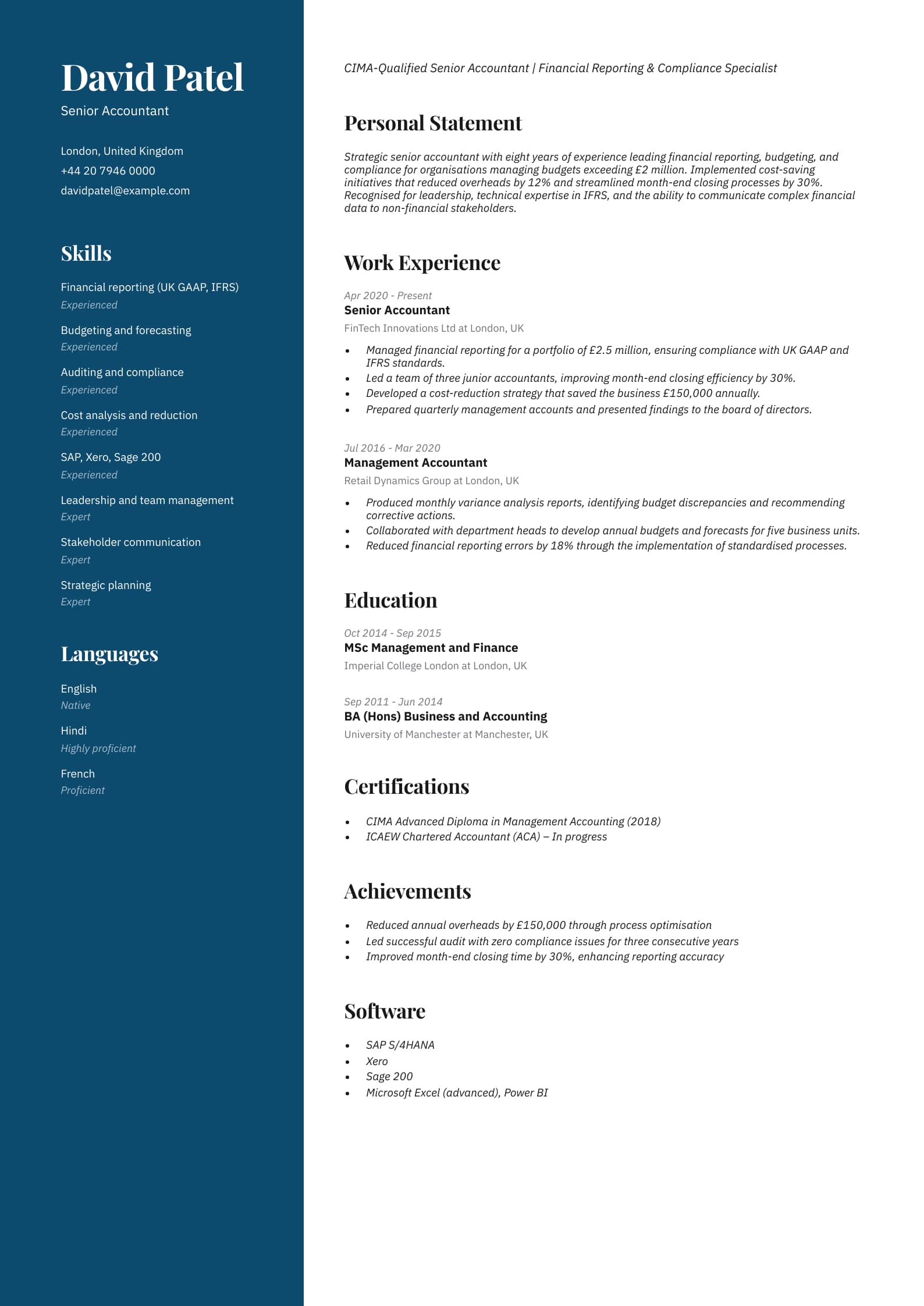
Let's look at two practical accountant CV samples before you proceed to writing yours—one for junior accountants and another for senior-level professionals. These CV examples demonstrate the proper formatting, keyword optimisation, and achievement-focused content you should aim for.
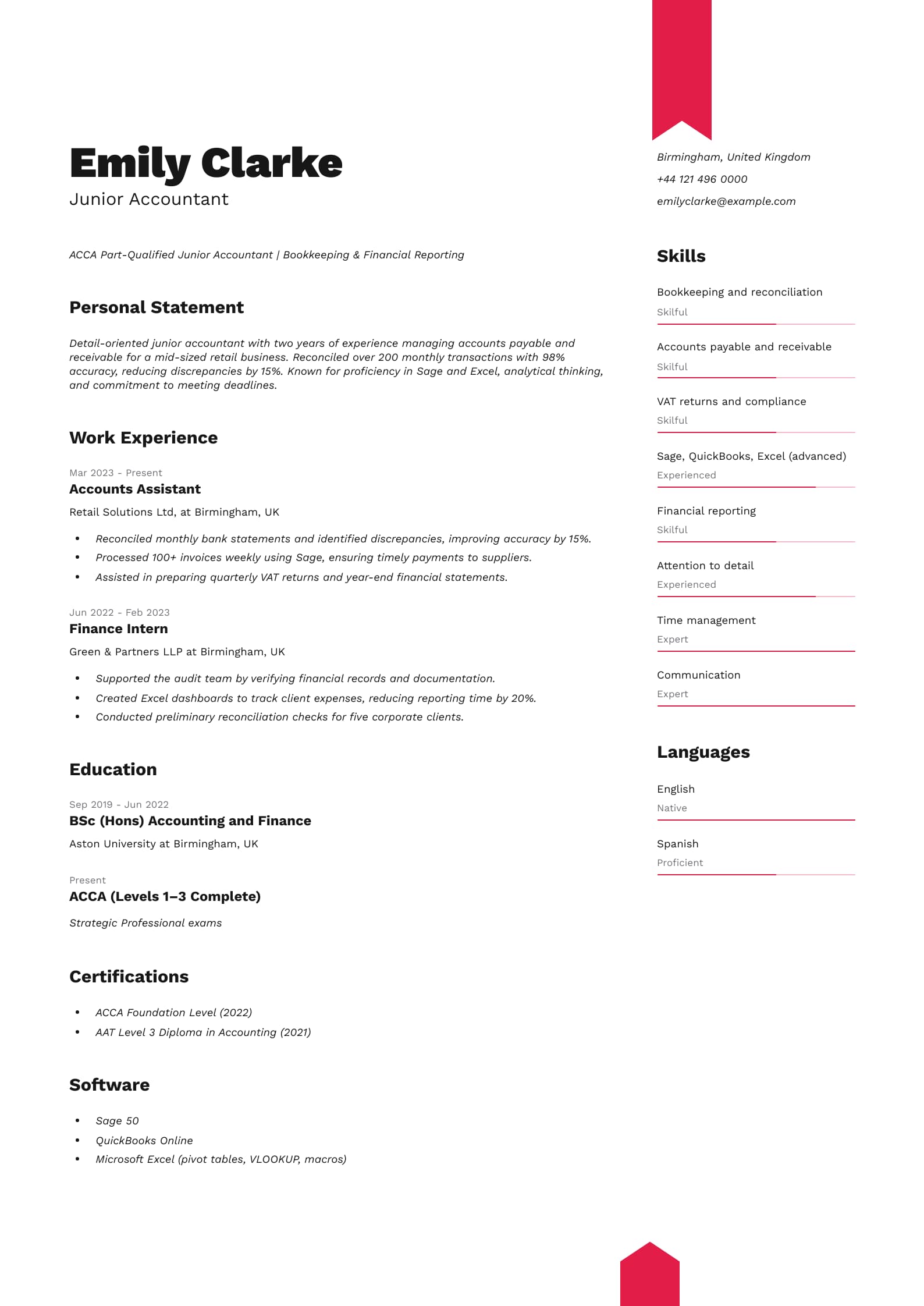
This example works because it immediately establishes credibility with the ACCA qualification, uses specific metrics, and includes industry-standard software that recruiters look for.
This senior-level CV example emphasises leadership, measurable financial impact, and strategic contributions. Plus, the achievements section provides concrete proof of value that sets this candidate apart.
How to Write an Accountant CV: A 5-Step Guide
Writing an accountant CV becomes straightforward when you break it down into manageable steps. According to a government report, the number of jobs in the UK’s financial sector has increased by 8% in the last decade. This means there’s a steady competition with growing opportunities, hence having a well-polished CV is important.
For most accounting roles, the reverse chronological format is the best choice. It lists your most recent experience first, making it easy for recruiters to track your career progression. This format is also ATS-friendly, which is crucial when applying through online portals that use automated screening systems.
Now, let's see how to write each section in detail.
#1. Add Your Contact Details and a Clear CV Headline
Your contact section should include your full name, city and country, professional email address, phone number, and LinkedIn profile. If you have a portfolio of financial models or Excel dashboards, include a link to that as well.
The CV headline is where many candidates miss an opportunity; a strong one immediately tells recruiters what you do and what you specialise in.
Here are some examples of what works here:
ACCA-Certified Accountant | Financial Reporting & Compliance
Management Accountant with 5+ Years in Retail Finance
Junior Accounts Assistant | Bookkeeping & VAT Returns
The key is specificity; good headlines include your qualification, experience level, or area of expertise. This helps recruiters immediately understand your professional profile.
#2. Highlight Relevant Accounting Skills
Your skills section should balance technical expertise with interpersonal strengths. Start with hard skills—the technical competencies specific to accounting, such as:
Technical Competencies
Bookkeeping and reconciliation
Financial reporting (UK GAAP, IFRS)
Budgeting and forecasting
Accounts payable and receivable
VAT returns and compliance
Payroll processing
Sage, QuickBooks, Xero, SAP
Microsoft Excel (pivot tables, VLOOKUP, macros)
Financial analysis
Then add soft accountant skills that demonstrate professional effectiveness, including:
Soft Skills
Communication
Attention to detail
Time management
Teamwork
Here's how to structure this section:
Skills Section Structure
Skills
Financial reporting (UK GAAP, IFRS)
Budgeting and forecasting
Sage 50, QuickBooks, Xero
Accounts payable and receivable
VAT compliance
Microsoft Excel (advanced)
Analytical thinking
Communication
Time management
#3. Showcase Work Experience Using Metrics
This section typically determines whether your accountant CV lands you an interview. Focus on achievements, not responsibilities. Recruiters know what accountants do; they want to know how well you performed.
Use action verbs to start each bullet point; e.g., managed, reconciled, audited, analysed, prepared, developed, implemented, etc. Then add numbers wherever possible.
Key performance indicators (KPIs) and your achievements can be presented like this:
Work Experience Example
Senior Accountant ABC Financial Services, Manchester, UK January 2021–Present
Managed financial reporting for a £3 million portfolio, ensuring compliance with UK GAAP and IFRS.
Led a team of four junior accountants, reducing month-end closing time by 25%.
Developed a cost-saving initiative that reduced overheads by £120,000 annually.
Prepared quarterly management accounts and presented findings to the board of directors.
#4. Include Education and Accounting Certifications
Your education section should list your degrees in reverse chronological order, along with the institution, location, and dates of attendance. If you're a recent graduate, you can include relevant modules or your dissertation topic if it relates directly to the role.
Typical degrees include:
BSc Accounting and Finance
BA Business and Accounting
MSc Management and Finance
Professional qualifications set accountants apart. In the UK, the major accounting bodies are:
ACCA (Association of Chartered Certified Accountants)
CIMA (Chartered Institute of Management Accountants)
ICAEW (Institute of Chartered Accountants in England and Wales)
If you're part-qualified or working towards certification, include it. This shows commitment and signals that you're developing advanced expertise.
You can also add online certificates from platforms like Coursera, edX, or LinkedIn Learning if they're relevant to the position.
Here's how to format this section:
Education and Certifications
Education
BSc (Hons) Accounting and Finance University of Leeds, Leeds, UK September 2018–June 2021
ACCA (Levels 1–3 Complete) In progress: Strategic Professional exams
Certifications
ACCA Foundation Level (2021)
AAT Level 3 Diploma in Accounting (2020)
Google Finance Certificate (2022)
#5. Add Extra Sections (Software, Courses, Projects)
Once you've covered the essentials, consider adding sections that give recruiters a fuller picture of your capabilities.
Software proficiency is crucial in accounting. For example, you can list:
Accounting Software & Tools
Sage 50, Sage 200
QuickBooks Online
Xero
SAP S/4HANA
Microsoft Excel (advanced)
Power BI
Additionally, courses show commitment to professional development. Include short courses, workshops, or seminars in taxation, payroll, compliance, accounting standards, or financial analysis. Projects can also be especially helpful early in your career; academic projects, Excel dashboards, or bookkeeping systems you've built demonstrate practical application of your skills.
Optional sections you might consider:
Languages, which can be relevant for multinational companies
Volunteer work, if it involved financial tasks
Achievements, such as awards, recognitions, or notable contributions
Here's an example:
Optional CV Sections
Software
Sage 50, QuickBooks, Xero
Microsoft Excel (pivot tables, VLOOKUP, macros)
Power BI
Courses
Advanced Taxation (HMRC, 2023)
Payroll Fundamentals (CIPP, 2022)
Languages
English – Native
Urdu – Fluent
German – Conversational
How to Write an Accountant CV With No Experience

To write an accountant CV with no experience, you need to focus on academic achievements, transferable skills, and practical projects. Here’s what you can leverage:
Academic projects, such as a financial analysis assignment, budget modeling, or mock financial statements. Include these in your education section or create a separate "Projects" section.
Internships are valuable even if they are unpaid or short-term. Any exposure to bookkeeping, reconciliation, or data entry should be listed under work experience. Use the same achievement-focused approach and mention measurable outcomes where possible.
Transferable skills, such as attention to detail, numeracy, analytical thinking, and time management. These are fundamental to accounting and can be demonstrated through university coursework, part-time jobs, or volunteer work.
Portfolio. Create Excel dashboards, budget templates, or financial models you can share with employers. Upload them to Google Drive or a portfolio website and include the link on your CV. This demonstrates initiative and gives recruiters concrete evidence of your capabilities.
5 Common Mistakes to Avoid in Your Accountant CV
Even experienced accountants make CV mistakes that cost them interviews. Here are the most common ones:
Using generic CV templates that hide key information. Some templates prioritise design over function, burying qualifications under graphics or unusual layouts. ATS systems struggle with these formats. Stick to a clean, reverse chronological format with clear headings and standard fonts like Calibri or Arial.
Not including accounting keywords that ATS systems scan for. Many companies use applicant tracking systems to filter CVs. If your CV doesn't contain keywords like "financial reporting," "reconciliation," "Sage," "ACCA," or "budgeting," it might never reach a recruiter. Read the job description carefully and incorporate relevant terms naturally.
Listing duties instead of achievements. "Responsible for managing accounts payable" tells recruiters nothing about your performance. Compare this to "Processed 100+ invoices weekly, reducing payment delays by 20%." The second version is specific, measurable, and demonstrates impact.
No metrics or measurable impact. Numbers make your CV credible. "Improved accuracy" is vague. "Improved accuracy by 15%" is concrete. Wherever possible, quantify your contributions: budgets managed, discrepancies reduced, time saved, costs cut, and similar.
Poor formatting. Inconsistent spacing, random bolding, and mismatched fonts make your CV difficult to read. Use a professional CV font, consistent heading styles, and clear section breaks.
Create a Professional CV in Minutes
Do you need help structuring your accountant CV? We’ve got you! Use our CV builder to create a polished, ATS-friendly document in minutes. All you should do is choose from professionally designed templates, enter your details, and download your finished CV ready for submission!
Final Thoughts
An accountant CV represents your chance of demonstrating the precision, professionalism, and financial expertise that define effective accountants. By focusing on measurable achievements, tailoring your application to each role, and presenting your skills on a CV clearly, you significantly improve your chances of securing interviews.
Accountant CV FAQs
#1. How long should an accountant CV be?
An accountant CV should be one to two pages long. If you're early in your career or applying for junior roles, stick to one page. Senior accountants with extensive experience, multiple qualifications, and a long work history can extend to two pages, but ensure every line adds value.
#2. What skills should an accountant put on a CV?
An accountant should put a mix of technical and soft skills on a CV. Hard skills like financial reporting, bookkeeping, VAT compliance, and knowledge of UK GAAP or IFRS are essential. Meanwhile, soft skills such as attention to detail, analytical thinking, communication, and time management show you're effective in a team environment.
#3. Should I include certifications like ACCA or CIMA?
Yes, you should include certifications like ACCA or CIMA since they are highly valued in the UK accounting sector. If you're part-qualified, include that as well; it shows you're working towards full certification. Even if the job doesn't explicitly require a qualification, having one signals credibility, commitment, and advanced technical expertise.
#4. Do employers prefer a CV or résumé in the UK?
In the UK, employers prefer a "CV" (curriculum vitae), which is standard, while résumés are more commonly used in the United States. A UK CV is typically longer and more detailed than a US résumé, covering education, work experience, skills, and certifications comprehensively.