
A nanny CV highlights your soft skills and caretaking abilities to help you convince a family to entrust you with their children. Considering that parents can be extremely picky employers, you should make sure to submit a strong, polished application that effectively demonstrates what you’re capable of.
In this article, we will explore how to write nanny CVs that emphasise childcare, share two well-made examples, and point out some common mistakes. We will also give you tips on writing this document without experience.
Key Takeaways
A nanny CV must emphasise skills like communication, patience, time management, and emotional intelligence to help you secure a job.
Your nanny or au pair CV should contain contact information, a CV summary, work experience, education, skills, and certifications.
If you have no experience, focus on your transferable skills, volunteering, certificates, and hobbies and interests.
Avoid formatting mistakes, grammatical errors, vagueness, and writing about duties instead of achievements.
2 Inspiring Nanny CV Examples
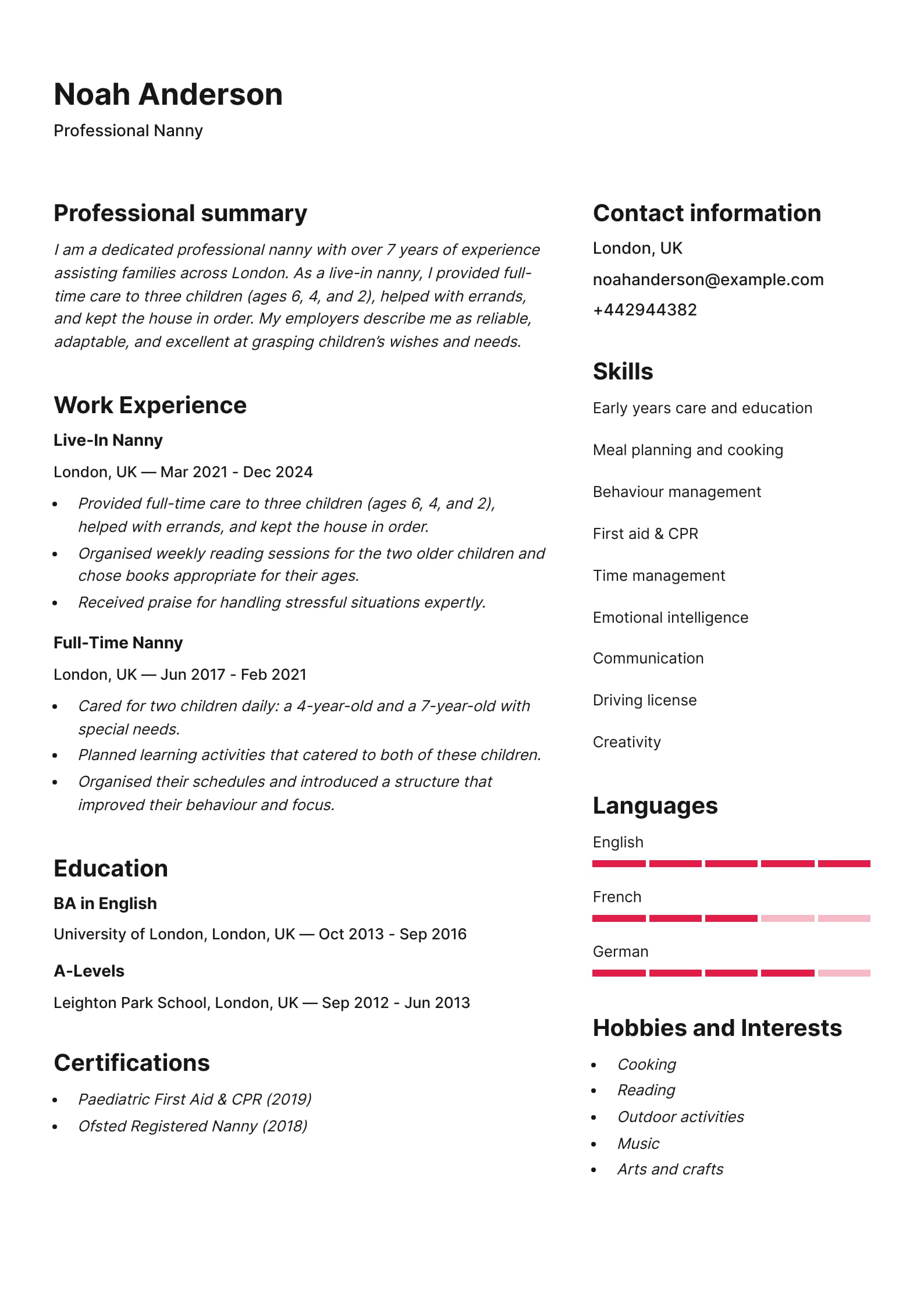
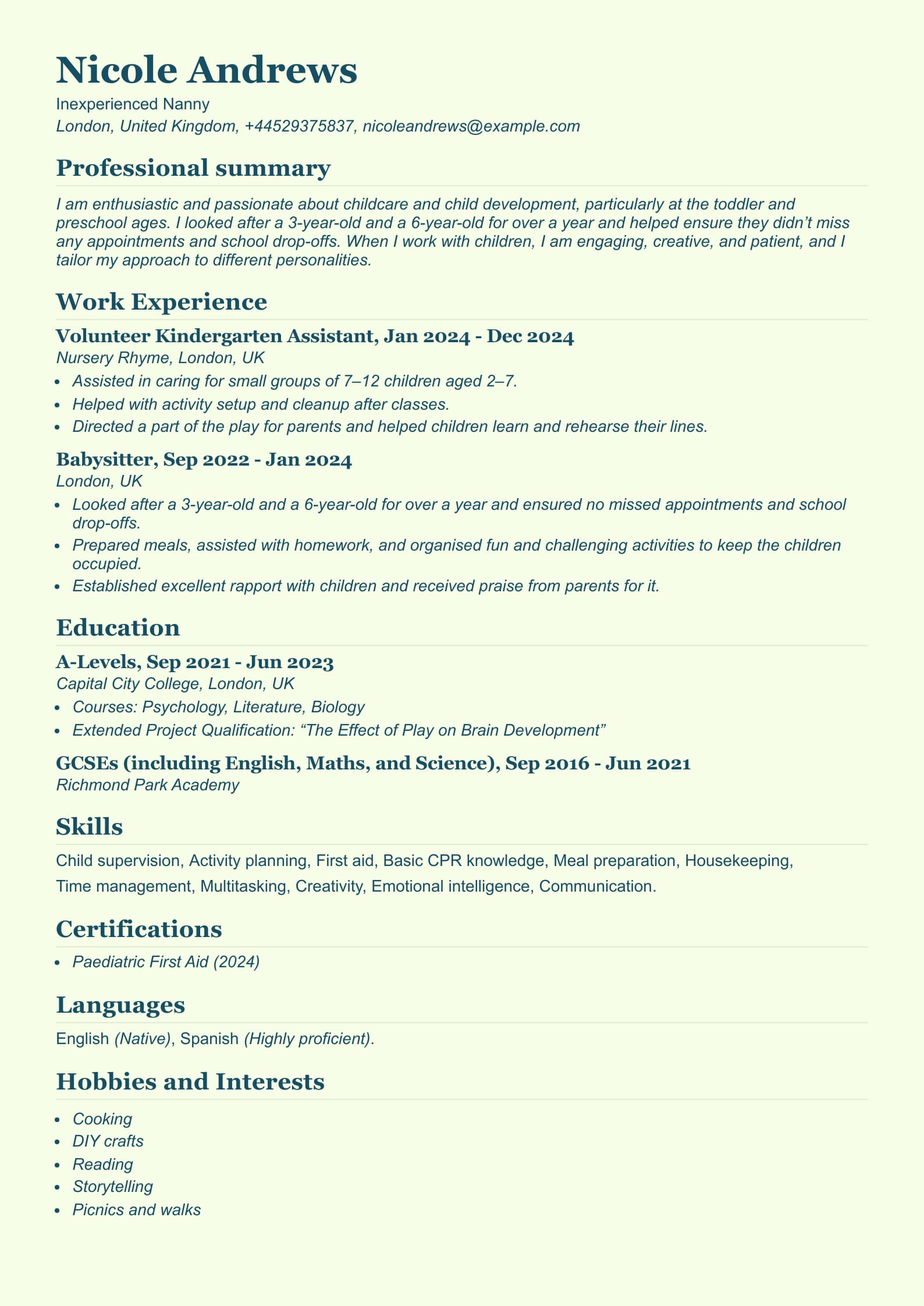
These nanny CV examples will illustrate how to successfully write your own before we explore the specific tips and details. So, we’ve provided two: one for an inexperienced nanny and one for a professional nanny.
Step-by-Step Guide to Building Your Nanny CV

These are the steps you should take when building your nanny CV:
#1. Add Your Contact Details and a Headline
Before you write down the details of your professional and academic history, add your contact information to the header of your CV. This is very important; employers can’t reach out to you if you don’t provide them with the means.
Contact details typically include:
Contact Details
Full name
Address
Email address
Phone number
LinkedIn profile (optional)
Professional website (optional)
Aside from this, you may be tempted to add your social media accounts, too, but we advise against that. Any posts that don’t align with your potential employer's views or values may steer them away from hiring you.
That said, this is a standard contact information section:
Contact Information Section
Contact Information
Nicole Andrews London, United Kingdom nicoleandrews@example.com +44529375837
The next section, a CV summary, is placed right under the contact information, so that employers can review it immediately. Essentially, this part serves as an overview of your application and should contain only the most impactful information, packed in 4–5 lines of text.
If you’re not sure how to write an effective CV summary for a nanny application, use this formula:
Sentence #1, where you should add your title, experience, responsibilities, and potentially academic background if you’re still entry-level
Sentence #2, where you should highlight your most significant achievement using numbers and action verbs
Sentence #3, where you can emphasise some of your hard and soft skills by using them as traits
Here’s what this section might look like:
Nanny CV Summary Example
Professional Summary
I am a dedicated professional nanny with over 7 years of experience assisting families across London. As a live-in nanny, I provided full-time care to three children (ages 6, 4, and 2), helped with errands, and kept the house in order. My employers describe me as reliable, adaptable, and excellent at grasping children’s wishes and needs.
#2. Showcase Work Experience
Work experience should make up a bulk of your CV, considering that it’s the most important section that employers typically pay attention to. Here, you should list your relevant positions, along with periods of employment. Then, add 3–6 achievements under each entry to showcase your contributions.
These achievements should be written carefully because they should convey a lot in only one sentence. The best approach is the one we mentioned for the CV summary section; use numbers and action verbs for added impact.
When you put all this together, here’s what the work experience section should look like:
Nanny Work Experience Section
Work Experience
Live-In Nanny London, UK March 2021–December 2024
Provided full-time care to three children (ages 6, 4, and 2), helped with errands, and kept the house in order.
Organised weekly reading sessions for the two older children and chose books appropriate for their ages.
Received praise for handling stressful situations expertly.
Full-Time Nanny London, UK June 2017–February 2021
Cared for two children daily: a 4-year-old and a 7-year-old with special needs.
Planned learning activities that catered to both of these children.
Organised their schedules and introduced a structure that improved their behaviour and focus.
#3. Highlight Relevant Skills
The skills section is simple but essential, as employers often look for it immediately to see whether you possess the skills they require. That’s why it’s important to list some of the ones mentioned in the job description; these act as keywords and almost guarantee an interview invite.
However, though crucial, this section should be kept short, with 6–10 skills as bullet points at best. This isn’t a hard rule, but sticking to it ensures you cover all the essentials without overloading your application.
So, nanny skills in this section should be presented as follows:
Nanny Skills
Skills
Early years care and education
Meal planning and cooking
Behaviour management
First aid & CPR
Time management
Emotional intelligence
Communication
Driving license
Creativity
Generally, there’s no need for elaboration here; the list alone is enough. If you do want to explain some skills further, save that for your nanny cover letter, where you’ll have more space and writing freedom.
#4. Include Education and Certifications
Education may not be the most relevant section on a nanny CV, but it should still be included. That’s especially true for nannies who lack experience and can, therefore, discuss their academic achievements and the skills they’ve built while studying.
Typically, this section should contain your two most recent degrees, along with the institutions that issued them, and periods of study. If you need to, you can add achievements as bullet points, but this is unnecessary when you have sufficient work experience.
Here’s what this section should look like:
Education Section
Education
BA in English October 2013–September 2016 University of London, London, UK
A-Levels September 2012–June 2013 Leighton Park School, London, UK
As for certifications, they should be listed as bullet points in a separate section, containing only their names and the years when you obtained them. You don’t need to add any further explanations, unless you feel that the name isn’t transparent enough to show what the certificate is for.
Ultimately, the certification section looks like this:
Certifications Section
Certifications
Paediatric First Aid & CPR (2019)
Ofsted Registered Nanny (2018)
#5. Consider Adding Other Sections
Once you finish the mandatory sections, you should consider adding optional ones that can show your further strengths and abilities. Typically, those may include:
Additional Sections
Hobbies and interests, where you should write about activities you do in your free time and topics you enjoy. Remember to include only what’s relevant to your future job.
References, where you can list a few of the families with whom you worked and add their contact information, after checking if they don’t mind
Languages, where you should put the languages you speak, along with fluency levels. This may help you secure a job in bilingual families or with immigrants.
How to Write a Nanny CV Without Experience
To write a nanny CV without experience, you can focus on the following areas:
Transferable skills. Though you may not possess the capabilities of an experienced nanny, you surely have transferable skills you’ve built up over the years. These are particularly useful in this profession, as they entail abilities like time management, communication, and emotional intelligence, which are crucial for a nanny.
Volunteering. Even if you don’t have official work experience, think of the times you’ve helped your friends or family with childcare and include that on your CV. Furthermore, you should mention assisting in kindergartens and similar institutions, as this demonstrates your ability to handle several children at once.
Certificates. If you don’t have any certificates, consider getting some to boost your application. Many nannies obtain first aid and CPR certification from St John Ambulance, so it may be a good idea to look into it and see whether any of the available options might be useful.
Hobbies and interests. A nanny CV can benefit from a hobbies and interests section, especially if you include activities that may help you be a better caretaker. For example, cooking, arts and crafts, and other creative hobbies can be a huge plus.
4 Common Mistakes to Avoid When Creating a Nanny CV
Common mistakes to avoid when creating a nanny CV include:
Poor formatting. Using a proper format for your application is important for two reasons: it helps your CV pass the applicant tracking system (ATS) scan and improves your chances with recruiters. No one wants to read a long block of text with no white space, headings, paragraphs, or bullet points. So, make sure your document is readable and scannable.
Lack of proofreading. Glaring typos and grammatical mistakes in your CV can make you come across as unprofessional and careless, which employers don’t typically appreciate. Read your document at least once after writing, let someone else check it, or run it through Grammarly or another grammar checker to be extra safe.
Writing about duties instead of achievements. Being a nanny, you likely won’t be able to include measurable achievements, but you should still focus on what you’ve accomplished in your previous positions. For instance, mention the number of children you took care of or the praise you received from parents for specific activities.
Being vague. Vagueness often results in generic claims that don’t set you apart in any way, so be careful to avoid it. Include some specificity: exact numbers and particular accomplishments, for instance.
Make an Eye-Catching Nanny CV With Our Help
Making a nanny application should be easy enough with CV.co. For starters, enter the required information, follow step-by-step instructions, choose a CV template, and finalise the document. Then, you can submit it directly to the employer or download it in PDF first.
Even if you prefer to do everything from scratch, you can still benefit from our CV examples tailored for various industries and career levels. Browse our library, and you’re sure to find precisely what you need.
Final Thoughts
Now that you know what the typical CV format for nannies looks like, it should be easy to use it to secure your next job. All you have to do is follow our instructions and emphasise your soft skills, childcare experience, and relevant certifications. If you do that, you’ll receive an interview invite in no time.
Nanny CV FAQ
#1. What are the most important skills for a nanny CV?
The most important skills for a nanny CV are first aid and CPR, child supervision and care, behaviour management, communication, patience, and emotional intelligence. For the most part, nannies need strong people skills, as they must interact with both the children and their parents.
#2. Should I include volunteer experience?
You should include volunteer experience, especially if you’re new to being a nanny and don’t have a strong professional background. In that case, volunteering can be an excellent substitute and make your application stand out.
#3. How far back should my nanny CV go?
Your nanny CV should go back approximately 10 years and follow the reverse chronological format, with the most recent information placed first. There’s typically no need to go back further, unless you want to highlight particular experiences and achievements from your past.