
A journalist CV demonstrates your professional experience and writing skills to help you secure a job in this exciting and challenging field. The most successful applications are those that highlight measurable results through achievements and emphasise your passion for research and storytelling.
In this article, we will provide two examples of journalist CVs, break down the writing process into five simple steps, and show you what mistakes to avoid. Furthermore, we will give you some tips on how you can create a compelling application without prior experience.
Key Takeaways
A journalist CV should highlight your writing skills, enthusiasm, and passion for storytelling.
The best journalist CV templates contain contact information, a professional statement, a work experience section, education, skills, and other relevant details.
If you have no official work experience, you can write about your academic achievements, transferable skills, volunteering, and personal projects.
You should avoid writing about responsibilities instead of achievements, omitting measurable results, formatting improperly, and forgetting to proofread.
2 Excellent Journalist CV Examples
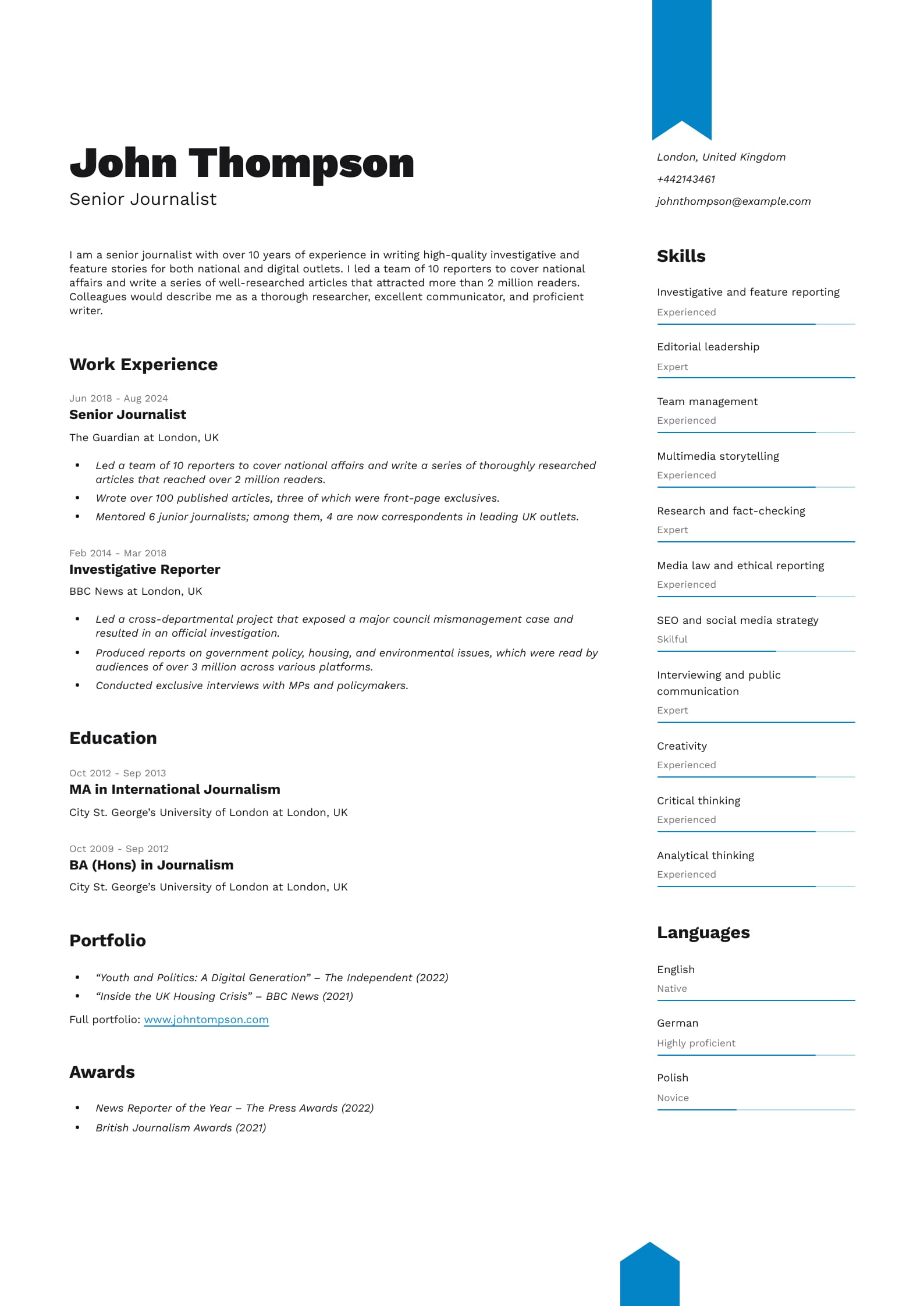
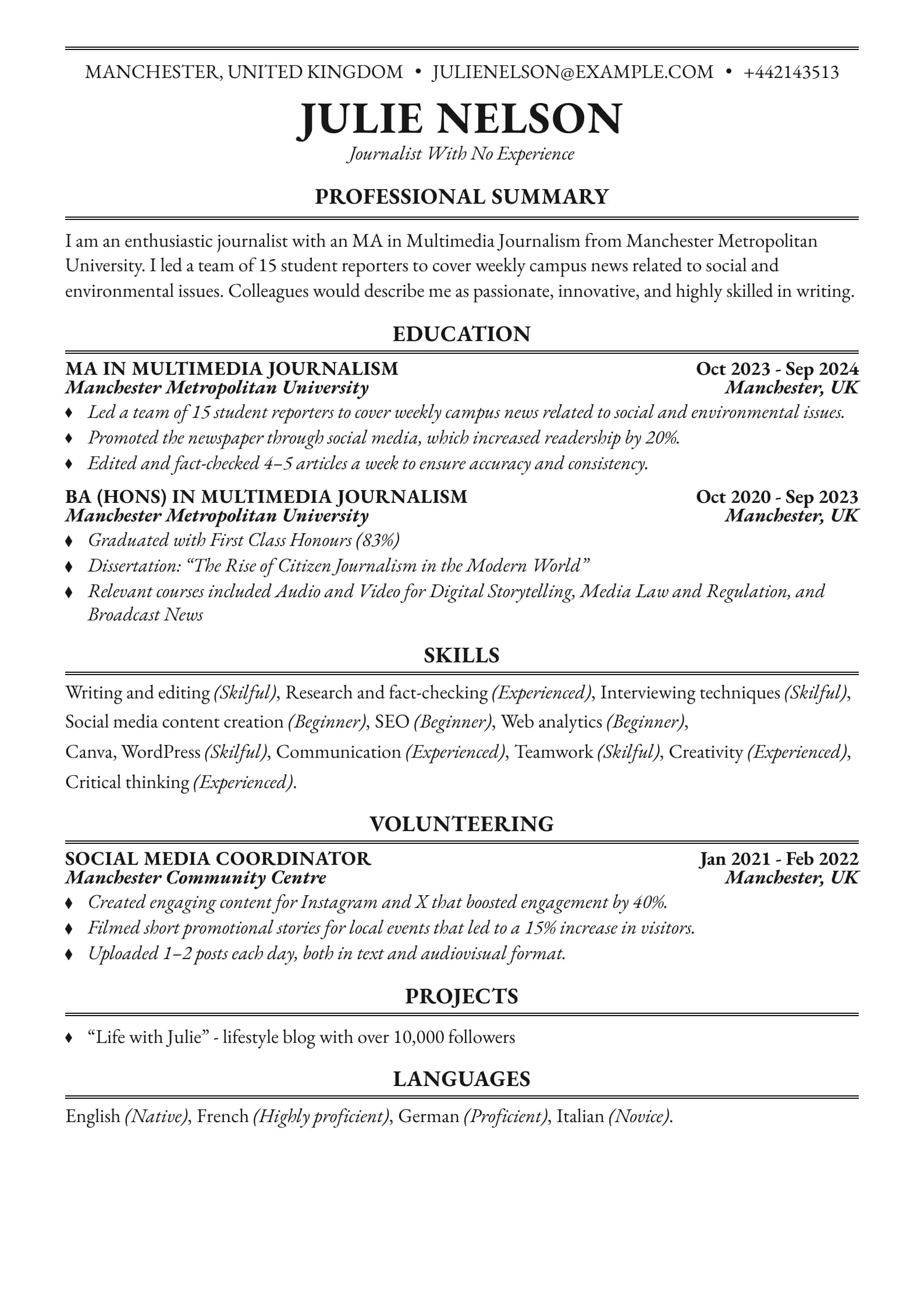
Before we share step-by-step tips on writing your application, let’s examine two reporter CV examples that can inspire your writing. The first one is a sample for journalists with no experience, while the second is made for veterans in the field.
How to Write a Journalist CV in 5 Key Steps
To write a journalist CV, you should:
#1. Add Your Contact Details and a Professional Summary
The first section of your journalist CV should contain your contact details, so that recruiters can get in touch with you if your application fits their requirements. This information is placed in the header, where they can immediately see it.
You should include the following details:
Header Details
Full name
Address
Email address
Phone number
LinkedIn profile (optional)
Professional website (optional)
In general, this is enough; there’s no need for social media accounts and personal blogs. This information is both irrelevant and potentially damaging to your image, especially if your posts don’t align with the company’s values.
Here’s what a typical contact information section looks like:
Contact Information Example
Contact Information
John Thompson London, United Kingdom johnthompson@example.com +442143461
Next, you should write a professional summary, placed directly under the contact information section. This serves as a short overview of your CV that highlights your skills and significant achievements. However, since it’s only 4–5 lines long, you need to be very intentional about the words you’re using.
We suggest using the following formula to create an effective summary:
CV Summary Guidelines
Sentence #1, where you should mention your title, years of experience, and several general responsibilities you’ve undertaken over the course of your career. If you’re a beginner journalist, include your education here instead.
Sentence #2, where you should highlight your most significant achievement using action verbs and measurable results
Sentence #3, where you should focus on your soft and hard skills
This is what it looks like in practice:
Summary Example
Professional Summary
Senior journalist with 10+ years of experience producing high-quality investigative and feature stories for national and digital outlets. Led a team of 10 reporters to cover national affairs and produce a series of in-depth pieces that garnered over 2 million readers. Known for my thorough approach to research, excellent communication skills, and writing proficiency.
#2. Showcase Work Experience
The work experience section is the most important part of a journalist CV, as it contains a detailed overview of the positions you held in the past. These are typically arranged in a reverse chronological order, starting with the latest entry. Thanks to that, recruiters can immediately spot your most relevant roles and easily track your career path.
Aside from the title, company, and period of employment, you should also include 3–6 bullet points elaborating on your achievements under each entry. These should be as specific as possible, preferably with measurable results to support your claims.
A journalist's work experience section should look like this:
Journalist Work Experience Example
Work Experience
Senior Journalist The Guardian, London, UK June 2018–August 2024
Led a team of 10 reporters to cover national affairs and produce a series of in-depth pieces that garnered over 2 million readers.
Authored 100+ published pieces, including three front-page exclusives.
Mentored 6 junior journalists, three of whom are now correspondents in leading UK outlets.
Investigative Reporter BBC News, London, UK February 2014–March 2018
Led a cross-departmental project that exposed a major council mismanagement case, resulting in an official investigation.
Produced long-form reports on government policy, housing, and environmental issues, reaching audiences of over 3 million across all platforms.
Secured exclusive interviews with MPs and policymakers.
#3. Highlight Relevant Skills
The skills section is where you should include all your journalist skills in a bullet point list. We recommend choosing 6–10 of your most relevant capabilities and starting with hard skills first. However, you shouldn’t leave out soft skills, either; they can be particularly relevant for journalists, who frequently work with people.
It’s also worth noting that the skills section can be placed directly underneath the work experience section or pushed lower, beneath the education section. That decision is yours; consider what information you want to prioritise on your CV.
This is what a typical skills section on a journalist CV should look like:
Journalist Skills Section
Skills
Writing and editing
Research and fact-checking
Interviewing techniques
Social media content creation
SEO
Web analytics
Canva, WordPress
Communication
Teamwork
Creativity
Critical thinking
#4. Include Education
The education section should contain two of your most recent degrees, the institutions where you earned them, and periods of attendance. For journalists, this typically means including a university degree, as approximately 91% of them hold one in the UK.
Typically, this section is very short and straightforward; however, you can add more information if you’ve recently graduated and have no relevant work experience. In such cases, list your significant achievements here, like we’ve done in the first CV example.
Here’s what the education section usually looks like:
Education Section Example
Education
MA in International Journalism October 2012–September 2013 City St. George’s University of London, London, UK
BA (Hons) in Journalism October 2009–September 2012 City St. George’s University of London, London, UK
And this is what it can look like if you elaborate on your achievements:
Education Section with Achievements Highlighted
Education
MA in Multimedia Journalism October 2023–September 2024 Manchester Metropolitan University, Manchester, UK
Led a team of 15 student reporters to cover weekly campus news relating to social and environmental issues.
Promoted the newspaper through digital channels, increasing readership by 20%.
Edited and fact-checked 4–5 articles a week, ensuring accuracy and consistency.
#5. Consider Adding Other Sections
Aside from these key sections, you can add optional ones to pad out your CV further and include other skills you deem relevant.
Typically, those sections are:
Optional CV Sections
Awards, where you should list all the recognitions you’ve received for your excellent work
Projects, where you can add any personal ventures relevant to your job that may help boost your standing among the candidates
Publications, where you should mention all articles and papers you’ve written or contributed to
Languages, where you should list the languages you speak and your fluency levels for each one
These sections are pretty easy to write; all you have to do is list the information as bullet points and elaborate only on entries that you believe are unclear. Further explanations should be saved for a journalist's cover letter, which offers some extra space.
How to Write a Journalist CV Without Experience
To write a journalist CV without experience, you can do the following:
Focus on education. If you don’t have much to say in the work experience section, emphasise your education instead. Place the section higher on your CV and include bullet-point achievements with measurable results while describing your university degree or A-Levels. This will compensate for a short or missing professional background section.
Focus on your transferable skills. You may not possess job-specific abilities that are typically acquired through experience, but you’ve surely picked up transferable skills during your studies. Add those to your CV instead; they are often very valuable, as they include communication, teamwork, leadership, and similar abilities.
Include volunteering. Volunteering may not be traditional employment, but it helps you build skills and a work ethic, which is just as important. Plus, it demonstrates your proactivity and enthusiasm, qualities that recruiters usually appreciate.
Talk about personal projects. If you’ve undertaken any personal projects related to your profession, make sure to add them to your CV. For instance, blogging can be a form of journalistic practice and should, therefore, be included. After all, it demonstrates your writing skills and allows potential employers to view samples of your work.
4 Typical Mistakes to Avoid in Your Journalist CV
Typical mistakes to avoid in your journalist CV include the following:
Omitting measurable results. A lack of measurable results on your CV can make it appear generic and, therefore, indistinguishable from the competition. This is certainly something you don’t want; your goal is to stand out, and the best way to do that is to include numerical proof of your past accomplishments.
Listing job duties instead of achievements. Many candidates elaborate on their past positions by only talking about their responsibilities, which is the wrong approach. After all, recruiters already know what specific roles entail, so this information is nothing new. So, instead, focus on the particular ways you contributed to your previous workplace to demonstrate what you bring to the table.
Poor formatting. Formatting is important for two reasons: recruiters and applicant tracking systems (ATS) scans. A poorly formatted document that lacks headings, paragraphs, white space, and bullet points is unlikely to ever reach a human being in the first place. Most such documents are rejected by the scan, and, if not, recruiters rarely spend time on unreadable applications.
Lack of proofreading. Grammatical errors and typos are a dealbreaker for most employers, as they make you appear careless and unprofessional. That’s why it’s important to double-check your application or run it through a grammar checker after you’ve written it.
Create a Submission-Ready CV Within Minutes
For additional help with your journalist application, use our CV builder to create one in less than 15 minutes. The process is simple: enter your information, follow our AI assistant’s instructions, and select a suitable CV template. Then, once you finalise the document, you can download it in PDF format or send it directly to your potential employer.
And if you’d rather write your application on your own, take a look at our extensive library of CV examples. We offer many options for various industries, so you’ll surely find precisely what you need.
Final Thoughts
Hopefully, this article has helped you understand how to write an effective journalism resume for the UK market and secure your dream job. The key is to focus on your achievements, highlight your skills, and demonstrate that you possess the required experience, enthusiasm, and drive. If you succeed in doing that, you’ll land an interview in no time!
Journalist CV FAQ
#1. Do I need a portfolio link on my CV?
You need a portfolio link on your CV because this is the best way to demonstrate your writing and reporting skills to your potential employer. So, make sure to build a good, versatile portfolio of articles that you’re proud of and showcase it on your application.
#2. Should I include freelance experience on my CV?
You should include freelance experience on your CV, especially if you’re a novice who doesn’t have an extensive professional background. But even if you aren’t, freelancing can be a useful entry, as it shows you have initiative and know how to work independently.
#3. What skills should be on my journalist CV?
Skills that should be on your journalist CV are writing, reporting, research, attention to detail, adaptability, journalistic ethics, storytelling, interviewing, and more. Additionally, journalists must be excellent communicators, as they are likely to cover sensitive topics that must be handled professionally.