
A volunteering CV is a document that volunteers use to apply for various positions or by candidates who lack work experience and want to highlight unpaid work. Since it’s not used in the same way as a standard CV, there are some important distinctions to make between the two.
In this article, we will show you how to write a volunteering CV, which sections to focus on, and what common mistakes to avoid. We will also provide a good example to serve as guidance when you start writing your own.
Key Takeaways
A volunteering CV and a standard CV differ in purpose, focus, common formatting, and key sections.
To write your own volunteering CV, you should pick a format, add contact details, write a personal statement, emphasise your skills, showcase volunteering experience, and include education and certifications.
You can highlight volunteer experience in your CV by using action verbs, quantifying achievements, and linking volunteering with transferable skills.
Common mistakes to avoid when writing a volunteering CV include adding too many irrelevant details, omitting measurable achievements, and poorly formatting the document.
Volunteering CV vs. Standard CV
A CV for volunteer work is similar in content and structure to a standard CV, but there are distinct differences in its purpose and approach. After all, it’s a document meant to help you secure a non-profit position in which soft skills and cultural fit matter more than career progression.
Here’s how the two compare:
| Standard CV | Volunteering CV |
Purpose | Demonstrating professional qualifications and suitability for a paid position | Highlighting community involvement and passion for the cause |
Focus | Career progression, professional accomplishments | Volunteer work, commitment to a cause, transferable skills |
Common formatting | Reverse-chronological | Functional |
Key sections | Work experience, skills, qualifications | Skills, volunteering experience |
When to use | Applying for paid work | Applying for a volunteer position or to showcase volunteer experience due to a limited professional background |
Volunteering CV Example: How to Showcase Skills & Experience
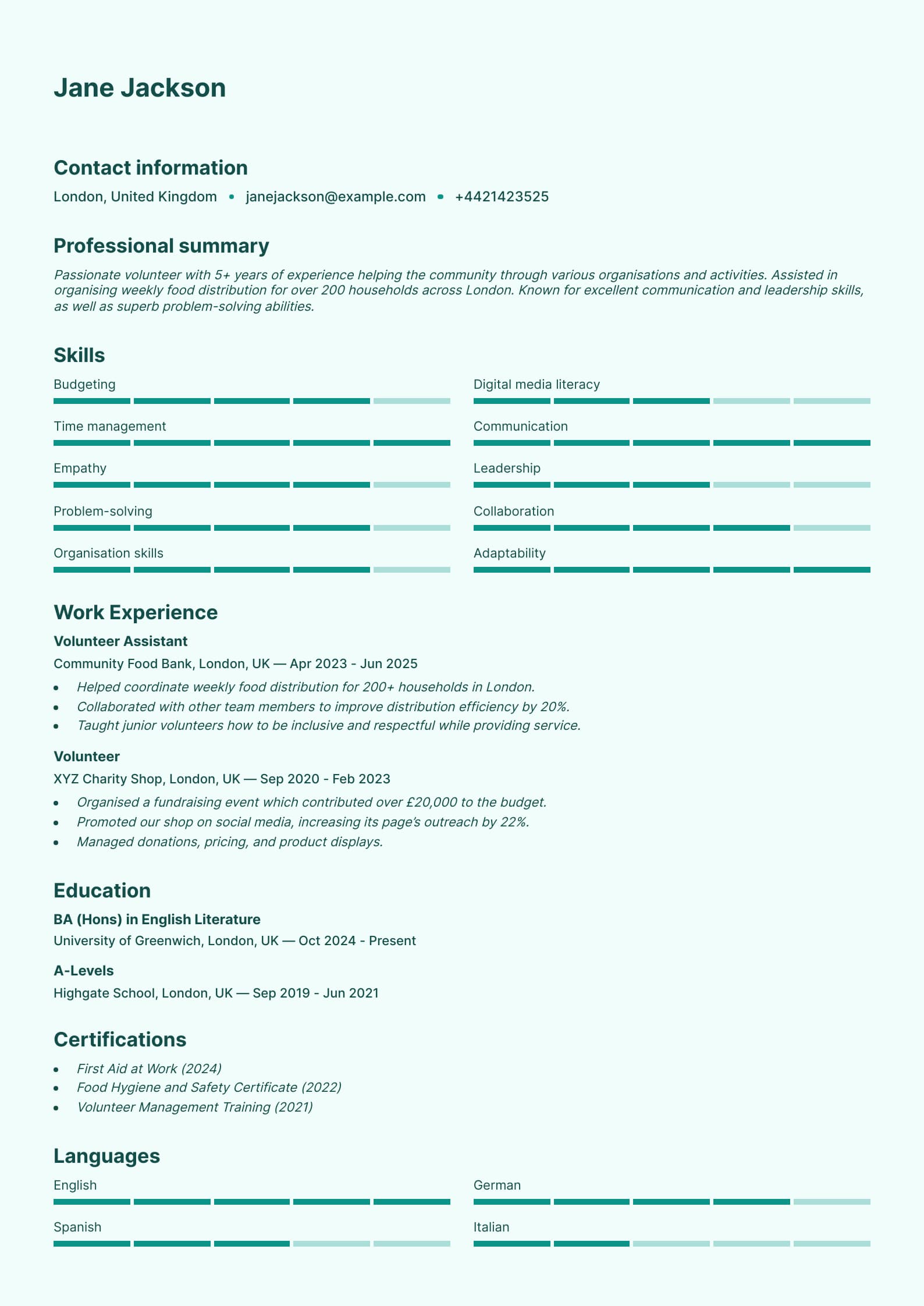
Before we dive into the step-by-step guide, here’s a volunteering CV example to show you what a strong application looks like in practice.
How to Write a Volunteering CV: Step-by-Step Guide
To write a volunteering CV, you need to pick the right CV format and then write your contact details, a personal statement, your skills, volunteering experience, and education. These are the basics, though you can add more sections if you believe they might give you an edge in the selection process.
Here’s a step-by-step guide on writing a volunteering CV:
#1. Pick the Right CV Format
Before you start writing a CV, you should figure out how to organise the information in the application. In other words, you need to pick one of the three commonly used CV formats:
Most Popular CV Formats
Reverse-chronological, which prioritises volunteering experience and lists information starting with the most recent entries. This format is the most commonly used across all industries because it’s readable and easy to follow.
Functional, which focuses on your skills, placing them above the volunteering experience section. This format can be useful for novices who don’t have an extensive background to discuss.
Combination, which blends the characteristics of both and is used to highlight both experiences and skills.
For a volunteering CV, we recommend using the functional or combination format, as skills often carry greater weight than experience in volunteering. However, you won’t go wrong with a reverse chronological format, either; it is so widely accepted that it can never be a bad choice.
#2. Add Contact Details
Contact details should be placed at the top of the application, where employers can see them immediately. That way, they can easily contact you with an offer if the rest of your CV meets their standards.
The key components every contact information section should have include:
Key Contact Details
Full name
Address
Email address
Phone number
LinkedIn profile (optional)
Professional website (optional)
On the other hand, you should avoid listing any overly personal information, links to your private blogs or social media accounts, and anything else that might negatively impact your application.
Also, double-check whether your email username is professional; the one that you came up with when you were 12 probably isn’t the best choice.
Here’s what this section should look like:
Contact Information Example
Contact Information
Jane Jackson London, United Kingdom janejackson@example.com +4421423525
#3. Write a Personal Statement
Next comes a personal statement, often the trickiest part of a CV, because many candidates don’t know what information to include for maximum impact. However, we recommend the following formula:
Sentence #1. Mention your title and years of volunteering experience, along with several duties that you have performed during this time.
Sentence #2. Talk about your most significant achievement, using action verbs and concrete, measurable results.
Sentence #3. Briefly list your most relevant skills; in a volunteering CV, this is an opportunity to highlight soft skills.
Keep in mind that a personal statement should be only approximately 4–5 lines long, meaning that all this should be kept as short as possible. Yet, the information must be impactful, as personal statements essentially serve as a hook that encourages further reading.
Here’s what you get when you put all this advice together:
Personal Statement Example
Personal Statement
Passionate volunteer with 5+ years of experience helping the community through various organisations and activities. Assisted in organising weekly food distribution for over 200 households across London. Known for excellent communication and leadership skills, as well as superb problem-solving abilities.
#4. Highlight Your Skills
Skills gained from volunteering or other relevant experiences should be listed in the skills section, typically located immediately below the personal statement. That’s because, as mentioned before, many volunteers pick the functional format to emphasise their skills.
The skills section is pretty easy to write; all you have to do is list several relevant skills as bullet points without any additional explanations. Try to add more than six, but don’t go overboard either; the rule of thumb is 6–10 skills.
This is what this section can look like:
Skills Section Example
Skills
Budgeting
Digital media literacy
Time management
Communication
Empathy
Leadership
Problem-solving
Collaboration
Organisation skills
Adaptability
#5. Showcase Your Volunteering Experience
Showcasing your volunteering experience is similar to writing about regular job experience; mention your role, the organisation you worked for, and the duration and location of volunteering. Then, you should elaborate on your experience further in bullet points under each entry.
These bullet points are where many candidates make mistakes; instead of focusing on achievements, they write about their past responsibilities. This is never a good idea, as it doesn’t provide concrete information about your actual performance.
Keeping that in mind, here’s how to list volunteering on a CV:
Volunteering Experience Example
Volunteering Experience
Volunteer Assistant Community Food Bank, London, UK April 2023–June 2025
Assisted in organising weekly food distribution for 200+ households in London.
Collaborated with other team members to improve distribution efficiency by 20%.
Taught junior volunteers how to be inclusive and respectful while providing service.
#6. Include Your Education and Certifications
In the education section, you should list your two most recent degrees, along with the institution that issued them, its location, and the period of attendance. So, if you have a master’s degree, there’s no need to write about your A-Levels; it’s sufficient to include your bachelor’s.
As for certifications, you should add all relevant ones as short bullet points, stating the name of the certificate and the year you obtained it. There’s no need for further elaboration, unless you believe that a short clarification is necessary.
These two sections may look like this:
Education and Certifications Examples
Education
BA (Hons) in English Literature October 2024–Present University of Greenwich, London, UK
A-Levels September 2019–June 2021 Highgate School, London, UK
Certifications
First Aid at Work (2024)
Food Hygiene and Safety Certificate (2022)
Volunteer Management Training (2021)
#7. Leverage Additional Sections
Finally, if you have any relevant skills and qualifications that don’t fit into any of these sections, you can add a few optional ones. Here are a few possibilities:
Optional CV Sections
Languages, where you should list all the languages you speak, along with your fluency level for each
Hobbies and interests, where you can discuss what you like to do in your free time, while keeping it relevant to the volunteering field you’re applying for
References, where you can list the full name and job title of the person whose recommendation you’ve received
How to Highlight Volunteering Experience in Your CV: 3 Actionable Steps
To highlight volunteer experience in your CV, use action verbs, quantify achievements, and link volunteering to transferable skills.
Here are a few brief tips on how to do that:
#1. Use Action Verbs
Whenever you’re writing about your achievements or experience, use action verbs to highlight your proactivity. If you use overly passive language, it may sound as though you lacked initiative and simply went along with whatever was expected of you.
That said, here’s a brief list of action verbs you should consider:
Led
Earned
Advised
Created
Devised
Boosted
Assisted
Achieved
Arranged
Managed
Executed
Analysed
Compiled
Exceeded
Developed
Cooperated
Collaborated
#2. Quantify Achievements
Quantifying your achievements is a great way to illustrate your contributions and create a compelling argument for being chosen for a position. Generally speaking, numbers are convincing, as they give weight to your claims and make them more believable.
So, try to include numbers wherever possible, particularly in the personal statement and the volunteering experience section. If you’re submitting a cover letter along with your CV, make sure to quantify your achievements there too.
#3. Link Volunteering to Transferable Skills
Transferable skills and volunteering usually go hand in hand, as most volunteers learn to communicate, organise, manage time or resources, lead, and solve problems. So, if you have any past volunteering experience, you likely possess some of these abilities, which you can highlight in your CV.
To do that effectively, mention some of the skills you picked up in the volunteering experience section. For instance, one of the bullet points could briefly describe how you’ve successfully managed a team, organised an event, or solved an issue. This way, you cover both achievements and skills at once.
3 Common Mistakes to Avoid in Your Volunteering CV
The most common mistakes to avoid in your volunteering CV include the following:
Volunteering CV Mistakes
Overloading with irrelevant details. You may think that it’s better to include as many details as possible, but that’s not exactly the case. Adding too much irrelevant information can make your volunteering CV appear cluttered, and the actually important content might get lost in the fluff. So, focus on the details that truly matter.
Leaving out measurable achievements. As we’ve mentioned, measurable achievements give weight and specificity to your CV, so it’s crucial to include them if you want to stand out. Otherwise, your application may get lost in the sea of other similar ones.
Poor formatting and structure. Your CV may be rejected before it even reaches a human being if its formatting and structure aren’t adequate. After all, most organisations and companies use applicant tracking systems (ATS), which scan the document and only send forward those that fit specific standards.
Create a Professional CV Within Minutes
If you need extra help with your volunteering application, use our CV builder to create one within minutes. All you have to do is follow instructions, enter your information, select a suitable CV template, and submit the completed document to your potential employer.
And if you want to write your application from scratch, but just need a little assistance, browse through our collection of CV examples. We have a range of options for various industries, so you will surely find something that suits your needs.
Final Thoughts
Hopefully, our guide has prepared you for writing a volunteering CV and clarified the minor differences between this and a standard application. Remember to highlight transferable skills and experiences that demonstrate them; that’s the surest way to secure the position you’re aiming for.
Volunteering CV FAQ
#1. Do I need a CV for volunteering?
You need a CV for most volunteering positions, although you should check the description for specific requirements. Some roles require a cover letter as well; in other words, a full application, like when applying for a job.
#2. What skills are needed for volunteering?
Skills needed for volunteering typically include communication, teamwork, time management, organisation, adaptability, and problem-solving. Of course, the specifics vary depending on the position you’re applying for, but your focus should be primarily on soft skills.
#3. Does volunteering count as a job?
Volunteering doesn’t officially count as a job, since it isn’t paid, but it is a good way to gain new skills and experience. As a result, it’s often found on student or graduate CVs, where it compensates for the lack of professional background.
#4. Can volunteer experience replace work experience on a CV?
Volunteer experience can replace work experience on a CV when you’re at the start of your career and have no professional background to write about. In that case, adding volunteering is much better than leaving the section completely empty.
#5. Do employers value volunteering on a CV?
Employers value volunteering on a CV because it demonstrates initiative and passion for a particular field. Additionally, volunteers are more likely to possess particular transferable skills, such as communication, teamwork, and leadership.