

The STAR method provides job candidates with a framework that can help them answer interview questions, particularly those about their past work experiences. Most employers value candidates who use this method, as their answers are more concise, focused, and detailed.
In this article, we will give you a STAR method cheat sheet, teaching you all about how it works, when to use it, and what common mistakes to avoid. We’ve also prepared a few practical examples to illustrate this method in real-life situations.
Key Takeaways
Key Takeaways
STAR stands for Situation, Task, Action, and Result, which are the components that should appear in every answer to a behavioural interview question.
The STAR method helps you structure your answer and stay on topic instead of rambling.
The situation and task should be explained briefly to set the scene, but place special emphasis on actions and results.
Practise the STAR method before your interview by selecting the appropriate stories, telling them to your friends and family, and asking for feedback.
What Is the STAR Method Framework?
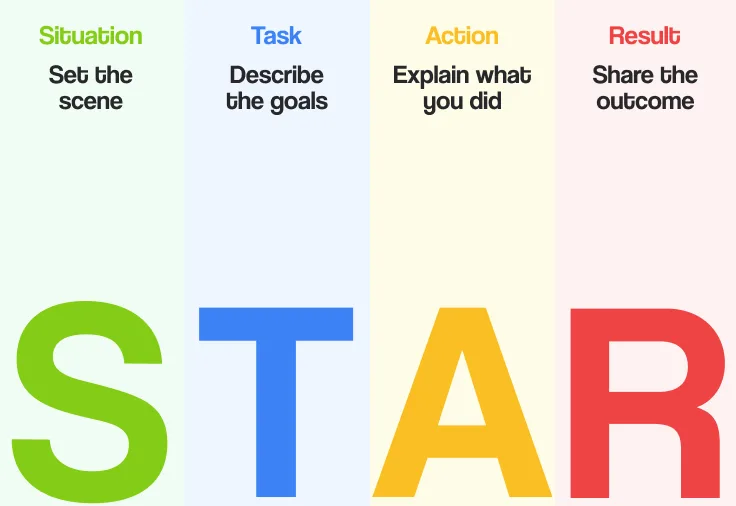
The STAR method is a framework commonly used to answer questions in behavioural interviews, which seek to understand how potential employees handled particular situations in their past positions. Relying on this method allows you to give structured, comprehensive answers that help you come across as an ideal candidate.
Now, let’s take a closer look at the STAR method of answering questions:
#1. Breaking Down Each Component of STAR
First of all, we should break down the acronym STAR, which stands for Situation, Task, Action, and Result. These components should appear in your answer to a behavioural question, usually in that particular order. That way, your story becomes cohesive and easy to follow.
Here’s what each component means and why it matters:
STAR Method Components
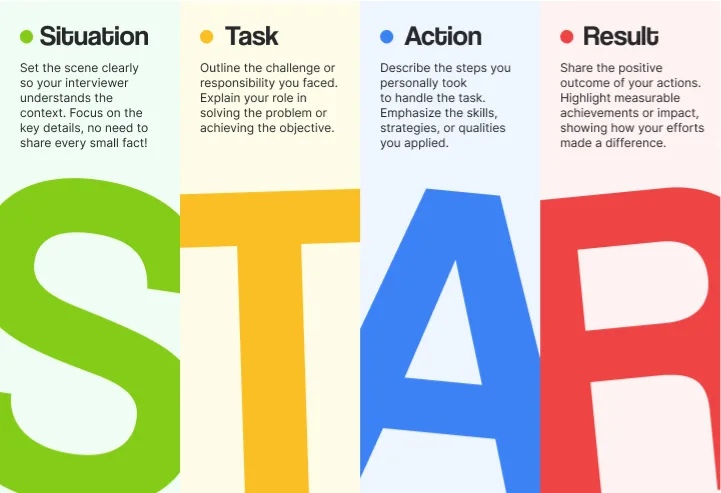
Situation is the context of your story, essentially explaining where you worked, what happened, and who played an important role. Since this is a setup for the more important parts, it shouldn’t be too long or detailed.
Task is the part of the story where you talk about the specific challenge or goal that you were supposed to tackle. This doesn’t have to be too long, either; usually, one sentence is enough.
Action is the most important part, as it demonstrates the steps you took to resolve the issue at hand. This is what employers are most interested in, too, so feel free to go into details about your helpful skills and traits.
Result is the resolution of the story, which shows the positive outcome of the actions you’ve taken. Remember to be as specific as possible and include quantifiable results for extra impact.
#2. Why Employers Love the STAR Method
Employers love the STAR interview method because it helps them follow the candidates’ answers to behavioural questions. Without this framework to guide them, interviewees often give confusing, complicated, or overly lengthy answers.
However, the STAR method helps them cover all the important points without straying off course. As a result, some employers require their candidates to always use this method in interviews, while others adopt a more lenient approach.
Still, it’s best to rely on it in all your behavioural interviews to leave an excellent impression.
#3. When to Use STAR in Your Interview Responses
As mentioned before, the STAR method is the best interview technique for behavioural interviews. However, you can use it for other types of questions, too, especially those that require you to tell a story or give a long-form answer.
For instance, the STAR method is highly effective in competency-based interviews, which are used to assess whether a candidate possesses the required skills. In these interviews, recruiters often ask potential employees how they would resolve hypothetical situations using their knowledge and competencies.
Mastering Each Element of the STAR Framework
Now that we’ve covered the basics of the STAR framework, we should dive deeper into each of its elements. This will help you better understand the method and help you apply it when necessary.
So, let’s explore each component separately:
#1. S – Situation
The situation part of the STAR method provides context for your story and paints a picture of your previous workplace and responsibilities. Essentially, it’s setting the scene before you dive into the details that your employers really want to hear about.
As a result, it’s best to keep this part short and describe your situation in one or two sentences at most. Anything more than that might come across as rambling without getting to the actual point.
So, if a recruiter asks you to tell them about how you handled a stressful situation at work, here is how you might set the scene:
Situation Example
At my previous position as a customer support agent, we experienced a system outage during peak hours. Clients couldn’t access their accounts, and we received numerous complaints.
As you can see, this example clearly describes the problem while avoiding unnecessary and irrelevant details. The situation is clear, and you can now proceed to the next step.
#2. T – Task
The task component of the STAR method should succinctly explain what your responsibilities and objectives were in the situation you’ve described. Essentially, the situation introduces the problem, while the task offers a potential resolution.
This part is typically even shorter than the first one and can be expressed in just one sentence. That’s because employers are more interested in the actual actions you took, which are described in the next step.
So, here is how you could talk about your task when answering the question we’ve introduced above:
Task Example
My job was to inform customers of the issue and help my team stay calm while trying to resolve the problem as quickly as possible.
#3. A – Action
Action is the crucial component of the STAR method, the one that employers are most interested in. This is the part where you describe what you did to resolve the problem at hand, highlighting your relevant skills and traits in the process.
As a result, feel free to spend extra time on this part and include more details. Focus on your ideas and achievements; don’t use “we” or “the team” when describing what actions have been taken. After all, recruiters want to know how you can contribute to your workplace, not those around you.
Here is how you could describe your actions when answering the question above:
Action Example
I drafted a standard message explaining the issue and posted it on our website so that every client seeking our services could see it. Then, I responded to those who had already contacted us and promised to keep them informed. Finally, I communicated with the IT team to get real-time information and an estimate of when the problem might be resolved.
#4. R – Result
Finally, the result should showcase the outcomes of your actions, preferably the positive ones, unless you were explicitly asked to describe a failure. Even then, you should focus on what you’ve learned from the experience and how you’re planning to avoid a similar situation in the future.
This part should, once again, be about a sentence long. When possible, include a measurable achievement to provide more specificity to your story.
Here is an example:
Result Example
Thanks to my transparency and quick response, we received about 20% fewer complaints than we usually do during outages. I was also praised for my contribution and asked to develop a crisis response manual based on my resolution of the issue.
Common STAR Interview Questions (+ Example Responses)

Now that we’ve covered the basics of the STAR method and its uses, we should explore some practical examples that you can encounter in real life. We’ll do that by introducing you to common STAR method interview questions that recruiters regularly use.
Let’s take a look:
#1. Leadership and Management Scenarios
Tell me about a time you had to manage several responsibilities.
“When I worked as a freelancer, I received requests from two of my biggest clients to work on their projects. Both tasks would require considerable effort to accomplish, and the deadlines for their completion were on the same day. I needed to organise my time well and put in some extra work to succeed.
And that’s what I did. I developed a plan outlining exactly how many hours a day to dedicate to each task. I stuck to this and informed both clients of my progress regularly, delivering the necessary reports and updates.
Ultimately, I completed both projects before the deadline and impressed both clients. I received excellent recommendations, which gave my career a significant boost.”
#2. Problem-Solving and Decision-Making Situations
Give an example of a mistake you made and how you fixed it.
“As an event planner, I was in charge of organising an event for a high-profile client. Two hours before it was to take place, I sent flower arrangements to the wrong location, which was on the opposite side of the city. I had to retrieve them on time and ensure that the client didn’t notice anything amiss.
Since I made the mistake, I decided to get the arrangements personally by driving across town. I left my plan and to-do list with my assistant and asked them to monitor the progress at the venue and keep me updated if necessary.
In the end, I retrieved the flower arrangements on time, and my client never found out about the crisis behind the scenes. They were very impressed by our work and became a regular at our company.”
#3. Communication and Teamwork Examples
Describe a time you had to adapt your communication style to your audience.
“I worked in a kindergarten, teaching young children French. They were between four and six years old, so I couldn’t communicate with them as I would with adults. Instead, I had to adapt my expressions and teaching methods to their level.
So, I developed a plan that took into account their desire to learn through play, music, and various activities. I also looked into some of the media popular with kindergarteners and prepared exercises featuring their favourite cartoons.
They reacted positively to my efforts, and I observed significant progress in a short time. They started picking up on some common phrases and memorised French songs that I’d introduced them to.”
#4. Adaptability and Learning Experiences
Describe a time you had to learn a new skill to complete a task.
“My previous position made a switch to a new project management tool just two weeks before an important project’s deadline. As the project manager, I had to ensure the switch went smoothly and keep all team members focused on the task.
I’d never used this tool before, so I watched several tutorials, explored the interface, and read the information on the website. It took me a few hours, but I grasped how it worked and created a short guide for my team members. Then, I started using it for task delegation and tracking.
Thanks to my efforts, my team members mastered the tool in no time and were able to use it to complete the project ahead of schedule. The whole department received praise, and my guide is still used for training new employees.”
Avoiding Common STAR Method Mistakes
Avoiding common STAR method mistakes shouldn’t be too difficult if you’ve prepared well. Still, here are some specific errors you should pay attention to, as recruiters frequently encounter them:
STAR Method Mistakes
Vagueness. Talking a lot without saying anything doesn’t leave a great impression on recruiters; in fact, it might not leave an impression at all. Vague claims make you sound generic, so be sure to include measurable achievements that help you stand out.
Rambling. Using the STAR method should minimise rambling, but it’s not a foolproof method; some candidates get nervous and stray off course anyway. Don’t let that happen to you, though. Practise until you’re confident that you can answer in a focused, concise manner no matter the question.
Excessive focus on the situation or task. These two parts are important for setting the scene, but they shouldn’t take up the bulk of your answer. That should be taken up by your actions, which paint you as a proactive, knowledgeable employee.
Preparing Your STAR Stories Before the Interview
Preparing your STAR stories before the interview involves reflecting on your professional experiences and identifying your proudest moments. Aside from those, you should recall times you learned something new, assisted a coworker, or made a mistake that helped you grow.
Once you’ve chosen your stories, write them out using the STAR method and practise telling them aloud. Ask a friend or a family member to listen to you and offer feedback; that way, you will gain insight into what your story sounds like to others.
And remember, one story can be adapted to fit several questions if you are creative enough. For instance, stories about helping your coworkers can answer questions about teamwork, communication, prioritisation, and problem-solving. It’s all about how you frame them.
Create Interview-Ready CVs With CV.co
Before you can use the STAR method for interviews, you need to secure an invitation to one. Our CV builder can help you with that by letting you make a job-winning application within minutes. All you have to do is enter the required information, choose the template, and adjust the design; our maker will take care of the rest!
Final Thoughts
Now that you’ve seen some STAR method examples and learned how to apply it, you should find it much easier to answer common interview questions. Rather than rambling on or giving vague responses, your answers will be focused, informative, and straightforward, just the way employers like them.
Frequently Asked Questions
#1. How long should a STAR response be?
A STAR response should be no longer than 3–4 minutes; keep it succinct yet detailed for maximum impact. If the answer is too long, recruiters might lose interest, while a very short response might signal that you don’t have enough experience and expertise to offer.
#2. Can I use the same STAR example for multiple questions?
You can use the same STAR example for multiple questions if it demonstrates a variety of skills and competencies, but it’s preferable to find several different ones. However, if you don’t have an extensive professional background to draw on, you can reuse the same answer, just make sure to frame it differently each time.
#3. What if I don’t have the work experience for STAR examples?
If you don’t have work experience for STAR examples, focus on your education, extracurricular activities, or any other projects you’ve participated in. Even examples from your personal life can serve the purpose, as long as they showcase the skills you’ve been asked about. And if none of that helps, you can reframe the question to explain what you would do if you found yourself in a particular situation.
#4. Should I prepare STAR responses for every possible question?
You shouldn’t prepare STAR responses for every possible question; just focus on the most common ones and practise answering those. Once you get more comfortable with the method, you’ll find it easier to slip into it, even when asked questions you haven’t been preparing for.